- I'm Chris Joneckis, I'm the director for the Office of Regulatory Operations and the associate director for review of management at the Center for Biologics Evaluation and Research in the US Food and Drg Administration. I'd like to speak a little bit about study data and study data standards. So data standards, if you will, are the standards that are used to transmit, exchange, define various types of information and data and in our case, that is provided in various types of clinical and nonclinical regulatory applications.
There is a link up here that will walk you through the various types of data standards and how we use those in the FDA and it's important that you understand this from an IND forward to a BLA or an NDA, that we do have requirements for certain types of data and that they must follow and comply with the various types of data standards. We have to be able to, as an agency, process review and archive a variety of electronic submissions of clinical and nonclinical data, and data standards are integral to how we can do that and they also facilitate clinical development and so on. So we do have, for example, standards with the content and format of electronic submissions, and they can be for the entire submissions that have format and content, or they can be for clinical studies, or they can be for preclinical information as such.
They are required for submissions from commercial companies from the initial IND forward and they are required in some cases such as the electronic content format for those intending to commercialize a product typically at phase two and beyond. Again, it's important to understand what standards are required at what point as I'll cover in a minute. They enable FDA to modernize and streamline a review process.
They enable more consistent use of our analytical tools. It's easier to visualize and view the drug data and search for signals among adverse events, highlight areas of concern. They're are standard way to exchange clinical and nonclinical research data between systems and they have a consistent framework for organizing the study data.
So they help us populate various types of templates for datasets. There's standardized names so we're sure that we're calling is a fever is a fever, or other adverse events, or other types of variables in clinical studies. Again, it's a standard way also of doing calculations with various types of common variables.
So they're enormously beneficial for FDA and actually for individuals developing these types of products. So there are data standards throughout the product life cycles. So some examples here would be maybe things that would be developed in the pre-application or pre-submission process.
These would be related to some of the preclinical animal studies, for example. One of those is known as the SEND or the Standard for Exchange of Nonclinical Data as the name implies. There are some during the investigational studies such as clinical studies data and these are known as the Study Data Standards Tabulation Model which was developed by a third-party organization like most data standards are and we use these for exchange of and recording various types of clinical data throughout the clinical trials.
And it's important that these start in the IND because if you're moving forward into a commercialization space, the clinical trials information that you capture, you wanna capture initially using the correct data standard so that it could be used later on in marketing as well. Or again, other types of pre-marketing applications in addition to the SDTM, we may use things like ADaM, again, SDTM as well. These are other ways of looking at various types of clinical data.
And then if their product is approved in postmarketing, we'll look at adverse events and annual reports. Again, we use SDTM and something called ICSR as additional types of data standards to transmit all the information, in this case related to adverse events or postmarketing commitments and so on and so forth. So the website I mentioned on the previous slide will lead you through which types of standards are required and what type of marketing application or what type of application, regulatory application, and again, when you have to comply with these and what ones are.
These standards are developed by third-party consensus organizations. Most of these in this realm are developed by what's known as CDISC or the Clinical Data Interchange Standards Consortium. It's a subgroup of what's known as Health Level Seven and they work with all oft he parties involved, various types of academics, manufacturers, regulators and so on to come up with a data standard that works in all cases.
And this can be modified over time, or advanced, or developed as new products are perhaps maybe added and so on and so forth. And so we have actually a whole approach for how we require certain types of information to be provided in data standards. So we have what's known as a overall FDASIA guidance which is basically 745A of the Food, Drg, and Cosmetic Act and that tells us, gives us, the FDA, the authority to regulate and require certain types of information and data following the data standards.
We have our guidances that talk about our electronic Common Technical Document which is the format and content in which we receive INDs and BLAs. We have an eStudy Guidance data, excuse me, eStudy Guidance that requires these various types of studies and gives individuals further information. We have a Data Standards Catalog on our website that tells people what's required, what are the supporting and required standards, and lastly the Technical Performance Guide because this does get very technical and provides specific recommendations on how you can actually submit all this information.
So it all works together relatively seamlessly and whenever we require or that new data be provided following a certain data standards, we give individuals time to become familiar with the standard. They may wanna pilot the standards. Sometimes we'll pilot some of this.
We'll often have a transition phase where people could submit if they'd like to, eventually leading to a required date where anything information coming forward has to be in the state of the standard or we may not review that. We will not accept the application and it has to be resubmitted after you do this. So again, it's very important that you understand what you have to replace and what are the data standards that starts really early on in development.
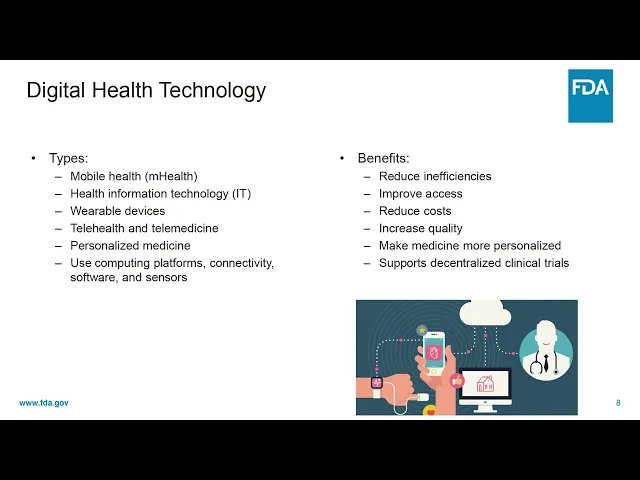
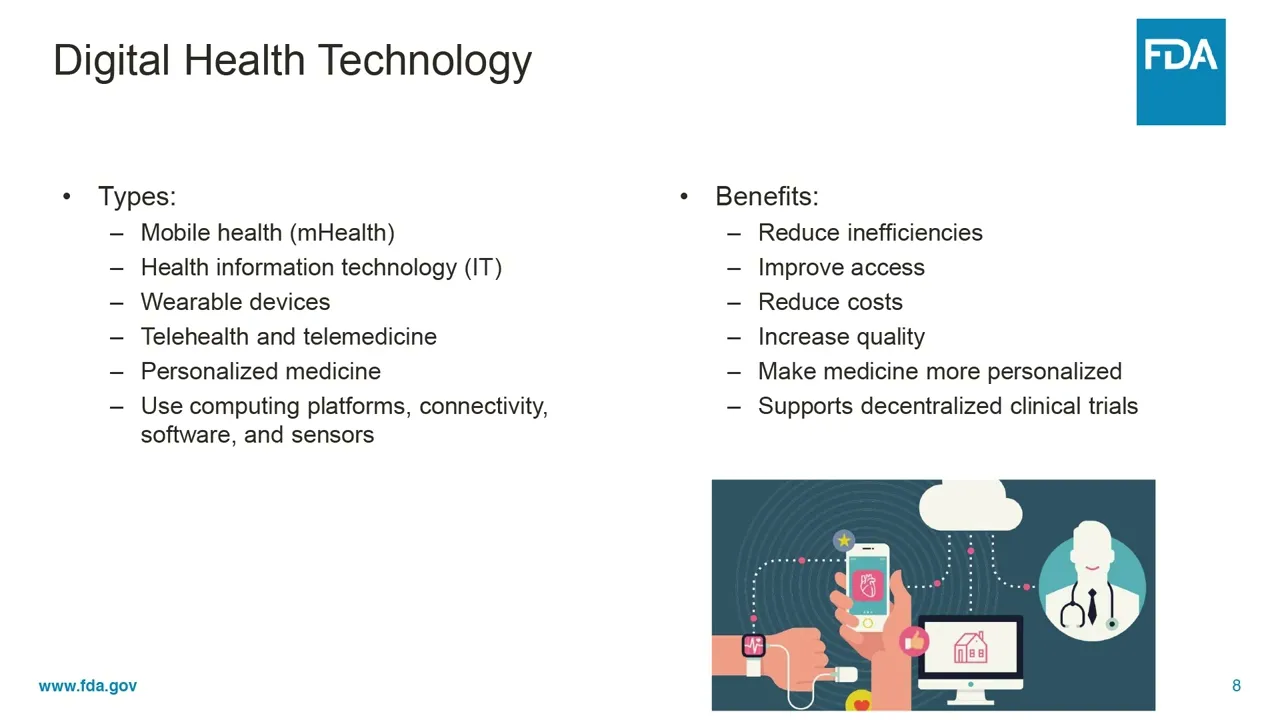
I'd like to just talk about a few approaches, new approaches that we've seen at FDA and how they can influence various things. So digital health technology. These are things like mobile health technology, health information technology that include wearable devices, sensors of all kinds.
They can be considered telehealth or telemedicine 'cause they communicate through various systems to provide information from the patient back to a essential collection point. It can facilitate various things such as personalized medicine and it uses a variety of computing platforms, connectivity, softwares, and sensors. And this has all been made available by a combination of advances in computer technology and advances in software technology and so on.
This has been of course, a great interest prior to COVID. But with COVID, this exploded 'cause it was perhaps the only real way to continue many of the clinical studies that were being done without having, under the constraints of COVID. A lot of this information can be collected offsite and it's not required that the patient can journey or travel to a particular clinical center or a healthcare provider in cases.
And so this really facilitated this and also facilitates collecting a lot of information that one may not receive such as from patients who can't really explore what's happening such as infants or people who are cognitively impaired or such. So it really facilitates decentralized trials. The benefits I think are clear.
Reduces inefficiency, improves access, can reduce cost, increases the quality, can make medicines more personalized, and again, just supports those conceptualized clinical trials where the clinical trial is not limited to one clinical site or one geographic area per se. There are however as a result of using digital health technology some really unique considerations for both the data quality. Again, how is this information gonna be transmitted and recorded with the development or the need to develop data standards in some cases.
How is one gonna validate the various THTs and data and some of these can collect huge amounts of data. Typically devices that would continuously monitor a particular variable. How do we handle that in terms of just do we need to see all that data and so how's that transmitted and so on?
How does one understand the techniques, the algorithms for processing and analyzing all this data? 'Cause it's not all done manually for obvious reasons. So we have been taking a really active role in trying to provide some additional guidance.
We're gonna have some additional meetings and such to try to understand how does all of this affect the whole whole clinical trials paradigm and then how can we provide necessary assurance of the data quality, handling large amounts of data while still using this and facilitate this advantage? This digital health technology which is a great advantage to clinical trials development. Real world evidence, real world data.
Again, this has been becoming increasingly important in the last few years. Real world data can be defined or thought of as data related to a patient health status or the delivery of healthcare routinely collected from a variety of sources. Real world evidences is that clinical evidence about the use of potential benefits or risks of a medical product derived from the analysis of the real world data.
Examples of what real world data may be would be largely thought of as things outside of the example of a clinical study, a formalized clinical study with a developmental plan and so on. It can be thought of as data derived from electronic health records. Perhaps that may include medical claims and billing data, data from product and disease registries, patient-generate data, again, in-home use settings.
THTs could be very useful here. Data gathered from other sources that can inform health status. Again, another example of THTs.
Right now most of the interest in use of real world data, real world evidence is on the postmarketing for products that have been commercialized and marketed to either support a new indication or to follow up on what's known as a post-approval commitment or a post-approval requirement that would be typically related to the safety of drug or biologic. However there is a lot of interest in using real world data and the evidence that's gathered from that in trying to facilitate development of various types of products as well. But that right now will require a lot more work and understanding.
Some of the similar concerns to similar concerns that are similar THTs, making sure that the information that we're collecting and so on is not biased in any kind of way that it is truly reflective of what's happening in the world outside of this controlled clinical study and so on. There are also the data, large data, amounts of data that could be collected as you can imagine going through health records and so on. If you've got a lot of information to be collected, again, how that's reviewed, how that's transmitted, and how that's archived and so on and so forth.
It presents a lot of similar challenges as we discussed with THTs. Again, generated by different study designs or analysis other than those again, traditional trials, but they could be randomized, large simple trials, pragmatic trials, or observational studies which is not only perspective which is typically how our clinical trials are done, but also retrospective. Use of data to evaluate potential benefits of risk and products effectiveness.
So again, as I mentioned, interest in supporting new indications for unapproved drug or biologic and again, satisfying or supporting post-approval study requirements. Generally this is typically how we're seeing and the interest that we're experiencing on that. So biomarkers, and so biomarkers have also been of great interest in the last several years.
You can think of a biomarker as a characteristic measurement, so excuse me, a characteristic measure as an indicator of a normal biological process, a pathological process, pathogenic process, or a response to an exposure or intervention including a therapeutic intervention. It can be a molecular, histological, radiographic, physiologic characteristic. So there's a wide variety of things this could include.
It can be something as simple as blood pressure or heart rate or it could be a laboratory test that measures a particular, something in a sequence of a disease mechanistic interaction. It could be imaging, it could be anything. It is not however to be confused with what's known as a COA or a clinical outcome assessment.
For example, how someone feels or how someone functions in that regard. Those can be very useful as well to assess various parts of clinical studies and such, but it's not really confused with the biomarker. It's used to see how well the body responds to a treatment for a disease or condition, and with biomarkers there has been established a qualification pathway for which one can qualify certain types of biomarkers through this formal regulatory process.
These are for biomarkers that are intended to be public and can be used by anyone studying the particular application of the biomarker basically in the stated condition of use. So it ensures a specific interpretation and application in medical product development. Regulatory review within that condition of use.
It can expedite patient access to safe and effective treatments by reducing the time and cost of clinical trials. Clearly if one can use the biomarker that's been validated, one does not necessarily then need to do all the exploration and all the other measurements that are done in clinical studies. Typically with biomarkers, there has to be this analytical validation part that's assessed upon what the biomarker is.
Maybe for example, performance or exceptive characteristics of an assay so you know that your measurement is in fact true, and it's linear, and it's valid and so on and so forth. And then there's some kind of clinical validation. Again, the biomarker is accepted, is able to measure or predict the concept of interest.
So as part of this qualification process is a very formal process that can be done and goes through a request and an evaluation and so on to see if the biomarker can, in fact, be qualified and if they are, they're posted on our website and they can be used by everybody. Certainly this is the public pathway. There is a private pathway that many applicants will use to use a biomarker in their specific individual studies.
It does not go through this pathway. It is not public. It is just solely for the use of that particular applicant as they move through their development and clinical studies and into market.
So you've heard in this course, so this section of this course, a lot of information and there is a lot to consider and think about as one moves through clinical, moves into clinical studies and through marketing post-approval. So our website and over the years I've been there, there's just an incredible explosion of information that's publicly available. Please take a look at the link, the US Food and Drg Administration, to start exploring all the various areas.
There's a lot of information that can guide you. There are in just about every sector some type of small business unit or communications group who can help with outreach to provide direction and information. And then of course, there's the Code of Federal Regulations as well if you'd like to have that link.
And I would just like to conclude that development, regulation of products, it's not a one-sided event. It requires participation from many people. You out there developing a lot of these products and moving these forwards, and we're trying to regulate them and understand them as well.
So we're trying to find everyone contributes to that overall process and determine what's a safe and effective product. So thank you for your attention.