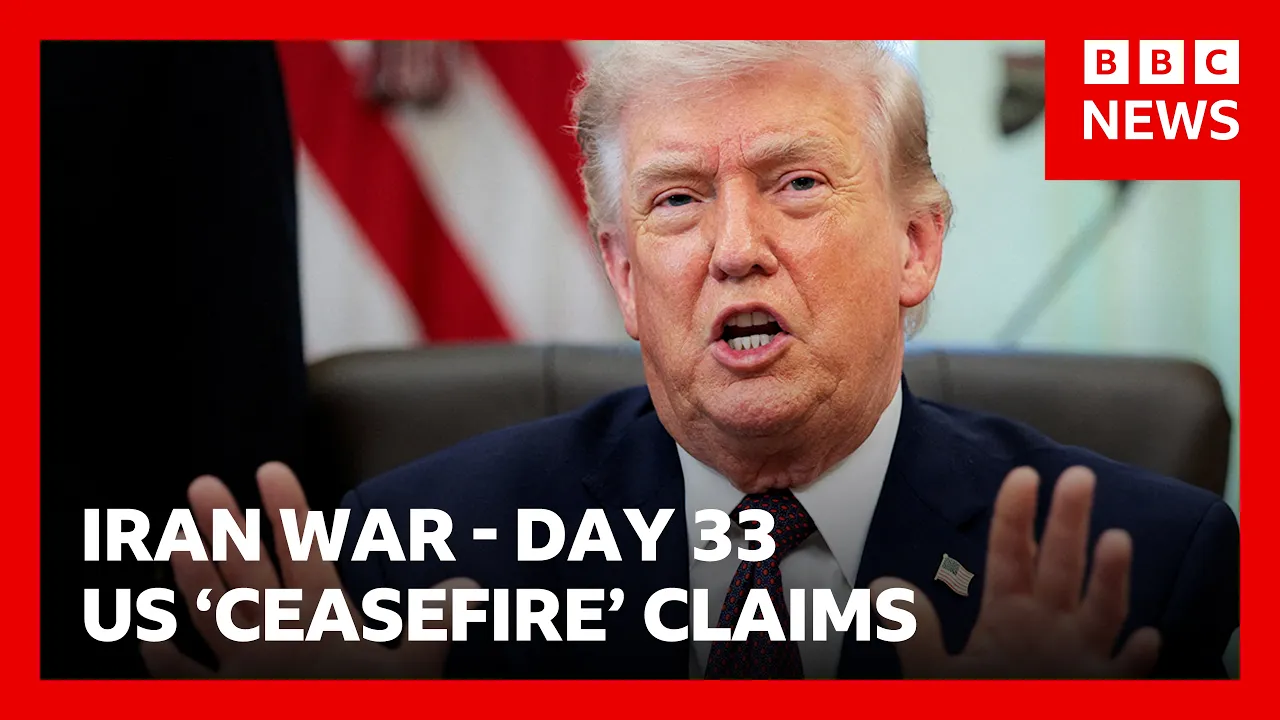
Live from London, this is the Iran War Today on BBC News. Over the next 15 minutes, we'll bring you all the key updates on day 33 of the war. Well, let's start with today's main developments.
Donald Trump says the US will end its war with Iran in the next two to three weeks with or without a deal. Iran denies Mr Trump's claim that asked for a ceasefire as the president suggests the US is weighing whether to pull out of NATO. Prime Minister K star says the UK will host a meeting with dozens of countries this week on opening the straight of Hormuz.
Global stock markets rally and oil prices dip following Mr Trump's comments. Well, Donald Trump has signaled once again that the war with Iran could be over in a couple of weeks with or without a deal with Iran. He said the US had already accomplished its war aims, including regime change and limiting Thran's ability to build a nuclear weapon.
But Mr Trump also said that the US will continue attack Iran until the Straight of Hormuz is open. He claimed Iran's new regime president has asked for a ceasefire and has threatened to pull the US out of NATO over the war. Have a listen.
Iran doesn't have to make a deal. No. Yeah.
I've spoken to a lot of people. It's a it's a new regime. They are much more accessible.
No, they don't have to make a deal with me. when we feel that they are for a long period of time put into the stone ages and they won't be able to come up with a nuclear weapon then we'll leave whether we have a deal or not irrelevant I speak now to our chief North America correspondent Gary O' Donahghue so Gary a lot of claims made by Mr Trump there in the past 24 hours or so. Yeah.
And not all of them necessarily uh sit well together. I mean today we've had him suggesting that uh he would accept a ceasefire with Iran if it opened the straight of four moves. Yesterday he said that was uh a world problem.
That was a problem for the world that NATO allies could go and get the oil if they wanted it. He didn't really care about that. that now seems to be an absolute prerequisite um for any kind of peace.
He's also, you know, said in the past that they're close to a deal. They want to do a deal. Now he says, "I don't care whether there's a deal or or not.
" He also extraordinarily I think he made it clear in an interview to a news agency, the Reuters's new agency. this um enriched uranium which the Iranians have 440 kilos up to 60% that that can get to weapons grade pretty quickly buried underground after after last year's bombing. President says he doesn't care about that cuz it's buried underground.
That was one of the key demands that they were have been talking about during these negotiations potentially even sending in ground troops. Uh the rumors were to get that material and take it out of Iran. That seems to be off the table.
also saying that that really that um they may have he feels they may have neutralized the proxies that Iran has in the region like Hezbollah like Hamas like the Houthis in Yemen of course well there's no real sign that the Houthis have been neutralized or indeed Hezbollah is completely beaten at this point in time so there's a lot of things to digest about his statements they they shift and as the war aims have shifted over the last as you pointed out 33 A Gary O Donghue, thank you very much indeed. Well, Iran has denied Mr Trump's claim that it has asked for a ceasefire. It has said the straight of Hormuz will remain closed to its enemies.
In a post on X, the head of the National Security Commission in the Iranian Parliament said Trump has finally achieved his dream of regime change, but in the region's maritime regime. While President Masoud Peskyan has said Thran has the necessary will to end the war provided its conditions are met. Well, BBC Persian's Sevash Adelan is here with me now.
So, how has Iran been reacting to to President Trump's claim? So, there seems to be a lot of confusion arising from President Trump's the the inaccuracies in the statement that President Trump made. First of all, Masu Peshkan is not Iran's new president.
He has been the president for a long time now. Uh secondly, it seems like what President Trump said about Iran asking for a ceasefire stems from a statement that he made that you just quoted. Iran has the will to end the war and then commit to to to to its requirements provided that those requirements are met.
It seems like President Trump took that as a willingness on Iran's part to to to want and ask for a ceasefire. Whereas Iran's condition has been very clear. You know, it had his own counter proposal to the US's peace plan.
It wants reparations and ironclad guarantees that it won't be attacked again. that inside Iran even that statement made by Masud Peshkan, Iran has the will to end the war has been met with a lot of criticism by the IRGC and some of the hardline media inside Iran. They've criticized Masud Peshan as for making that statement saying that that itself provides gives ammunition to the Americans or it emboldens the Americans to think that Iran is in a weak position.
So it also goes to show the internal rift inside the Iranian regime and also the very much ambiguous new state of affairs in terms of the decision-making mechanisms in Iran after we had the death of the supreme leader and its replacement with the new supreme leader. Who is calling the shots? Is it the president?
Is it the IRGC? How will they make a decision if it comes to the point where they need to decide whether they want to accept a ceasefire or not? Shandelan, thank you very much indeed for all that expertise.
Thank you. Well, global markets have rallied and oil prices fell briefly after Mr Trump's comments that an end to the war is in sight, but governments worldwide are bracing for severe economic fallout. Many have imposed measures to contain rising prices.
As the head of the International Energy Agency warns, we're heading towards a major major disruption. In Germany, gas stations will now only be able to raise pump prices once a day. Australia's Prime Minister Anthony Albanzi has called on Australians to switch to public transport as fuel tax cuts begin to take effect.
And the UK is set to host a meeting of 35 countries to discuss ways of reopening the straight of Hormuz, one of the world's busiest oil shipping channels which is being blockaded by Iran. Well, with me is our business editor, Simon Jack. So, the markets, Simon, have reacted positively to Mr Trump's comments, but governments are bracing for the long-term damage.
Yeah, two different approaches here. some to try and cut consumption and others to try and protect consumers from the extra costs that we've seen since these hostilities began. So, give you a couple examples.
Asia, which is most uh dependent on uh energy from the Gulf, you've seen, for example, in Thailand, they've told people to uh keep the air conditioning higher, so use less energy to keep it down, take off their jackets at work. Simple but practical tips. And also introduced a 4-day working week in the Philippines.
similar uh measures as well. As you say, Australia has encouraged people to drive less. Uh and in places like Egypt, for example, they've introduced a sort of effectively a 9:00 p.
m. curfew in telling people to keep their um to to keep lighting down and to drive uh less where possible. Same in Australia.
So those are kind of consumption types of things. So people use less. And on the other hand, you've got people trying to cut the cost to consumers, try and protect them.
So, for example, in Ireland, you've seen cuts in fuel duty. Um, you've seen, as you mentioned, in Germany only being able to raise petrol prices once uh a day. And Spain, for example, has had a a big VAT, spend 5 billion euros on a VAT cut.
So, different methods to do different things. One trying to, you know, cut the amount we use, other trying to limit the amount we spend. But, as I say, most of the and also some companies are doing the same.
airlines in particular in Asia. Some announcing emergency measures, cancelling lots of flights, lots of search charges being introduced there. Less of that happening in Europe.
Simon Jack, our business editor. Thank you very much indeed. Heavy strikes on Thran continued today.
The Israeli military launched a wave of strikes targeting infrastructure. Iranian media said steel complexes away from the capital were badly damaged. Tean residents have sent messages to our colleagues at BBC Persian reacting to Mr Trump's comments.
Have a listen. To be honest, I felt a bit hopeful last night about the war ending and things coming down. Then I saw that Trump might want to target infrastructure.
I'm honestly sick of this kind of contradictory talk. I feel like I've been in a purgatory for a month. I can't do anything and everything is up in the air.
I'm so tired of the war. I want them to continue striking. I'm tired of this situation.
I want the government to go. Iran has continued attacks against Israel and its Gulf neighbors in retaliation. Explosions heard across parts of Israel and Kuwait, Bahrain, Saudi Arabia, and the UAE UAE have all been targeted by Iranian strikes.
Today, our correspondent Katy Watson is in Doha. As the USIsrael war with Iran continues, so too does the retaliation from Iran felt here in the Gulf. In the UAE, a Bangladeshi national was killed from falling shrapnel from a drone, one of 35 launched from Iran overnight.
In Q8, there were fuel depots set on fire at the international airport, causing a huge fire. And here in Qatar, there were three missiles launched from Iran. One of those missiles landed on an oil tanker causing a small fire.
And according to a UK maritime organization, there was another projectile that was left unexloded. Authorities investigating that. In Bahrain, there were sirens that went off.
Saudi also intercepting drones. And this is something we're seeing every single day. With me is our chief international correspondent, Lee Ducet.
Lee, we we're expecting to hear from the president later on. What do we what do we have any kind of steer about what he's going to be talking about? Well, as you know from our coverage, President Trump says something almost every day and often more than once a day about the course of this war, when he's going to end it.
And for many weeks now, he's been teasing the world, most of all the markets and oil prices, that he's going to end it very soon. He said that on March 9th, I'm going to end it very soon. We've met our military objectives, and now he is saying it again.
But this is new that he's announced that he's going to have this major address. So, everyone is thinking, "Oh, it must be something even more significant. " Uh from what we hear, Bernard Dwisman, our White House correspondent, he has said that he's been calling around today and it's being downplayed a little bit that it will be more of an operational assessment kind of what we get from the Pentagon that the how they've they like to they've constantly repeated that Iran's military capabilities have been destroyed, that its navy has been all but uh destroyed, that leaders have been killed.
Uh perhaps he's got something new to mention, but he is under real pressure as you've been hearing yet again in this program uh about the economic shocks around the world, including in the United States. The midterms aren't that far away. So he will be expected to say something.
He said this morning it could be wrapped up in two to three weeks. Whe whether it will be two to three weeks, he's teased this idea today about a ceasefire even though you've heard from seash that's not really what the Iranians were saying. And as President Trump likes to keep telling us, he doesn't make up his mind till the last minute.
So, it's possible this speech may even change uh in these last few hours. And in the meantime, he's been sort of attacking the idea of NATO again, which isn't the first time. But how significant is it this time around, do you think?
This has been a constant theme of President Trump. Even when he campaigned for the first time in his first term um in office, which had begun in 2017, he called NATO obsolete. uh he called it a paper tiger saying that it was costing a fortune for the United States.
We know now that the former secretary general Yan Stolenberg published his own memoir just how close president came to leaving uh the NATO military alliance in his first term. This time round when he's making the threat yet again, he's saying that his decision is beyond reconsideration because this time he really is furious because he believes that NATO other members of the 32 member of alliance alliance should have in his words automatically come to his defense. But as we hear from one NATO member after another, they're still confused.
What is this war about? Collective defense only applies when there's a consensus in NATO and when one member is attacked and it's an attack against all. But this doesn't fall into NATO's into NATO's thinking.
I think NATO members again most of all the secretary general Margaret will hope that once the war ends when it ends they will try to again pull President Trump back from the brink. Lee Det Thank you very much indeed for your analysis. Thank you.
Well, whether you're joining us on YouTube, Tik Tok, sounds, radio, or TV, thanks for your time. We'll be back at the same time tomorrow with the Iran war today.