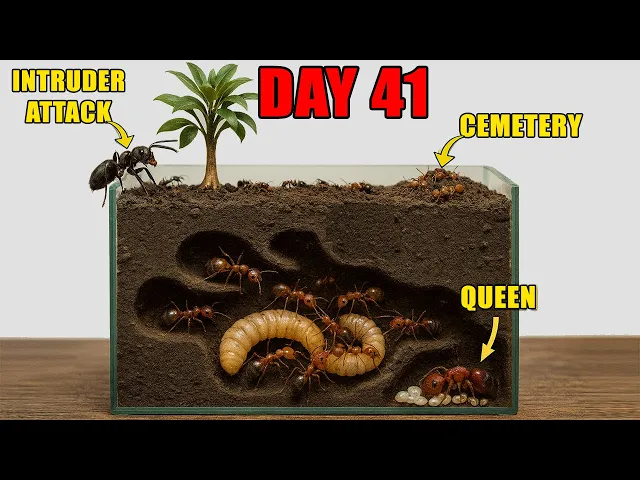
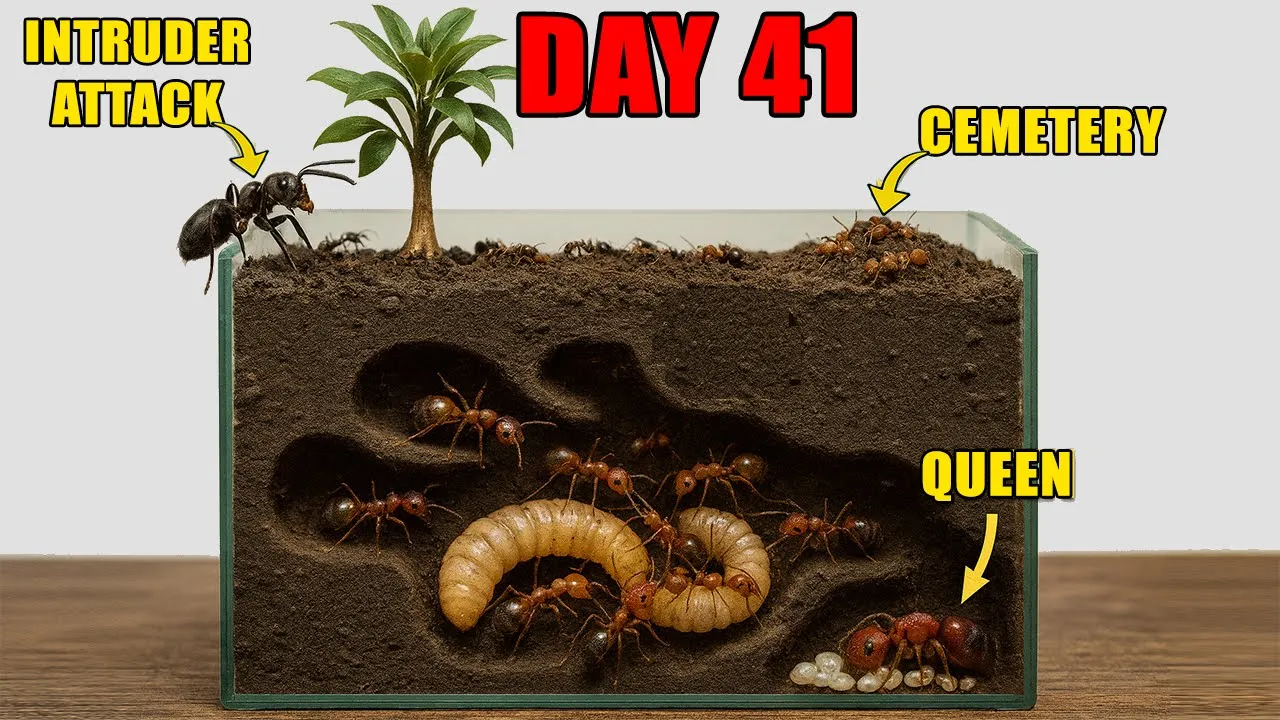
Ants are social insects that live in complex colonies, sometimes growing to hundreds of millions. To understand their behavior, I've documented their incredible journey over the past 3 months. What began as a single queen inside a quiet corner of my terrarium has transformed into a living, breathing empire built from dirt, grit, and teamwork.
But to understand how they built all this, we have to go back to day one when the entire colony was just one queen. At first, it was just her. No workers, no tunnels, just a tiny queen nestled in the soil.
She didn't eat or forage. In the first few days, she dug out a small chamber, laid her first batch of eggs, and guarded them like treasure. You see, this queen made it just once years ago during a single flight through the air.
But that one flight was enough. She stored the sperm from that moment inside her body and has used it ever since to fertilize her eggs. 30 days later, her daughters began to hatch.
These white eggs transformed from egg to larvae, then pupa, and finally into a fully formed ant. At this stage, I thought I could help. I tried offering the queen and its new daughters all sorts of treats to boost their energy.
But no matter what I placed near the nest, nothing was touched. It turns out when the colony is this small, the queen feeds her first daughters by regurgitating her own body tissues directly into their mouths. Her daughters were small and fragile, but they wasted no time.
The moment they hatched, they got to work digging tunnels, cleaning the nest, and searching for food. A worker's ant entire life revolves around caring for the colony. These newly hatched workers look pale yellow at first because their exoskeleton is still soft and unpigmented.
With more workers around, the colony is now ready to accept my food offerings. To see how they'd respond to new stimuli, I gave the ants a small drop of honey. One ant noticed it and rushed over to investigate, but quickly got stuck.
You see, ants vision is very blurry. They can't see sharp details or color like we can. So, she didn't realize what she was walking into.
And underground, where light never reaches, their eyes are nearly useless. But their real superpower is their antenna. These are their real eyes, constantly sweeping the air and ground for invisible scent signals.
Every trail, every message, every warning is written in scent. After a few minutes, the stuck ant broke free. Soon after, a second ant arrived and found the honey.
Watch closely, and you'll see something amazing. It took a small sample of the honey, then rushed back to the nest, leaving a pheromone trail behind her. Once she got home, she touched Antenna with her sisters, passing along the smell and basically saying, "Hey, I found food.
That's how ants talk, by bumping antenna and sharing scents. " One by one, more ants came pouring out of the nest, all following that invisible scent trail across the terrarium. They surrounded the drop, dipping their mandibles in, gulping up as much as they could.
If the food turns out to be good, they'll keep adding more pherommones to the trail to guide even more ants. But if the food goes bad or disappears, the trail slowly fades and the ants stop coming. The queen, meanwhile, remains hidden deep in her chamber, surrounded by her loyal caretakers.
She is laying more eggs than ever. Her chamber is guarded constantly. Workers groom her, feed her, and carry away her eggs as soon as they're laid.
Her presence emits a chemical scent called a pheromone that acts like a command signal. This scent tells the workers that the queen is alive, healthy, and still reproducing. As long as that pheromone is strong, the colony remains united.
As the days rolled on, the colony grew bigger. More tunnels appeared. Tiny chambers branched out like miniature streets.
Workers began to specialize. Some guarded the entrances. Others searched for food.
Many stayed underground, raising the next generation. The tunnels you see here weren't randomly dug. They serve specific purposes.
Some chambers are packed with seeds, others carefully lined for eggs. There are rooms dedicated to tending larae. And somewhere far from the center of activity, there's something somber, their graveyard.
Ants have a designated place to bring their dead. When a worker dies, her sisters carry her body into a burial site away from the brood to keep the colony clean and safe from pathogens. You might also find trash or moldy seeds there.
It's like a dump and cemetery combined. In the past 2 months, there are about five ants that die naturally in my terrarium. Worker ants have a lifespan of 1 to two months.
When one dies, her body starts releasing a special compound called olic acid. To the other ants, that smell means this ant is no longer alive and they start moving her to the graveyard. To understand the ants behavior, I put a tiny bit of oleic acid on one spot in the terrarium.
This acid I'm putting does not hurt the ants at all. It has acid in the name, but it's actually just a vegetable oil or an animal fat. A worker ant happened to walk over it and got some of the smell on her.
I expected the others to carry her away to the graveyard. But something weird happened instead. After being marked with the smell, the aunt didn't just stand there.
She began walking on her own, straight toward the graveyard. No one forced her. None of her sisters attacked or dragged her.
It was as if the scent overrode her instinct. She wandered to the trash site and just sat there still and waiting. As if she believed she was ready to die.
[Music] [Music] After some time, she groomed herself bit by bit. The smell faded and her behavior returned to normal. She stood up, wandered back into the tunnels and rejoined the colony like nothing had happened.
One morning, I placed a small piece of banana near the edge of the terrarium, a sugary boost for the colony. Sweet, soft, easy sugar. It was a perfect treat and energy source.
But what I didn't know was that the scent didn't just attract my ants. A group of wild ants, smaller, faster, and from somewhere outside, picked up the smell. First, a scout ant from a wild colony, smaller and darker, but lightning fast, picked up the smell with her antenna and climbed straight over the open rim and into the terrarium.
One of my workers spotted her, then quickly turned and rushed off in the other direction, gone in a flash. That's when it started. She wasn't fleeing.
She was alerting the colony. She rushed to the queen and the nearest workers, reporting the danger by touching antenna. An alarm pheromone spread through the colony.
The ant suddenly started panicking and tension snap. Back inside the nest, guards took their places at the queen's chamber. Nurses rushed to move eggs deeper into the tunnels.
It was an emergency evacuation plan. From deep inside the nest, workers poured out like a flood. The ants grouped up, mandibles wide open, ready to fight.
What was once a peaceful ant colony became a battlefield. In the end, my aunts drove the intruders out. She sprinted across the glass wall and vanished back over the rim, never to return.
Whether she made it home or got lost without a scent trail, I'll never know. But after that day, no other wild ants dare to enter. But not all wars are small.
In some parts of the world, ant battles happen on a scale that's hard to imagine. These aren't just little fights over food scraps or a few tunnels. These are full-blown wars lasting for weeks, years, or even decades.
They build massive networks of nests called super colonies that stretch across continents. One of the largest ever discovered covers thousands of miles across southern Europe, from Italy to Spain to France. Some of these wars have no clear end that go on for decades.
New queens rise, old ones fall, territories are won, lost, and won again. But in nature, danger doesn't just come from predators. Sometimes, nature itself is the biggest threat.
With winds this strong, pherommones and scent trails become useless. The ants lose their sense of direction, desperately clinging onto the ground to avoid being blown away. Those higher up get swept off fast.
The higher they are, the stronger the winds. Disoriented and scattered, the colonies showed just how vulnerable it is when nature changes the rules. In this moment, survival isn't about strength or numbers.
It's about luck, grip, and the hope that the storm doesn't last too long. If one ant gets carried too far, it is usually lost for good. Cut off from the scent trails that lead back home.
And yet, even in calm moments, they are fascinating behaviors to see. Every so often, in the middle of all the chaos, ants rushing, digging, hauling, I'll spot one ant doing something completely different, she'll stop. Then, with slow, deliberate movements, she begins grooming herself, using her front legs like tiny brushes.
She meticulously cleans her body and antenna. After a few moments, the antenna began to sweep the air again. She's back online, reading messages in the air, decoding trails, checking for danger or opportunity.