On the internet, you will find lots of training places that will tell you how to have money, success and love by increasing your self-esteem and your self-confidence. Normally, this video will make you see that it's not a given, because what's more, self-esteem, if it happens, well it doesn't even exist. Well, before we start, know that I am going to make at least three videos on the subject.
Already here, we will try to define self-esteem. In one or two videos, we will see what it means to have high self-esteem, and in the third, we will see what it means to have low self-esteem. So here we are going to define what self-esteem is.
In itself, the definition is simple: self-esteem is the evaluation you make of your value. We talk about global self-esteem or self-esteem depending on the area, such as esteem for one's body or one's work. Self-esteem should not be understood with self-confidence.
Self-confidence is whether you feel you have the skills or not, so it's an assessment of your abilities, not your worth. Even if we will see that the two can be linked. For example, I had a patient who said she was shit, but was completely confident in her abilities to manage her life.
On the contrary, I have good self-esteem, but if you ask me to go manage a nuclear power plant, I will just run away from the situation. High self-esteem should not be confused with narcissism. Narcissism, in psychology, concerns behaviors of denial of the negative about oneself, lack of empathy, having the impression of being worth more than others.
And we can have very high self-esteem without considering that we are superior to others, without refusing criticism or without attacking others. On the other hand, self-esteem, in studies, is quickly confused with self-esteem, self-love or self-acceptance. If you want to know your self-esteem, you will easily find the Rosenberg scale which will put you where you stand in terms of self-esteem .
Well, so, self-esteem like that seems clear. Now, we're going to make a bit of a mess of what you know, because the definition may seem clear, but researchers absolutely disagree on how it's constructed, where it comes from, is is this real? Because when I talk about fear, we pretty much see what it is, it's an alarm signal that pushes you to flee, fight or play dead, and you find that everywhere in the animal kingdom, and you see the structures that manage it in the brain.
But self-esteem, well, we don't really know. Does a coypu, for example, have self-esteem? We don't know anything about it.
So, the goal of this video will be to show you the questions that researchers ask themselves when they try to define what self-esteem is. So, we will start from the conception of self-esteem which is the easiest to understand and comes close to what we know, then we will gradually learn more and more surprising things. So, I'm sorry, but I'm going to have to go over some potentially very interesting ideas very quickly, but I clearly don't have the energy to make a 3 hour video, so we're going to stick to my objective, to show you how complicated it is, the interesting leads we have.
So, there are several conceptions of self-esteem, some of which relate it very much to self-confidence. According to some authors, self-esteem is then the sum of evaluations of all your skills and all your successes. For example, for some authors, self-esteem is in fact the evaluation of your self-efficacy.
If you feel that. . .
If you feel. . .
Well, no damn, if you feel that you're doing well in life and the respect you have for what you do. In this way of seeing things, according to other authors, it would, for example, be more personal success and the ability to achieve one's goals which would create self-esteem. In short, here, we have a common conception of self-esteem: you take all your skills, if you estimate if you have a lot or if you manage to do what you want, your value increases.
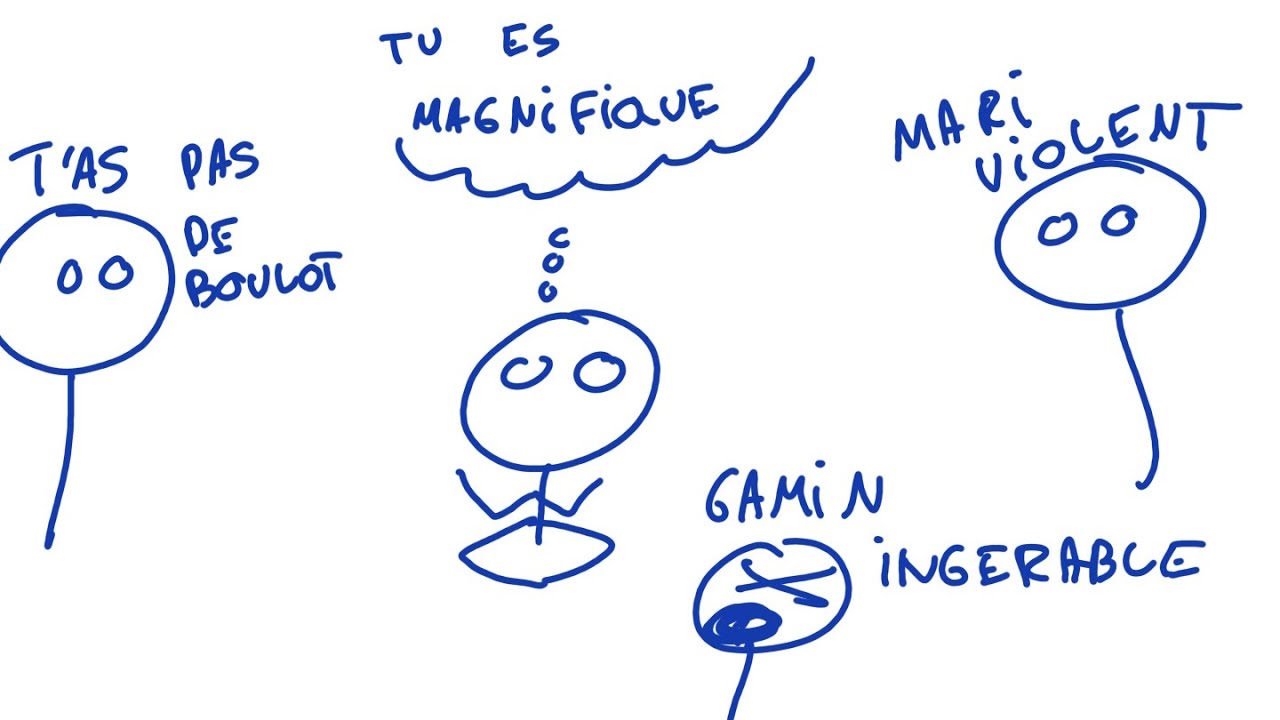
On the other hand, we have a completely different concept of self-esteem. Here, we have theories which say that self-esteem does not come from an internal evaluation, but from an external evaluation. In short, it's not you who evaluate yourself, but it's others who evaluate you, and the way you see yourself depends on how others have seen you in the past.
This explains the lower self-esteem of people who are mocked, mistreated, or people subjected to negative stereotypes. This is where you already see that if self-esteem is indeed dependent on others, working on it to have a better life makes no sense, because in these conceptions, to have better self-esteem, it is first surround yourself with caring people. A bit in the same genre, you have theories which postulate that self-esteem is in fact an evaluation of your social position.
Basically, the weaker you are positioned in social hierarchies, the lower your self-esteem , which pushes you to be more passive, like the coypu and the group that comes after the others. Obviously, it depends on which group you prefer, because if you are part of the pro-lots but in your family you are the dominant one, your self-esteem can be very good, but if you are the dominant one in your family while your focus is on social status at the national level, well, your self-esteem will be very low. Basically, here, esteem is your brain's processing of your position in a group.
Other approaches relate self-esteem to the ability to take care of oneself. The ability to take care of oneself is a fairly studied skill in care. It concerns your ability to maintain your focus on yourself and take care of the internal and external conditions that promote your well-being.
It involves many abilities, such as the ability to think of oneself as an object of care, the techniques to do so, the calculation of the energy necessary for operations. Well, for our health, and when we analyze what builds self-esteem and self-care, well, we see big points in common between them, such as motivation. When you have good self-esteem, you are much more motivated to take action for yourself, as we will see in the video on self-esteem, which is an important part of self-care.
In the sense of self-care, you have authors who are more on the side of fundamental needs. Basically, if your basic needs are met and you feel like you can fulfill them, well, you have good self-esteem. You are lacking affection, stimulation, freedom, well, you are wasting away, and so is your self-esteem.
This is often linked with self-determination theory. Self-determination theory says that you can act of your own free will or that you can act under pressure from others. When you develop your ability to act by yourself and for yourself, to think about managing your needs according to your own rules, your esteem would increase.
Well, and then you have theories that postulate self-esteem, that's the thing where you would never have thought that it existed, like for example in the Madeleine Mudge-man terror theory. So, it's a theory that talks about the fear of death, where I tell myself that maybe I should make a video about it one day. Basically, knowing that death is inevitable, it creates quite strong anxiety in most human beings, which you will manage through so-called proximal strategies, such as denial, keeping busy when you are anxious, filling your life of many things, and distal strategies, like beliefs, societal values, like religion, the belief in life after death, the fact of leaving a trace in the world.
Self-esteem, in fact, would be a strategy to protect oneself from the anxiety of death. Basically , by giving yourself importance and a place in the world, you reject the idea that you are a poor little shit lost in the universe and who will disappear. So, as you see, self-esteem is the evaluation of your value on the surface, but as soon as you dig into what's underneath, well you don't really know what it is anymore.
Because, according to the theory, the question to ask in the questionnaires would not be “what are you worth? ” » but “do you feel capable of doing the right thing? ” ", "are you treated well?
», “What is your estimate of your social position? », “Are you able to take care of yourself? », “Are you able to build your life according to your needs?
» or “how do you deal with the fact that you are going to die? ” » So maybe self-esteem is a different process than all that. Maybe it's a little bit of all that.
Maybe that's some of it but not that. And that’s a big part of the debates about self-esteem. For example, initially, we thought that people had a need for self-esteem and that, for that, they would integrate into a social group to gain self-esteem, when in fact, we noticed that it is rather that we would have needs for integration into social groups and that this integration would result in self-esteem.
The debate is all the more complicated as everything interacts together. For example, if you have skills in certain social and emotional areas, then you directly become more able to take care of yourself, integrate into groups or defend yourself. So, there are many researchers who try to mix different components to better understand esteem.
We would have had the elements that will create self-esteem, such as self-confidence, which allows you to manage success and failure, and dignity, which is respect for yourself and what is important to you. These two elements would lead to self-esteem, which is composed of one's own value, but also of self-acceptance, of what you are, of the feeling of competence and recognition of your qualities, and of attitude towards yourself, more or less benevolent, and also self-respect, which allows you to differentiate these instances from that of others. And these characteristics of self-esteem would result in better self-affirmation, better social relationships and a better ability to overcome the negative.
Currently, I don't see a model that can explain everything at once, otherwise I would have told you directly in this video. Obviously, here, I don't know if it's necessary to talk to you about all the scientific debates around this, because it's a bit abstract, but know that we can make everything more complex with the study of implicit, rather than explicit, self-esteem. Implicit would be the evaluation of your value, but not expressed, or rather unconscious.
Currently, we don't really know how to calculate it, so it's not very reliable, but it would nevertheless be important. For example, in studies of different cultures, we see that some cultures are more assertive about their value than others, and this could influence explicit self-esteem and not implicit self-esteem. People value themselves, but are less accustomed to saying it.
Also, we notice overall, in the world, that women have lower self-esteem on average. Except that, when we look for an explanation as to why, it could be that this result is due to the fact that men are more likely to throw flowers at each other. The difference in self-esteem could therefore be explicit, but not implicit, since men would rather tend to put themselves forward.
We also have collective self-esteem, the self-esteem that a social group has for itself, which is not exactly the same thing as individual self-esteem. In short, before going on to the videos on self-esteem and what it implies in your life, I will explain to you that it is not as simple and that you should not be surprised as in the next videos and theories on how to increase your self-esteem seriously, you will rarely come across "well you just have to note what you do well and give yourself kisses". Because, in fact, maybe we don't care about all that, the important thing is above all to manage everything the whole.
We will even see why focusing only on self-esteem without changing your life can have a negative rather than positive effect. So, for the next videos, normally, it should be in the following months, if I don't procrastinate. Well, in the meantime, good luck, you have plenty of other videos if you've never seen my psychology videos.