I am going to share a story actually >> um a story about the scariest moment for me ever in the mindfield psychological experimentation show I did and it's not what you're expecting >> well I mean you were the man who locked himself away for 3 days and uh started hallucinating so if if it's scarier than that then I think um the rest of us need to buckle >> [music] >> This episode is brought to you by Cancer Research UK. So, when most people think of naked mole rats, their unusual relationship to cancer probably isn't the first thing that comes to mind. >> But maybe it should be because it is incredibly rare for them to develop cancer, which could be partly down to their unique immune system, or it might be the way that their cells respond to damage.
So scientists are studying their biology for its cancer fighting secrets. It's a reminder that discoveries can sometimes come from places you don't expect. Cancer Research UK is the world's largest charitable funer of cancer research.
Thousands of scientists of doctors and nurses work across more than 20 countries to help turn discoveries in the lab into new tests, new treatments, and new innovations. >> And the impact is clear. Over the past 50 years, the charity's pioneering work has helped double cancer survival in the UK, meaning more people living longer, better lives free from the fear of cancer.
>> For more information about Cancer Research UK, their research, their breakthroughs, and how you can support them, visit canceruk. org/rest iscience. >> Uh, so let's begin with Franuis, who sent in a question.
It seems such a waste to spend energy adding heat to our houses in winter and spending more energy on AC to remove it in summer. Could we feasibly design a machine that pumps heat into a form of reverse fridge during summer, stores it, and then pumps the heat back into our homes in the winter? >> I mean, Franis, you have um you have a a mind that is a marvel, but unfortunately, you've invented something that's already exists.
Um because the machine you're describing is called a seasonal thermal energy storage system. Um and it's essentially it's like a big battery but for heat. Uh the problem is if you try and store heat it leaks quite a lot, right?
If you put a cup of tea in a thermos, come back the next morning, it's going to be cold, right? Heat has this habit of like sneaking away. But there are uh some places where they do this.
Uh so there's a a particular um neighborhood in Canada known as Drke Landing uh where it gets really warm in the summer but also extremely cold in the winter. I mean like that sort of part of the world has a like massive variance in summer and winter temperature. And what they did there is they they built 52 houses that were all connected to this massive underground storage field.
So, in the summer, what they do is they have all of these solar panels on their roof and um they use that to pump this solution basically down into this massive underground chamber where they have all of these bore holes. And they literally heat up the rock that sits down there to about 80° centigrade. And then in the winter when it's like freezing cold up top, they reverse the process.
They pump water through these like very warm rocks and use it all to to heat up their houses up top. You know, the London Underground um [laughter] is basically a perfect demonstration of the way that uh that the earth itself can hold on to energy in the form of heat. >> I was going to say that's impressive that the rock can hold the heat so well.
This happens in the underground in London as well. Yeah, cuz right in the early days when the underground was built, it was like 10, 15° and they're the clay, the sort of London clay. Um, it was actually quite cold down there.
But after, you know, 150 years or so of all of these trains moving in and out of tunnels of people, of that energy being continually pushed in, it sort of saturated the heat capacity of the of the the clay itself. The clay cannot take on any more heat effectively. So, all of the heat just continues to be down there.
It can be 40° down there. In winter, you you actually get more people fainting in the underground during winter than in summer when it is also insufferably hot. But in winter, people are also wearing all of these like coats and things.
So, the earth itself is actually very capable of of of like holding on to working as this this heat battery. Um, it works really well in this place in in uh in Canada. There's a there's another example, a Finnish company who've done this as well.
they're using sand instead, this massive silo filled with sand. And they sort of heat the sand up to this crazy numbers like sort of 500° C um using renewable energy in the summer and then blow air through it in the winter to to give them heat back. The only problem with this is that um if you wanted to like install one of these batteries yourself, if you wanted to like, okay, you know what?
I can dig down however many I could dig a kilometer down under my own house and have my own little battery. >> That's what I think. >> I know.
I know that's what you're thinking. The slight problem with this is that I mean there's it's the the the square cube law is going on here, right? which is that um actually the surface area to volume ratio needs to be you basically need to do it for a lot of houses simultaneously for for the heat not to escape.
You need like 50 houses at once. But if you know if Frontway you happen to be a housing developer um who wants to like heavily invest in minimizing energy bills for the future of your potential um homeowners then I mean this is a great way to do it. Just as long as you don't mind a bit of sand in your in your water in your shower >> or your air.
>> Or your air. Exactly. >> Ah, turn on the dust storm.
I'm getting chilly. [laughter] >> Okay, next question. We had one question come in from a guy from Slovenia, in fact, who said, "Do you think there will ever be a tool, an invention that humanity creates which would let us gaze into a different dimension?
" >> Oh, wow. I love this question because it's um I I hope so much that before I leave this earth, I get to look in a direction that isn't one of the three I was born into. [clears throat] >> So boring looking in the same three directions the entire time.
>> I know. I think that there's so much more out there. I feel feel like Belle from Beauty and the Beast.
It's just I'm I'm just this provincial 3D blob and I desperately want to not look up, down, left, right, forward, backward, but I want to look anacata. And I think that, you know, things like, oh, well, look in a history book, then you're, you know, looking through time, a fourth dimension. I'm like, no, I want it to be spatial.
>> And I think that the closest we are is um unsatisfying. We can see the results for example of dimensional change. Um look in a mirror and every time you look in a mirror you are looking at yourself as you would appear if you had been rotated in a fourth dimension through a fourth dimension.
Like you can think about this as like an L shape. If this is stuck in a plane and it's moving around, it can never become this unless it gets rotated in a third dimension outside of the plane. And if we do that to our bodies, we wind up just like this, getting mirror reversed.
So when I see my mirror image, I'm seeing what I would look like if someone from a fourth dimension grabbed me and rotated me out beyond these three dimensions that I live in. We have a lot of computer simulations that can simulate four-dimensional objects, right? There are a lot of amazing games uh that allow you to do this, but they only show you three dimensions and then the object like leaves for a little while or part of it leaves and comes back in and you go, "Oh, it was transformed in more dimensions than I can perceive.
" Interesting. But it's not just the effects that I want. It's the um the actual direction.
And I feel like it's too late for me. I think that children might be able, if we catch them early enough, they might be able to see. I think they're the tool because they haven't been ingrained into the three dimensions yet.
Like, you know how if you look at kids, they'll they'll sometimes when they're learning to to form letters, they'll write words backwards and mirror reversed. It looks like an amazing feat that would be hard for me to do as an adult. And they're just like, "Oh, yep.
" And they write their name. Everything's perfectly reversed because to them this and this are the same shape. Like they they understand what is the same between anatomorphs, between mirror image pairs.
And we unlearn that as we become more familiar with the universe that we live in. I do have somewhere a four-dimensional Rubik's cube. Let me see if I can find it.
I I don't think I've put on my wall yet. Let me look in the chill room, which maybe I'll show you guys one of these days. >> Chill as in cold or chill as in cool.
>> Both. >> I'm so sorry. I don't know where the heck it is.
It It doesn't matter because I forget which kind of moves are allowed on it. So, I would just make a fool of myself. Um, but if you if you if you look up four-dimensional Rubik's Cube, Melinda Green a long time ago made an interactive website where you can solve a fourdimensional Rubik's cube.
It can be rotated in the three dimensions we're used to, but also this fourth one that kind of turns it inside out. Um, and it's phenomenal. And she's actually invented a physical version.
And I've been talking to her about like how do we make more of these? and and what would you do if you had, you know, more resources? And she's like, "Ah, I would put lines on them to represent the like geodessics and I'm very excited for it.
" >> That sounds really cool. I mean, impossible, but really cool. I do like the idea though of um of just getting uh getting a child as young as possible and then just being to them like demanding to point where the fourth dimension is because they're the only ones who can possibly know.
>> Exactly. They're the only ones. And from there maybe um guy we could invent a tool to actually see it for ourselves.
>> What if though what if we are like Belle and uh actually once we do get to the fourth or other dimensions all that's to be found is beasts. Um >> but they won't really be beasts but there will be Gastons who are afraid of that knowledge that new vista that's been opened and they will say kill the beast. Kill the fourth dimension.
Build walls to to block it. And they may be right, but should they be right? [laughter] >> Thing is, Michael, I think Beauty and the Beast was originally written as a a little story that you would tell young, very young um girls who are about to be married off to um scary old rich men >> to make them okay with it.
>> It's like you think he's a beast because he is. But [laughter] >> maybe if you put in a lot of work, you can fix him. Well, look, the fourth dimension is my old rich man, and I am jumping into I'm jumping into this relationship with both feet.
Okay. >> Yeah. Give me the candlestick.
I'm a [laughter] I'm a teapot. And off we go. Um Okay.
Amazing. >> Let's Let's move on to a question from Henry. Um why does gravity bend light if light has no mass?
>> It's a great question, isn't it? It's a great question. >> Yeah.
>> And the thing is is that um that doesn't make any sense if you stick to the to Newton's idea of what light is of what gravity is. Sorry. That it's like it's something that acts on mass.
But Einstein's version of gravity is that it's not the light that's bending. It's the space around the light that is bending and that is why it appears to bend. It's not that it's like having a gravitational pull or gravitational effect.
And I know that actually we did this whole episode on gravity and we talked about um there's lot of slight problems with with imagining it as though it's a it's it's a bowling ball on a rubber sheet which is the the one that sort of people talk about quite a lot. But there's a there's a slightly simpler way to think about this I think. Imagine if you're standing in like a in an elevator in a lift and you've got a laser and you're sort of pointing the laser over at the other side um hitting the wall directly opposite the the elevator and then all of a sudden there's like a rocket engine under the elevator that blasts off accelerating the the elevator up extremely fast.
Um, now the thing is is that while the floor is rushing up, uh, while the light is traveling across the room, the floor underneath it is rushing upwards so quickly that it means that by the time the light hits the wall, the wall will have moved up. Um, so to you standing on the inside of the elevator, it looks like the laser beam is curving downwards because you're moving up incredibly fast. And what Einstein realized essentially that's like the bending of the light as it were.
And what Einstein realized is that that acceleration feels exactly the same as gravity. There's those two things that the feeling of them as it were is sort of indistinguishable. If you if you wake up in a windowless box and you feel heavy, you don't know whether you're on Earth or whether you're you're in a rocket that's accelerating at at 1g.
And so if acceleration can bend light, then gravity must also bend light. And the proof of this came in um like the really remarkable proof was of Einstein's ideas came in 1919. It was a big eclipse.
For years it was just this cool theory, right? But then this solar total solar eclipse happened and astronomers they um in 1919 went to the site of the eclipse and um they looked at stars that were directly behind the sun. Now, if light didn't bend, then during the the total eclipse, you shouldn't be able to see them, right?
You'd have to wait for different moments in the year, different times to be able to see those stars. But because the sun's gravity bends the light from those stars around during the total solar eclipse, those stars appeared next to the sun. And that the position of them, the position of those stars was shifted by exactly the amount that Einstein had predicted.
So, and and that experiment that was what really made Einstein this this celebrity overnight. >> Superstar. >> Superstar.
Yeah. He proved that light doesn't need mass to be pushed around. It's it just needs this this this road that it follows.
>> Yeah. The spaceime that it travels through is being curved. And the light is just traveling in the geodessic the straight line path.
And whoops, it happens to be curved. Guess I went around the sun into your eyeball. Peekaboo.
This is really why Einstein has the reputation that he does. This is why everyone is still, you know, hundred and whatever years later, still so completely flawed by the unimaginable foresight of this man. like to be able to sit in a room and have a thought experiment like that elevator and conclude from it that during a total eclipse you should still be able to see the stars that are hiding behind the sun and then ending up being correct.
I mean that really is just phenomenal. I mean >> I mean that's the dream. Your ideas are testable.
They are tested in your lifetime >> and you were right. You predicted things we had not observed before. >> Yeah.
>> Hannah, have you ever had your mind experimented on by scientists? >> Not knowingly. >> Well, good.
Um, one of these days I'd like to do some on your brain, but uh, today I want to talk about the scariest experiments I've been a part of. I I did this a lot in college for money. You know, you could you could go in and make a few bucks by taking a survey, or you could make dozens of bucks by having them do an MRI scan on you.
>> Are you one of the the weird people that they talk about the the the idea that psychology experiments are largely done on a particular type of person? >> Exactly. They're done by college undergrads who want five bucks to get a Big Mac, you know.
And so, yeah, I was one of those people that like the foundations of psychology are built on [laughter] and continue to be built on. And I remember one time I did this MRI study and while they calibrated the machine, they had me watch a movie and I could pick a movie and it was clear that they had three movies to choose from. One was for women, one was for men, and one was for children.
>> And the the movie for children was Airbud. And I'd never seen Airbud. So I'm like, "Yeah, I'll do Airbud.
" >> So I'm watching Airbud in this MRI machine while they calibrate the magnets to my brain. And the amount of time it took for them to calibrate the machine was the amount of time it takes for the kid in the movie to realize the dog can play basketball. So I got to watch everything but the dog play basketball.
And I was so upset. It wasn't worth the 50 bucks I got paid. And I'm still mad about it.
I still haven't seen Airbud. >> Did they not give you the option to continue the film? >> No, they were like, "All right, now the experiment must commence.
" And I had to like recognize patterns and stuff. And I'm like, "Please put the dog back on the screen. " Now, I've seen clips of the dog playing basketball.
And I did a whole episode about whether or not a dog could play basketball according to the rules of the state that the movie appears in. I won't spoil it, but the conclusions were quite surprising. Anyway, psychological experiments is what we're talking about.
When I was in high school, I had a psychology teacher that got me into psychology. It's why I studied psychology in college. But all he really did is play us videos.
He played candid camera clips and then would talk about the psychology that was part of the prank we were watching. You know, Candid Camera is a TV show where people get pranked. Uh, pranks are a big thing on the internet now and they can be amusing.
They can sometimes be cruel, but often, almost all the time, you're learning a lot about how humans behave and how we think. So, I envision doing a prank show that was actually um psychological experiments because so many experiments on human psychology are basically tricking people into thinking one thing and seeing what they do. And so in Minefield, we did a lot of experiments that were, you know, pretty pretty intense.
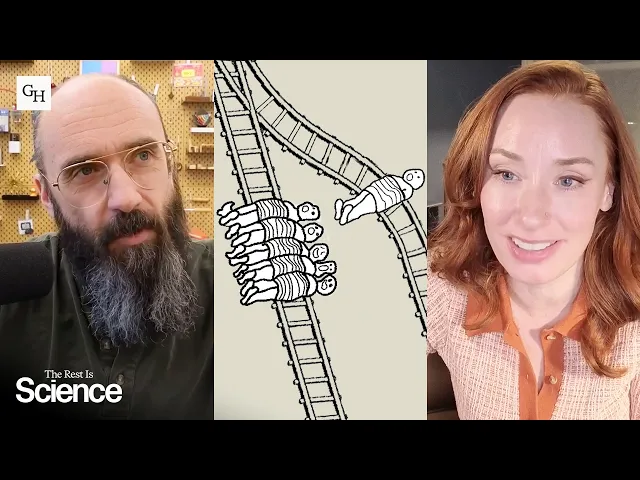
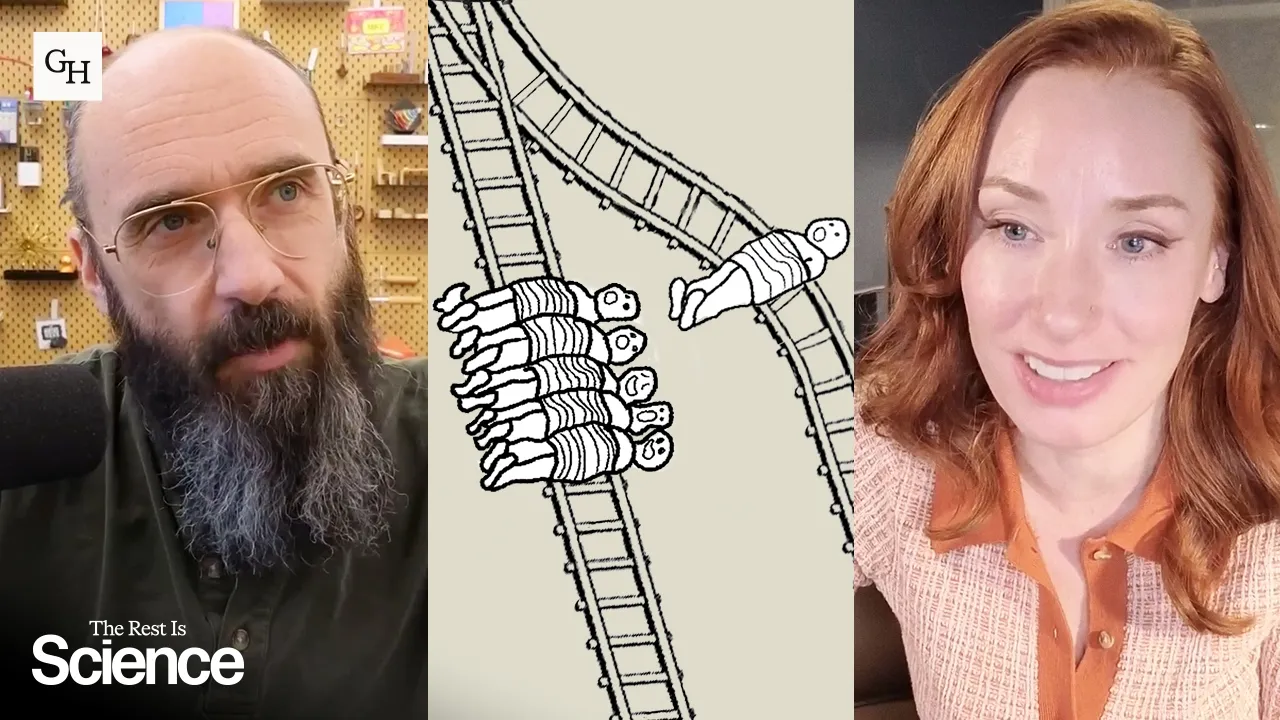
We actually recreated the trolley problem, right? >> We developed this intense ruse where people thought they were coming in to review these new high-speed rail car interiors, right? Is the fabric soft?
Are the colors good? Is the lighting good? But then there was a delay and they had to go and wait in this air conditioned room because it was a hot day.
That was a switching room. And this old man that we hired who used to switch railroad cars like teaches them, "Yeah, I have to switch the lines because these guys are coming to work on it and whatever. " He shows them and he's an affable guy and they they get to do it themselves while they wait.
And then he has to leave the room and boom, the trolley problem happens. And the trolley problem being the idea that uh the question normally theoretical but apparently not in your case of whether you uh there is a trolley careering down a track and is set on a on a path where it's going to kill five people or whatever it might be and you have the choice to pull a lever to redirect the trolley the train as it were uh so that it only kills one. The question is do you do it?
>> Yeah. So, so what what would you do? >> So, it's really I mean the whole point of this this like theoretical thought experiment was to demonstrate how sometimes there isn't a clear answer to an ethical question because if you take the the utilitarian approach, right, which is like count up how many lives are saved, then then you say, well, obviously you should pull the lever.
You know, there's five people on on if you do nothing and then there's one person if you if you pull the lever. But then I mean then there's also like the sort of value ethics, value based ethics which says okay but the the the murder you are effectively murdering somebody because it's your intervention which is choosing somebody's death. You're choosing to intervene in a situation and with the the person's death is a direct consequence of that.
I personally I don't know what I would do in that situation. I think I would really I think I would struggle to pull the lever if I'm honest. Yeah, it's a struggle because yes, if I pull the lever, then only one person dies, not five.
But they died because of my action. >> I feel a lot more responsibility over it. I've got to talk to that, you know, person's family and say, "Yeah, they would have been okay if I hadn't done it.
" >> I did save five people, but what had never been done was testing it in real life. if you actually put people in that position. So, uh there were CCTV cameras broadcast all over this switch room.
So, you could see the tracks and you could see that a worker went on to the side track while five were working on the regular track. And the authority figure, right, the guy who's employed to switch the tracks has left and these alarms start going off like person on track, train approaching, train approaching, what do you do? And as it turns out, um people don't do anything.
They freeze. >> Really, >> there's there's fight or flight, but there's also freeze. And that is the most common uh behavior that we saw.
Now, we had to have an actual psychiatrist on set to debrief people to tell them everyone's okay. This was all not real, and the decision you made is not something that should bother you. You know, you really helped science today because people were really broken up about the fact that they did nothing.
and we needed to make sure and we followed up with them a couple of weeks afterwards because you don't want to traumatize people into thinking I'm the kind of person who wouldn't pull the lever. I allowed five people to be killed instead of one. So, it's a it's a really serious thing, >> but that's it.
You're learning you are learning something about yourself. >> You're learning something about yourself. And so, we we had to sit down and tell every person afterwards, you know, first of all, obviously, everyone's fine.
Those are all actors. You were watching pre-recorded segments where no one was in danger. But the decision that you made is is uh the right one.
You know, there there is no decision that is fair. And to put you in that position was not fair. So, you shouldn't leave thinking [gasps] I did the wrong thing.
But that wasn't the scariest episode for me because I just got to watch people do it. Um, for me the most fear I felt, it wasn't when I went to Peru and drank iawaska with a shaman in the middle of the rainforest. It was a experiment we did in partnership with Philip Zimardo, >> the guy who was behind the Stanford prison experiment where a bunch of college students were taken in during the summer and some were assigned to be guards and some were assigned to be prisoners and they started treating each other so badly like physically abusively that he had to end the experiment and he was like, "Holy cow, if you give people authority and no oversight, they just abuse it.
" um the famous experiment which we did a whole episode on, but we also did one on how to make a hero. And we wanted to test if people would truly become a whistleblower. If we put people in a situation where something was being done that was wrong and it was up to them to stop it, would they?
If you ask in a survey, 95% of people say, "Of course, I would come forward. " But in real life, it's a lot more complicated. And so we rented out a wing of a psychology department at a university in Los Angeles and posed as real experimenters and we were bringing in um people to place phone calls to get us um subjects for the experiments and we told them you know we're looking at isolation.
We're going to put people in isolation for 10 days. Now in the show I had done 3 days and that is around the maximum where someone starts to to lose their grip on reality. There's a lot of anxiety and fears and and also just depression feelings of your life isn't worth it.
And we told this to these um recruiters and we said yeah it's really dangerous. Um you know here's a list of all the the things that could go wrong and and and all of the like mental problems that could be caused by it. But it's important for science that we do this.
And during the informative sessions, like half of the people in that room were confederates who worked for us. And that was for part of later in the experiment. I also receive a phone call at some point during the orientation where I'm told that the experiment has not been approved by the university's ethical review board and that it cannot continue.
So at this point then the people who you are who are on candid camera effectively they they know that this is not good and not only that is not approved. it's not approved and they overhear this conversation because part of it's on speaker phone and then I switch it and then I say look you know I'll deal with this later like we need to we need to start doing this now and every single person agreed to go ahead and phone bank for me to get recruits and we had them call actors who were trained to ask like is this safe and the recruiters just like they worked for me they lied and they said Oh yeah. No, this is th this is really safe and you're going to be fine and it's going to be like a vacation.
And um >> they actually lied or they conceal I mean were they like I guess there's like a spectrum of lying, right? Like were they just sort of concealing and saying they didn't know or were they actually lying? >> Most of them didn't directly lie.
There were some who were almost happy to say, "Yep, this is like probably even good for you. " Others they lied in really interesting ways where they would say they would be asked what are the what are the risks involved and they would say well there's nothing toxic there's no electric shocks they they just mentioned true things that weren't a problem to avoid mentioning the actual known problems of forced isolation and we then had our confederates come in and and say hey I'm starting to feel bad about this. I don't think we should be doing this to give the real participants an opportunity to say, "Yeah, I'm leaving or I'm going to make a phone call.
" Right? And this was all filmed on hidden cameras. >> How many of them did How many of them said that they wanted out?
>> None. Still no one no one said anything. They just said, "Well, you know, it's what we're hired to do, basically.
" And then we had a woman come into the rooms where they were the cubicles where they were doing the phone calls who said she was from the ethical review board and wanted to know what they were calling about. And they all confessed that it was for the experiment involving isolation. And we did this for 2 days and only one person agreed to go on record accusing me of violating the ethic review board's decision.
Everyone admitted that they were doing it and that it was wrong and that they felt bad doing it, but they just wanted to not be a part of it. First of all, there's an a million things going on here. >> Was it loyalty to me?
Was it dedication to the job they were hired for? The most common rationalization was that it was important for science that we do this. And that was also what Stanley Mgrim heard the most from his participants when he many decades ago asked people to to administer electric shocks to participants that weren't real but they thought were real.
When asked why did you go ahead and like do what the experimenter said and shock people so badly, they said well it was for science. It was for learning. It was worth it.
M I mean the the the background of that Stanley Mgrim experiments is I mean darker still. It was uh after the Nuremberg trials when Nazis were accused of participating in this horrific moment in history of of participating in the deaths of millions of people and and people's defense was well I was just doing my job. And the pilgrim experiments were to say, you know, how far will people go?
How far will people harm each other if they're told to do so by somebody in a white coat and a clipboard? >> And it turns out very far. >> They'll go very far.
Even for something as simple as like a minimum wage phone banking job to recruit test subjects, it's it's almost like it's hardwired into us to be loyal to the job and do what we are told by authority. And in a lot of ways, I think the guilt can be diffused onto the system that's asking you to do it. Look, I'm just a small part in this.
>> Like, it's not really up to me. Um, I don't want to lose my job. I don't want to get in trouble from my employer, so I'll just go ahead and tell people there are no known risks.
And everyone did it. It was scary for me because I had to be the unethical experimentter. I had to answer the recruiter's questions when they said, "Well, when are you going to tell people that this is dangerous?
" And I'm like, "Oh, we'll debrief them afterwards on the known risks. " afterwards and I had to pretend like this didn't bother me. And I want to be liked.
I think it's part of being a YouTuber. >> I just I'm a people pleaser. And I really really had a hard time psychologically with two days of being evil, but then having no push back.
Only one person ever pushed back and never to me. They told the the authority figure, my boss who who showed up, they told her, "Yeah, he shouldn't be doing this. " And yes, one person said, "I will go on record and say that I did this and that I was told to do this.
" >> It does. I I wonder whether we should do a whole episode on that that Mgrim experiment and talking about the sort of tendency of humans uh in in more detail cuz I think that the research on it is absolutely fascinating and it feels quite dark in a lot of ways that like that actually once you once you have that intersection of like moral responsibility but with um sort of financial reward with like societal expectation with like systems and norms actually we really do struggle to to buck the trend and stand up. I mean, it reminds me quite a bit of the bystander effect.
>> Yes. >> Which is is is is this idea. I mean, it's not quite as bad as um uh I think the very the the the first sort of tellings of the bystander effect made it sound really horrific.
There's like this this um paper in the 1960s that said somebody was stabbed to death in New York and 38 people saw it and nobody did anything. >> Kitty Genevies. Yeah.
a real murder with with witnesses all around and not a single person called the police or intervened. >> But I think in the over time actually that that idea of 38 people watching on was a little bit of an exaggeration. And I think that a couple of people had actually called the police.
It was sort of it was a bit of an exaggeration by journalists, but you do see this bystander effect in the psychological experiments that you're describing where you get people in particular when you have um smoke filling in a room and actors that are not reacting, people sort of assume that it's not really their problem. Or you have some students who are sort of sitting in a room and over an intercom they hear the sound of somebody else having a seizure or or crying for help or something and and very very few people will intervene. But it's sort of like people can reason um reason that this isn't their problem, that there's somebody else who will step in and fix it.
>> Yeah. Uh the seizure one, I remember an experiment where people were doing some task that was obviously just a filler task over headphones. They [snorts] everyone was in their own little cubicle and they heard the people they were working with over headphones and um in in one condition there were like four people all listening together and talking together and then the other people were alone with just them and one other person.
And if the other person they're listening to faked having a a seizure or a heart attack, the other person listening immediately got up and went for help. But if there were if they believed there were four people on this line and one of them had a heart attack, they would just keep sitting there for a while because surely someone else is going to do something, >> right? The thing is is that I mean in these experiments that sort of because it's a lab setting because it's sort of a constructed setting when you watch back videos of genuine disasters, right?
So, so real emergency situations, kind of real high stakes um scenarios. Actually, I mean, you often do see people who step up. And I think that the the original idea of the bystander effect is that the more people that there are, like on your phone call, the more people there are, the less it's my problem to do something.
Whereas, I think in situations where you have, I don't know, like a someone wielding a knife, for instance. Actually, the more people there are, the more likely it is that people will step in and and try to mount a response. is much less scary when you feel as though there's sort of safety and numbers.
So, it's maybe not quite as depressing as sometimes the telling of this, but there is still something in there though, right, of like personal responsibility versus collective responsibility. I also wonder whether there's like a international dimension to this um trolley problem that you described right at the beginning. One of the most fascinating experiments that I've seen done on the trolley problem was in the sort of the early excitement about driverless cars, maybe around 2018 or so, there was a group of scientists who set up a uh an online game where you could go and play the trolley problem with a driverless car, but it would give you lots of different options.
So, your driverless car could run over five people or one person, the traditional version, or it could run over a couple or an old granny or a cat or a mom and a baby and so on and so on and so on, and would present you with these problems. And what was completely fascinating about that was the the breakdown of how different cultures valued different things, how how some cultures, particularly in Japan, really cared a lot about older people. um would sort of would prioritize them right at the top.
Whereas other cultures, western cultures for instance, um you know, cared about children much more. Everyone cares about cats. Um that's uh [laughter] I think the other thing that's that that came on a bit.
But but um we should definitely do some episodes digging more into your psychology past. >> Well, yeah, because there are just so many factors. Yeah, people in groups can be better, but they can also be worse than they are alone.
And what factors cause it to go one way or the other? we're still learning about. And we also still have open questions about the hypotheticals themselves.
How valid are they? Because I in a lab setting, that's very different than real life. Um, if you're programming a autopilot car uh to, you know, >> favor young couples with a baby over old people.
Um, is that really a real choice in real life? Because in real life, what the car will do is it will stop itself. It will drive off the road.
It'll crash itself into a wall. Like there's always some other option that isn't the simple this person or that person. I always thought it was really interesting how if you're following the trolley problem logic, you want the car to crash itself rather than crash into people.
But who's going to buy a car? Who will buy a car that will crash and potentially hurt the people driving it rather than other people instead? >> Exactly.
Yeah. Yeah. We haven't talked about the train.
Um what's it carrying? What if it's got um you know 12 people on it? >> What if it's got a million embryos on it?
>> Mhm. >> Actually, Amy, one of our producers, she's uh she's just pointing out that there's this this idea of inflicted insight, you know, the the the idea that there's there's there's trauma to learning something about yourself that you can't unknow. And that psychologists really started to discuss this a lot after the Mgrim experiment.
>> Inflicted insight. What a great phrase. Yeah, we we encountered that so often in minefield and I encountered it personally.
Like the reason I disliked how to make a hero was that I learned how easy it was to get away with bad stuff. Right? I think we live our lives thinking, "Oh, I couldn't do that.
I'll get caught. " But then here I am literally being an evil, manipulative scientist and everyone's just eating it out of my hand. Like, yeah, of course.
It's interesting the idea that being powerful and evil made you feel uncomfortable. Sometimes I do this thing where um I'll like have a day or two where I will deliberately not get out of the way of anybody when I'm walking down the road. >> Hannah, >> have you ever tried this?
>> No, I'm not a sociopath. [laughter] like go down Oxford Street or something like a really really busy busy road and just like I'm not getting out of the way and everybody does move around you. It's like you feel so powerful and so evil and I can't keep it up.
But it's it's fun to do for like a moment and then you know >> I think it's probably a good lesson that yeah we are a lot more powerful than we think and allow ourselves to be maybe for good reason >> but it's fragile that the barrier between the two. >> Well there you go. We've uh we've learned about some of the scariest things on the planet there then, Michael, which is ourselves.
Um so if you have got any questions that you would like us to answer, you can send them in at the rest is science@galhanger. com. >> And you can join our newsletter at thereis.
com/science. >> We are going to be back next Thursday with another edition of Fieldnotes and on Tuesday with our normal episode. Um until then, >> stay curious.
Bye-bye.