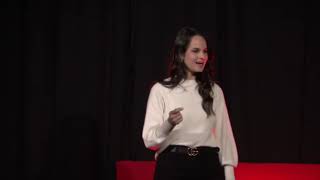
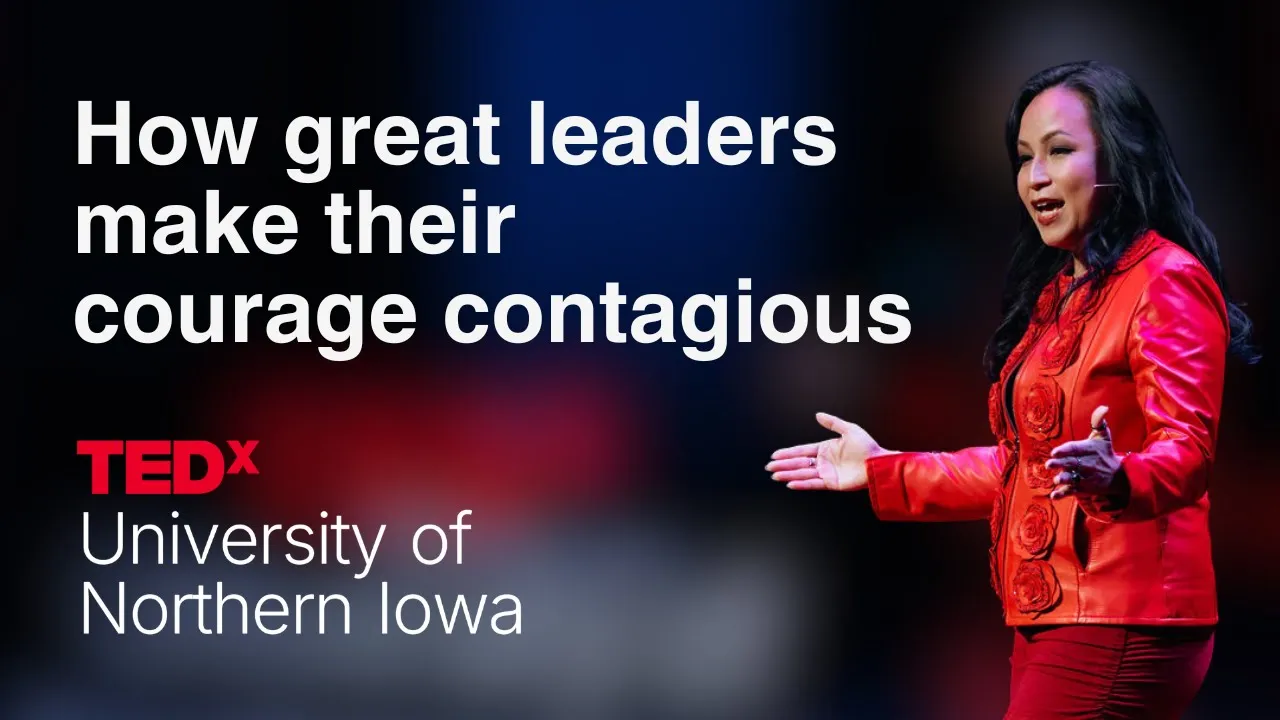
[applause] We need to create new leaders. Think about how much we celebrate great innovators in retail and technology who made big bets that paid off. Yet, once these risktakers get to the top, they often suppress that same courage in in others rather than passing theirs on.
So, how do leaders of today protect what they've built while creating leaders of tomorrow? And what happens when we tell a whole generation to comply and don't rock the boat? That comes at a cost, as I learned as a child of immigrant parents.
Saigon fell 50 years ago in April 30th, 1975. My family escaped just one day before on land. That meant two parents, eight children, and two soldiers driving around for hours in a car the size of a VW bug.
On the waters, it meant waiting for a wave in the rocky ocean to raise the smaller boat we were on by several stories to the lip of a much larger vessel, at which moment people would jump. My mother turns to the big stranger next to her and accepts his offer to throw the baby to yet another stranger who barely catches me by one chubby little hand. I watched my parents rebuild their lives from nothing.
My father went from an officer commanding hundreds of troops to a janitor mopping floors and then a social worker. My mother went from an elementary school principal to folding clothes at a mom and pop store. Together, they raised eight children who all went to university.
Midway through college, I asked permission to change degrees from engineering to business. My daddy said, "You Asian, doctor, lawyer, engineer, pick one. We didn't escape a war and cross oceans for you to throw it all away.
Now, all parents are protective, but immigrant parents can be extra. That's because they've already taken the most unimaginable risks. My family left everything behind.
country, culture, community, all for a chance at a better life. Yet, once these brave people make it to their new home, they teach their children to play it safe. Sit down, shut up, don't rock the boat.
And just like that, risktakers create risk avoiders who lose their inheritance of courage in a single generation. My career spans a decade each in engineering, marketing, and sales. In every domain, I've experienced the same behavior in business.
The problem is, even if we exemplify courage, we don't necessarily pass it on. Leaders who built their legacies on being disruptive are now blocking their own people from thinking differently. Because if it ain't broke, don't fix it.
Right? That may seem sensible, but it's not sustainable. Large companies in America last less and less these days.
In the 1950s, the average S&P 500 company lasted 61 years. Today, that's down to 18. Those who survived the longest have been able to adapt, sometimes drastically.
General Electric went from light bulbs to corporate financing. Amazon, that darling online bookstore, now offers data services in the cloud. And whereas we once bought tools from Stanley, today we each hold one of their giant cups.
Safe bets of today may have been courageous risks at one time, but formulas get outdated and eventually we have to innovate again. And who's next in line to do that? When we insist that people quietly follow directions without taking initiative, we create a generation of ordertakers who need to need need to be spoonfed and may be easily replaced by technology.
Instead of creating leaders, we're stealing motivation because it sucks to work somewhere you can't think for yourself. I've been told, "You just don't do what I tell you to. " when actually I did just differently and with better results.
After exceeding expectations time and time again, reactions like these from managers were soul crushing. Employee disengagement figures are higher than ever, costing our economy hundreds of billions, not to mention the loss of potential and the damage to our collective health. I know because I went to the emergency room twice.
It turns out that playing it safe like my parents wanted and my bosses insisted was the most dangerous thing I could do. It kept me stuck until I stopped listening to the lessons my parents taught and started following the lessons I caught from their examples of courage. I left my steady job.
I built my own business and established myself as an expert. But determined to exact change from within, I returned to corporate. This time, I searched for something I heard only existed in legend, an empowering boss.
I found a leader who fostered a culture of contagious courage. When I brought him ideas, he listened enthusiastically, provided guidance, and then trusted my judgment. When there was a problem, he asked for a proposal, and allowed me to be creative in my solutions.
I felt heard and encouraged as a collaborative value maker, not just an order taker. And my leader, he gained a thought partner. He didn't accept all my ideas.
Some of them were really out there and not all of our risks did well. We might have broken some glass, but some worked amazingly like exploring virtual meetings on mass way before the world went remote. When COVID emerged, we were able to pivot an entire business serving thousands of people in a short couple weeks without missing a beat.
That's how I learned that great leaders listen to others ideas with the same curiosity as if they were their own. Provide guidance and then trust them with the space to experiment. So, is the solution to try everyone's risky ideas?
Well, of course not. That wouldn't work either. But in this time of low trust and great division, we need new leaders who can rise to challenges we've never seen before and some we've yet to conquer.
After years feeling stifled and unhappy, leaders like these unlocked my potential and harnessed the brilliance of their entire organization. They elevated me to vice president of a Fortune 500 company within six years. It is possible to reboot your career after the age of 45.
To pave it forward, I pick and develop leaders who are more than managers, but proliferators of contagious courage. I call them collaborative risktakers. This approach works well for parents, business, and our new set of heroes, as it did once before.
At the end of the Vietnam War, the same year my family escaped, the actress Tippihedrin wanted to help refugees earn an income with a low language barrier. Given proven professions, she offered to send Vietnamese women to typing school. But the ladies were much more interested in her beautifully manicured nails.
At the time, that luxury was reserved for the elite, and beauty schools were only offered in English. Tippy then courageously embraced their idea over hers and equipped her salon to teach them the skills of the trade. And that's how 20 women revolutionize what is now a$1 13 billion dollar industry.
You see the greatest gift that leaders can leave is a saying that parents pass on. Not a life without risks but the capacity for courage. So how do you become a leader like this?
We need to replicate our courage, not suppress theirs. We need to remember our courageous cho choices to support it in theirs. Because our legacy, it's not in the winning or the losing.
It's in the learning. It's not about protecting what might be lost, but being open to what might be sought. It's not about the control.
It's in the collaboration so that the lessons taught can now match the lessons taught. And no matter how rocky, no one misses the vote. So the next time you're faced with a new and uncomfortable idea, resist every instinct in your body to shut it down and protect the baby by holding on to doing it how you've always known.
Instead, do this. Ask them for three options and a recommendation. The options indicate they've done their homework.
The recommendation invites them to have a point of view. Help them work through the risk and reward of each option and outcome and then unleash them. You'd be surprised at how trusting others ideas is the safest bet after all.
Immigrants have done very well beyond safe bets of being doctors, lawyers, and engineers. The same is true of great leaders because there are no safe formulas. There's no way to take on all the risks so that those behind you don't have to.
Great leaders have the courage to guide their people to take their own risks as they once did. And that's how we pass the cape to our successors. And that's how great leaders make their courage contagious.
Thank you.