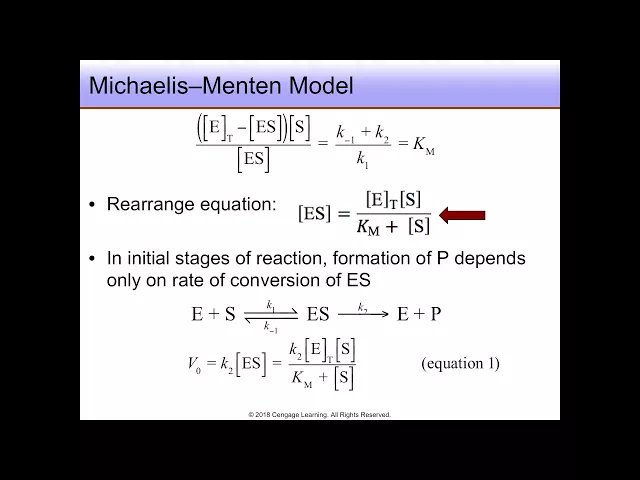
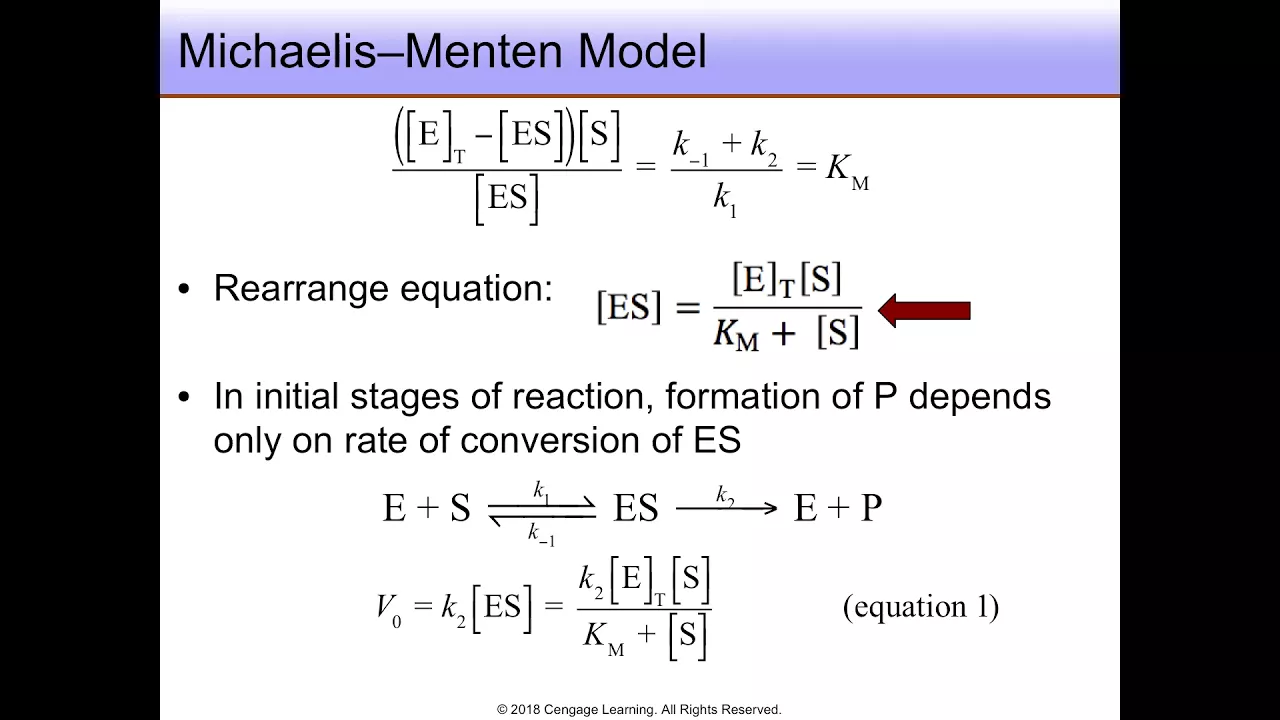
in this lesson we want to use the expression for steady state conditions as a means to derive an expression relating substrate affinity and catalytic rate to the rate of product formation keep in mind theory is fine but we need our expression to include terms whose value we can readily measure in the lab let me just remind you of the steady-state conditions we've specified for the rate of es formation is equal to the rate of es breakdown let's begin with the expression for equivalence or steady-state derived in our last lesson keep in mind that at any
time the enzyme might be in either the free or unbound form or in the es complex the amount of free enzyme or a present well therefore simply be the total amount of enzyme added minus the amount actually bound to substrate let's take this relationship and substitute it into our steady-state equation at the top of the slide this gives us the expression at the bottom of the slide to simplify our expression let's rearrange the equation and collect all the rate constants together when we do so we get a ratio of rate constants as shown here this
ratio of rate constants is the km or Michaelis constant an equilibrium dissociation constant we've simplified an equation since we now have one constant instead of three if we rearrange our equation slightly we get the form in the center of the slide an expression for the concentration of es in the early stages of reaction product formation depends only on the rate of es conversion in other words velocity is equal to k2 times the concentration of es if we substitute our expression for es concentration we have equation one at the bottom of the slide let's remind ourselves
that we are operating under steady state conditions that the concentration of substrate is so high that all of the enzyme molecules are bound to substrate this means that the concentration of es is simply equal to the total concentration of enzyme or concentration of e sub T under these conditions we are at zero order kinetics and the velocity has reached its maximum value V zero is equal to V Max next we'll substitute this expression into equation 1 and this gives us the final form of the Michaelis Menten equation it tells us that the initial velocity of
the reaction or V 0 is directly dependent on v-max on how fast the enzyme converts substrate to product it is also inversely related to km so that as km decreases and substrate affinity increases we get more product per unit time let's now consider a special case where the substrate concentration is equal to the value of km under these conditions or a velocity expression simplifies to 1/2 v-max in other words the km is simply the substrate concentration where velocity is at half its maximum value we can therefore estimate v-max and km from our substrate saturation plot
shown here the v-max would be the asymptotes to the flat area of the curve to find km we first find the value for 1/2 V Max on the y axis and see where that crosses the curve the corresponding value on the x axis is the value for km please note that this is at best an estimate that is to say it isn't very accurate the most important thing to take from this lesson is an understanding of how the Michaelis Menten equation relates reaction velocity to the two parameters the maximum enzyme speed and the affinity for
substrate