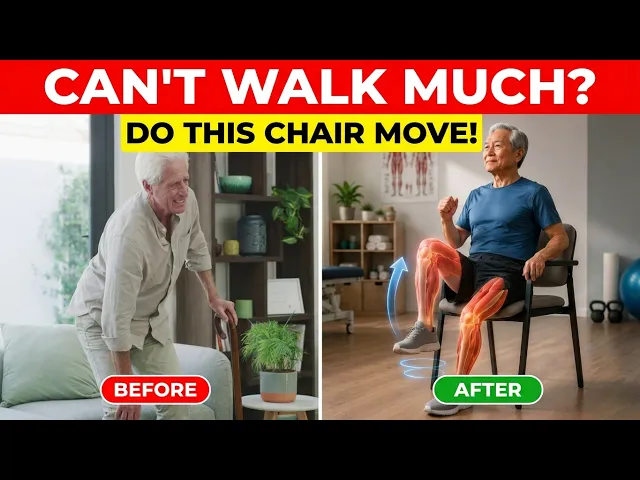
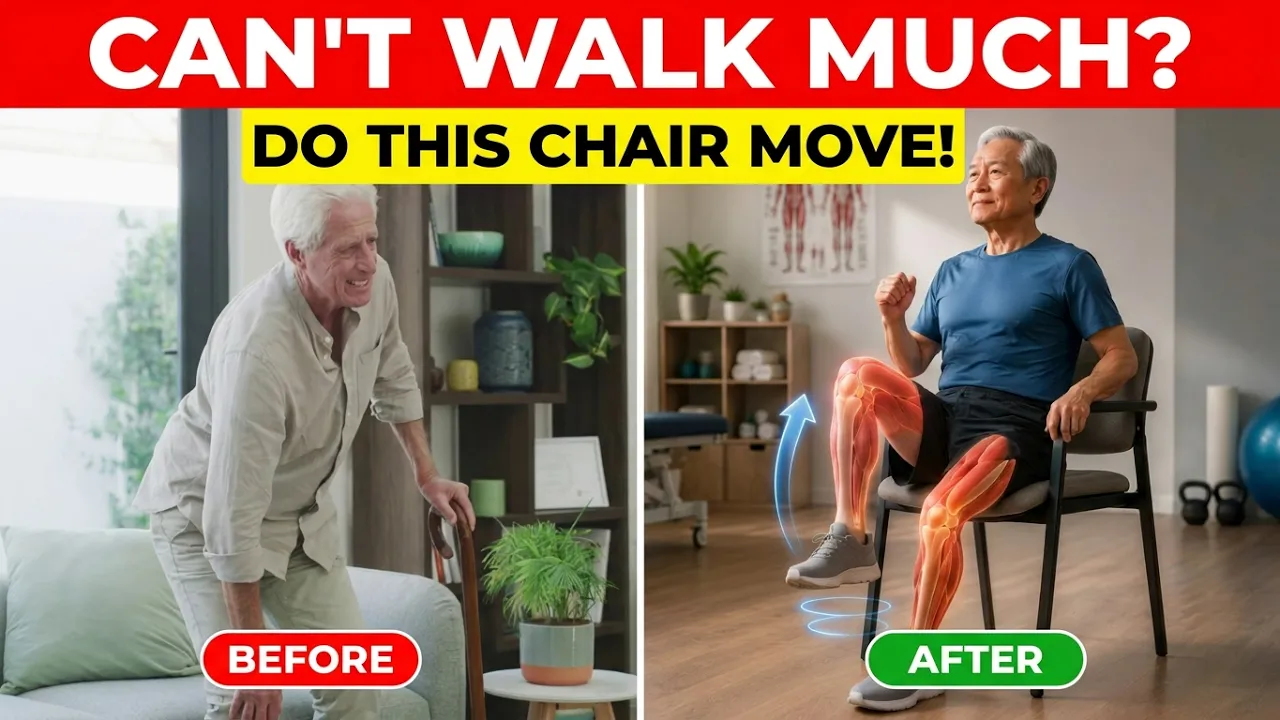
If walking has become painful, slow, or difficult after 60, sitting down may feel like the safest choice. But, here's what most seniors are never told. When your legs stop getting the right kind of movement, they do not simply rest.
They can slowly lose strength, balance, and control. The exact things you need to stand up from a chair, to cross the room, step into the bathroom, or turn in the kitchen without feeling unsteady. Experts from the National Institute on Aging make one thing clear.
Older adults need movements that build strength, improve balance, support flexibility, and help them keep doing the daily activities they enjoy. In their exercise guide, they explain that being physically active can help older adults stay independent as they age. That means this is not just about getting more exercise.
It is about giving your legs the right signal before weakness becomes your normal. And this is why today's chair routine matters so much. If you cannot walk much right now, your thighs, calves, hips, knees, and standing muscles still need a safe way to work.
This simple chair exercise routine uses five gentle but powerful movements to wake up the muscles that help your legs feel stronger, steadier, and more reliable. And number one is the movement I saved for last because it trains the exact action many seniors struggle with first, getting up from a chair without help. Before we begin, tell us in the comments your age and where you're watching from.
Now, let's start with the easiest movement first. Movement five. We're starting with this one because it looks simple.
But, for someone who cannot walk much after 60, this movement sends an important message to the legs. Wake up, lift, move, and coordinate again. Many seniors notice the same problem.
After sitting for a long time, the first few steps feel heavy. The knees do not want to lift. The feet feel slow, and the body needs a few seconds before walking feels safe again.
That is exactly why seated marching belongs at the beginning of this routine. The CDC's physical activity guidance for older adults says, "People 65 and older need a mix of aerobic activity, muscle strengthening activity, and balance-focused movement every week. " That is important because healthy legs are not built by one system alone.
Your legs need rhythm, strength, control, and coordination working together. Seated marching gives you a gentle version of that while staying in the chair. Sit tall in a sturdy chair.
Keep your back away from slouching if you can. Place both feet flat on the floor. Now, lift your right knee as high as comfortable.
Then, place it back down. Lift your left knee, then place it back down. Right, left.
Left. Just like you are marching in place while seated. Do not rush this.
The goal is not to swing the legs wildly. The goal is controlled lifting. Let your hip muscles do the work.
Keep your chest up. Keep breathing. Try this for 30 to 60 seconds.
If lifting the knee high feels difficult, lift it only 1 or 2 in. That still counts. If your hips and knees feel uncomfortable, make the movement smaller.
The safest movement is the one you can repeat without pain. This movement trains the muscles that help you pick up your feet when you walk, step over a rug, or move through the house without dragging your legs. And once your legs are awake, the next movement starts building strength where many seniors lose it first.
The front of the thighs. Movement four, seated leg extensions. Now that your legs are awake, we move one of the most important strength movements for seniors who cannot walk much, the seated leg extension.
This movement targets the front of the thigh, especially the quadriceps, the muscles that help straighten your knee, support your steps, and make standing up feel less difficult. Harvard Health Publishing explains that when you straighten your knee, the quadriceps on the front of your thigh contracts. Harvard also notes that stronger muscles around the knee and hip can help support those joints, and that the quadriceps are often one of the first major anti-gravity muscles to lose strength when knee or hip problems appear.
That should get your attention. Because weak quadriceps do not just show up during exercise. They show up when you climb one step, rise from a low chair, or try to walk without your knees feeling uncertain.
Here's how to do it. Sit tall in a sturdy chair with both feet flat on the floor. Keep your hands on the sides of the chair if you need support.
Slowly extend one leg forward until the knee is as straight as comfortable. You do not need to kick high. Just straighten the leg, then slowly bring the foot back to the floor.
Now switch to the other side. Move with control. Lift, extend, lower.
Lift, extend, lower. Do 10 to 15 repetitions per leg. The biggest mistake is swinging the leg too fast.
If you throw the leg forward, momentum does the work instead of your thigh muscles. Another mistake is leaning backward. Try to keep your chest tall and your body steady.
Let the front of the thigh do the job. If your knee feels sensitive, use a smaller range of motion. Even a partial extension can still help wake up the muscle.
As your legs get stronger, you can slow down the lowering phase to make the movement more effective without adding weight. This movement helps train the muscles you need for stairs, standing, and walking with more control. But strong thighs alone are not enough.
Next, we move down to the calves, the muscles that help power every step you take. Movement three, supported heel raises. Now we move to the calves, and this is where many seniors underestimate what their legs are missing.
Your calves are not only there to make your lower legs look stronger. They help you push off when you walk, rise onto your toes, climb a step, and steady yourself when your body starts to shift forward. Sports medicine experts at Mayo Clinic explain that calf raises work the calf muscles in the back of the lower legs.
Mayo Clinic's balance guidance also says, "Older adults especially need balance exercises because the risk of falling goes up after age 65. " That combination is why this movement matters. Stronger calves and steadier ankles can make every step feel more controlled.
Here's how to do it safely. Stand behind a sturdy chair. Place both hands lightly on the back of the chair.
Keep your feet about hip width apart. Now slowly lift your heels off the floor so you rise onto the balls of your feet. Then lower your heels back down with control.
That's one repetition. Do 10 to 20 repetitions, depending on your comfort level. Move slowly.
Do not bounce. Do not throw your body upward. Let the calves lift you, then let them lower you.
If standing feels too difficult, start with the seated version first. Sit in your chair. Keep your toes on the floor.
Lift your heels and lower them down. Once that feels easy, move to the standing version with chair support. The biggest mistake is gripping the chair too hard and using the arms to pull the body up.
The chair is there for balance, not to do the work for your legs. Another mistake is rolling the ankles outward. Try to keep your weight even through the big toe and second toe as you rise.
This movement helps train the lower leg strength you need for walking, stepping, and feeling more stable on your feet. But calves are only one part of strong legs. The next movement targets something many seniors completely ignore.
The side hips that help keep the knees from collapsing inward. Movement two, seated band knee press outs. This is the movement many seniors are missing because most people think weak legs only come from weak thighs or weak knees.
But many walking problems actually begin at the hips. When the side hips are weak, the knees can drift inward. The body may wobble when turning and each step can feel less steady than it should.
Healthcare experts at Cleveland Clinic explain that weak hip abductor muscles, including the gluteus medius and gluteus minimus, are the most common cause of Trendelenburg gait, a walking pattern where the pelvis shifts because the hip muscles are not keeping it level. They also explain that these muscles help open the hips and keep the pelvis stable when you move. That is why this chair movement is so important after 60.
It trains the side hip muscles that help your knees, hips, and walking patterns stay more controlled. Here's how to do it. Sit tall in a sturdy chair with both feet flat on the floor.
Place a light resistance band around your thighs just above the knees. Start with your knees slightly inward, then slowly press both knees outward against the band. Bring them back in with control, then press out again.
In out, in out. Keep the feet planted. Do not let the ankles roll.
The movement should come from the hips, not from twisting the feet. Do 10 to 15 repetitions. If you do not have a band, do the same movement without one first.
Once it feels easy, the band makes the outer hips work harder without forcing you to stand. The biggest mistake is snapping the knees outward too fast. Slow pressure is better than quick movement.
Another mistake is using a band that is too strong. You should feel the hips working, but you should not feel pain in the knees. This movement helps train the muscles that support steadier walking, safer turning, and better knee control.
But now we come to the most important movement of the entire routine. The one that decides whether your legs can still lift you out of a chair. Movement one, chair sit to stand.
And now we come to the most important movement in this entire routine. This is the one I saved for last because it is not just a leg exercise. It is the movement that shows up every single day when you get out of bed, stand up from the toilet, rise from the dining chair, get out of the car, or simply try to move without asking someone to pull you up.
CDC's Steady Fall Prevention Program uses the 30-second chair stand as an assessment for older adults, and the stated purpose is to test leg strength and endurance. That should tell you how important this movement is. If doctors and fall prevention professionals use chair standing to understand lower body function, then practicing a safe version of this movement can be one of the smartest ways to train your legs after 60.
Here's how to do it. Sit near the front half of a sturdy chair. Keep both feet flat on the floor about hip width apart.
Place your feet slightly behind your knees if comfortable. Now lean your chest forward just a little. Press through your feet and stand up slowly.
Then sit back down with control. Do not drop into the chair. Lower yourself like your legs are guiding you down.
That is one repetition. Start with five to eight repetitions. If you need to use your hands on the chair arms, that is okay.
Safety comes first. As your legs get stronger, try using less help from your hands. Eventually, you may be able to cross your arms or keep your hands in front of your body.
The biggest mistake is pushing mostly with the arms and letting the legs do almost nothing. Another mistake is letting the knees collapse inward. Keep your knees pointing in the same direction as your toes.
Think feet strong, knees steady, chest up. This movement trains your thighs, hips, calves, and core all at once. But more importantly, it trains confidence because when standing up becomes easier, your whole day becomes easier.
And that is why this is number one. Strong legs are not just for walking farther. They are for staying independent.
Here's the simple routine to remember. You do not need to do everything perfectly, and you do not need to push through pain. Start with one round.
Move slowly and let your legs learn the pattern again. Begin with seated marching for 30 to 60 seconds to wake up your legs and get them moving. Then, do seated leg extensions for 10 to 15 repetitions per leg to train the front of your thighs.
After that, use the chair for support and do supported heel raises for 10 to 20 repetitions to strengthen your calves and ankles. Next, do seated band knee press outs for 10 to 15 repetitions to train the side hips that help control your knees when you stand and walk. And finish with chair sit to stand for five to eight repetitions because getting up from a chair is one of the clearest signs that your legs are still protecting your independence.
Start with one round per day. If your body feels good, slowly build to two rounds per day. The goal is not perfection.
The goal is consistency. You are giving your legs a daily signal. Stay strong, stay steady, and keep helping me move.
Walking is still valuable. But after 60, especially if walking hurts, your legs also need strength, control, and balance. And the encouraging part is this.
Your body can still respond when you start from where you are. If you have severe pain, dizziness, recent surgery, or a history of falls, check with your doctor or physical therapist before trying these movements. Now, tell us in the comments which movement feels hardest for you right now.
Standing up, walking, climbing stairs, or keeping your balance. Also, share your age and where you're watching from. Thanks for watching, and I'll see you in the next video.