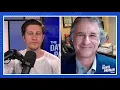
Speaker 1: Today, I'm going to be speaking with Daniel Levitin, who's a psychologist, neuroscientist, author and professor emeritus at McGill University. Some of his books include A Field Guide to Lies, Critical Thinking with Statistics and the Scientific Method, and also Weaponised Lies How to Think Critically in the Post-Truth Era. It's really great having you on.
I appreciate it. Speaker 4: Thank you for having me, David. Speaker 1: So, I mean, where to start?
Where to start? You know, I think maybe one place that would be interesting would be for context. You know, we've recently been doing a lot of thinking about how to best engage in conversations with people who might have different opinions, but also importantly, who maybe don't have a factual foundation or basis on which we can have those conversations or people who can't tell the difference between news reporting and conspiracy articles that might be shared on Facebook as just general examples.
One approach is to speak to these folks with like a Socratic type method of questioning, gently probing How did you come to this conclusion? How do you determine if a news source is trustworthy? It's a it's a very long process, admittedly, which sometimes is effective at changing minds and sometimes is not where maybe we would start with you.
As can you talk a little bit about whether you believe that that's an ideal framework for some of these conversations or whether there might be better or at least different approaches to pair with that? Speaker 4: Well, I agree with you that we've got a problem. And the reason that we are so divided as a country is we're not using the same facts to come to any conclusion, but at least we have the same facts.
We may differ about how we want to proceed from there. But without that, it's bedlam. And I'm inspired here by the work of Lee McIntyre, a philosopher who's done a lot of work on this.
And I'm with you and with Lee. You can't reason somebody out of a position they didn't reason themselves into in the first place. All you can do is listen, understand, and make understood.
Try to understand where they're coming from. Allow them not to feel judged by you. And then, as you say, ask questions about how they came to believe, what they believed and whether they think step by step.
Is this a reliable source? Is there another way to look at it? And as as as MacIntyre says and as you said, it's a very long and arduous process.
But that's all we got for now. Speaker 1: There's no shortcuts. In other words, we've interviewed Lee, by the way, on the program, and it was it was fascinating.
In your work overall over the years, you've gone to the micro level of how graphs are used to deceive and to lie. And you've also talked much more macro sort of the way that that we just started today for 2022, where it's rapid fire social media sharing of fake articles and it's truncated y axes. When you look at an unemployment rate or stock market numbers, I mean, it's sort of like an all of the above thing.
Can we go a little narrower in specific about what you see as some of the most commonly used tools of deception? Speaker 4: Yes, thank you. And we are currently doing some research on this.
And there may be some quicker ways to move the needle a little bit that we can get to later. Mm hmm. Distorting graphs is a big thing, as you mentioned, a truncated y axis where, you know, the y axis is the up and down one.
And it looks like you've got a really big difference, but it's zoomed in on a difference that isn't really a difference to distort it. People can say all kinds of things with graphs that they didn't label the axes. If they're not labeled with numbers or what the quantities are, you don't know anything.
And my approach has been to educate. I'm an educator to try and educate people about the different tricks and swindles. And really, I think the most effective thing to do is to start with 12 year olds.
I don't know that we're going to reach people my age who have already made up their minds, maybe not even people your age, unless they're especially open minded. But if we start with 12 year olds, in another ten years, we'll have solved the problem. Speaker 1: Yeah.
And you know what? When one says that there is a particular group that says you're talking about indoctrination, when really you're talking about the opposite, you're talking about a toolbox for people to think for themselves rather than be indoctrinated into any particular worldview. Is that correct?
Speaker 4: That's perfect. I've never sought to tell somebody what to think. Just to teach them how to take a problem apart and how to think about it and form their own conclusions.
And if they come up with a different conclusion than I do, that's that's what democracy is all about. I like you. I embrace that discussion as long as the process was reasonable and somebody wasn't tricking them.
Speaker 1: When it comes a little more specifically to news consumption, which, you know, we can include radio, television and online kind of all platforms. I mean, to use an analogy to what many of us do when we look at an article or hear a piece of news for the first time. One of the difficulties, it seems, in self-driving vehicles is that there are some decisions that we as humans make intuitively and quickly that are really hard to have a computer mirror.
A classic is, do you go through the yellow light or do you stop? And we're at the same time calculating how fast are we going? Someone behind us, the width of the intersection, all of these different things.
And we're making these decisions very, very quickly in the same way many of us, myself included, similarly make decisions when we are first presented with a news article that we see somewhere. That's fine, I think, to intuitively kind of have that perception, but there really is a probably better sequence or toolbox that we can have to be able to assess for ourselves. Is a piece of news or article trustworthy?
Are the assertions accurate? What would such a toolbox look like? What would such a process be for the average news consumer?
Speaker 4: Well, to begin with, I think we can recognize can recognize, although we don't all agree on this, that there are some people who are experts in certain topics. So if you want to know about climate change, talk to somebody who works in the field, somebody who is a climate change scientist. Don't talk to a geneticist or a biologist.
A lot of the climate change misinformation has come from people who are not experts. And for that matter, if you want to know about something going on in the brain, don't talk to your foot doctor. I think he or she might know, but it's less likely.
So I think the average person doesn't whoever that average person is don't appreciate that. There really are experts who know things. Virologists is are an interesting case because we've during the pandemic seen a lot of flip flopping.
And so people say, oh, well, they don't know anything or they're there, they're just trying to make money off of us. And the reality is, the second part of this is to help people understand how science works, because a lot of the information we consume is scientific. Science is a self-correcting process.
They're flip flopping as they should. When new information comes in, they update their views. The third thing we can do, I think, is understand that there is a hierarchy of information sources.
None is perfect. None is unbiased. All are biased and imperfect.
But what you want in an information source is one that will like science self-correct. Print a retraction. If it's wrong, check it sources before it goes with the the article.
So TMZ is a sort of favorite case of mine because they did break the story of Michael Jackson's death before anyone else, but they got lucky for every story they broke. That was right. They broke 20 stories that were not right.
They've said that Miley Cyrus was dead, all kinds of stuff. And so I tend to trust sources that are a little bit more deliberate and circumspect and everybody has to draw the line somewhere different. But I think we all agree there are sources that.
Ah, just kind of capriciously say what they want. And included in those unfortunately are. I guess they're not really news shows.
They're commentary shows, people commenting on the news, which is not the news. Speaker 1: Right. And that goes to media literacy in a sense.
I mean, it's being able to distinguish the difference between news and opinion. Sometimes I'll get emails praising me for being unbiased and I'll say, I love that you love my show, but I am not a news show whose bias we really should evaluate in those terms. I mean, this is a program about my opinion.
The problem is that there are media actors that are deliberately blurring that line. Speaker 4: Oh, for sure. It leads to better ratings if they say this is what's really going on.
And let me tell you. They don't want you to know. And I have unique access to facts that you will never encounter.
That always makes me a little suspicious there. Speaker 1: You mentioned climate change and a couple of other things which I think lend themselves to to this next sort of idea. There's a contingent that has sort of placed itself seemingly above the fray in terms of some of these partizan disagreements by taking the position that they are.
And this is my it's sort of a pejorative, an enlightened centrist, in a sense. They've determined. Here's what one side thinks and here is what the other side thinks.
And I can rise above this and find the truth. And it happens to be sort of somewhere in the middle. So if you watch Fox News, you watch MSNBC.
And the truth is between those two. And of course, the problem with this is with something like climate science, you know, if you say, well, let's bring in one person who says it's real and one person who says it's not. And the truth is, it's sort of like in the middle.
This seems like like a problem, this idea of the truth being in the middle, doesn't it? Speaker 4: I agree. There's not too look, there are two sides to many stories, but there are not two sides to a story.
If one side is a lie or a complete fabrication or a distortion, that that's not a side amount that raises this thorny issue of who's going to decide, right? What's a lie and what's not. And that gets back to where we started.
I think each of us needs to be armed to make that decision for ourselves. We need a toolkit. And I you know, I've written a couple of books that provide the toolkit, but lots of people have I'm not here to hawk my books.
There are a lot of books on critical thinking and. It's a muscle that you have to exercise. You don't learn it once and then keep it because, as you say, it goes against our evolutionary.
Bias, which is to make snap decisions rather than deliberate ones. What my teacher Danny Kahneman, wrote about in his book, Thinking Fast and Slow. And so this enlightened centrist, one of them you may know of has called all sides dot com.
Speaker 1: Hmm. Yeah. Speaker 4: Where he presents four different views left to right, moderate left, moderate right, an extreme left or an extreme right.
And then you can decide the issue I have. And I told him, John Gable, is that some of the stuff on both sides is really not fact based. So it's not helpful.
And they need to do a better job of sorting that out. And again, I come back to. Well.
As a rule of thumb, I would ask some experts, and if the experts disagree, that's fine. I would report that. But there are some things that experts really don't disagree about.
The the suitable experts will tell you that the measles vaccine does not cause autism. Right. The information that was based on was retracted.
The guy was found to have fabricated data. Andrew Wakefield, he was his medical license was taken away. I mean, that's about as strong a case as we have.
And yet people still believe it because there are two sides, they think. Speaker 1: You mentioned Daniel Kahneman, who wrote Thinking Fast and Slow. And much of much of the book is based on the work he did with with Amos Swirsky.
One of the things that Daniel Kahneman writes about is that so much of our everyday lives is based on certain cognitive biases and heuristics that we, many of us, unless you really take some time to learn about them, you don't understand them. You know, availability, bias, you're very much skewed to kind of what you see around you. As one example, sometimes it's a bias to loss aversion, even when a loss and an A gain can sort of be the same thing mathematically.
But depending on how it's presented, it feels different. Which of those biases and heuristics do you think are most relevant when it comes to news consumption and what we believe or disbelieve or how we evaluate news? Speaker 4: You know, I worked in Condiments Lab as a student and worked on some of the experiments and.
Kahneman I'm sorry, I work in first his lab and Kahneman was around a lot, and Jaroussky and Kahneman both said that. This stuff is so hard, you can teach it to somebody and then they fall again a month later. And even PhDs and statistics were failing.
Our little tests. Fiendishly difficult. I think we have to face the fact that we are all biased, as you have admirably done.
We're biased towards, I mean, including trivial non-news, where some people are biased towards wanting to live in cities. Some people like to live in the country or a suburb. Some people want to take a vacation at the beach, some in the mountains.
Those are our biases or preferences. But hard to distinguish. When it comes to what we can arm ourselves with.
Yeah. Versus an economy and have this inventory of like 50 different things. Availability, heuristic, representativeness, heuristic, the belief, perseverance, all these things.
I don't know that we need to learn those. That's a lot of work. Yeah.
I mean, I find it entertaining, too, and I would encourage anybody who wants to to do so because it sharpens your mind immeasurably. But from day to day. I don't I don't stop and think about that stuff unless it pokes me in the face.
It's such an obvious example of that bias, either in reporting or in my own muddled thinking about something. What I really use is I look at the headline and I ask myself if it's even plausible. Does it does it just pass a simple plausibility test?
And then I look at who's saying it and where they got the information and that that search through about 80% of it for me. Speaker 1: Yeah. And it's admittedly a very strange time because I think five years ago a headline like the former president was flushing documents down a toilet.
We would all say it's not plausible and that would be the end. But think things do change, right? I mean, to some degree, we have to adjust to the current circumstances.
Speaker 4: Well, that's it. That's a wonderful point. There's this arcane thing we call Bayesian inferencing.
Right. Which is just a fancy name that statisticians and doctors and lawyers and judges use for. If new information comes in, you put it on the scale.
So, you know, maybe the evidence for climate change was that it was just a natural occurrence. Maybe if people thought that 40 years ago and then information comes in and at some point the scales might be evenly balanced or slightly tipped. And the idea is you have to stay open minded.
You have to be willing to learn something new that may shake the very core of what you believe. Speaker 1: Is there a single question that you could leave us with that is the most effective at starting conversations with people in order to get them to have an open mind? Speaker 4: Some some version of Oh, I didn't know that or I didn't realize that.
Where did you learn that or how did you learn that? Right. And then just follow follow the question and see where it goes.
And again, don't try to shame somebody that doesn't work. Don't try to say that their view is ridiculous. Right.
Because they're going to shut down emotionally and be defensive. And we've seen the research. They'll double down.
But in our lab and in Gordon Penicuik lab in Canada, a simple question of. Do you think that's reliable? Or where did you learn that or, you know, a lot of people say unreliable things.
I don't know. Tell me, could this be one of them? Mm hmm.
Speaker 1: Yeah. Another one that I think is interesting is what would it mean for your worldview if this wasn't true? And, you know, with the Trump was actually the winner stuff?
There's a lot emotionally wrapped up in the belief that Joe Biden didn't really win. And not not everybody's willing to answer the question, but for a lot of these folks, it would be really impactful if their guy just genuinely lost rather than there was this major multi-state conspiracy to steal it. And but but not everybody's necessarily open to taking that question seriously.
Speaker 4: Well, it's difficult, David, because in one version of this story, what you have to realize is, oh, a whole bunch of people have been lying to me. Right. And I bought it.
Am I that vulnerable and that gullible? And am I that defenseless? What we see with older adults who get scammed by con artists is they don't want to tell anybody because they're embarrassed.
Right. And they kind of don't want to admit that it was their fault for not asking the right questions. They just say, oh, well, this person lied to me.
And it's true. Some of those scammers are very, very good liars. But in government and media, we have some very, very good liars, too.
Speaker 1: That's true. That's true. We've been speaking with Daniel Levitan, whose books include A Field Guide to Lies, Critical Thinking with Statistics and the Scientific Method and also Weaponised Lies How to think critically in the post-truth era.
So appreciate your time today. Thank you. Speaker 4: Thank you, David.
This is fun.