imagine a vehicle the size of three blue whales but it could actually avoid any form of radar detection an aircraft that looks just like a UFO amphibious ground Vehicles balancing on a screw or trains and sleds propelled by jet engine you would think all these just sound like science fiction right well you are wrong they are in fact real machines built by the Soviets during the Cold War and with their unconventional designs and outlandish features these machines really attempted to push the boundaries of Transportation with each one more bizarre than the last and no vehicle
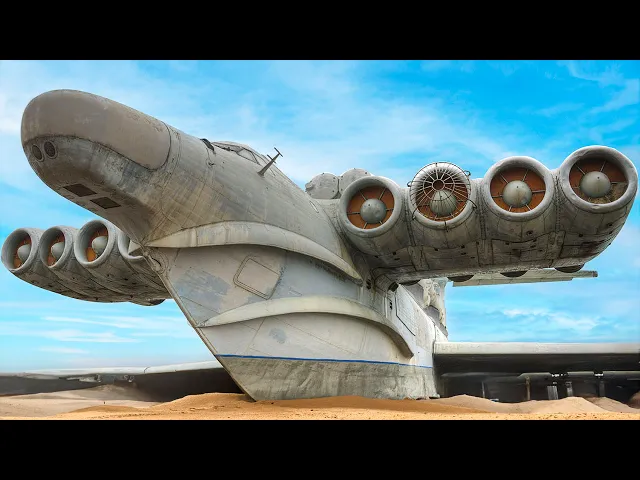
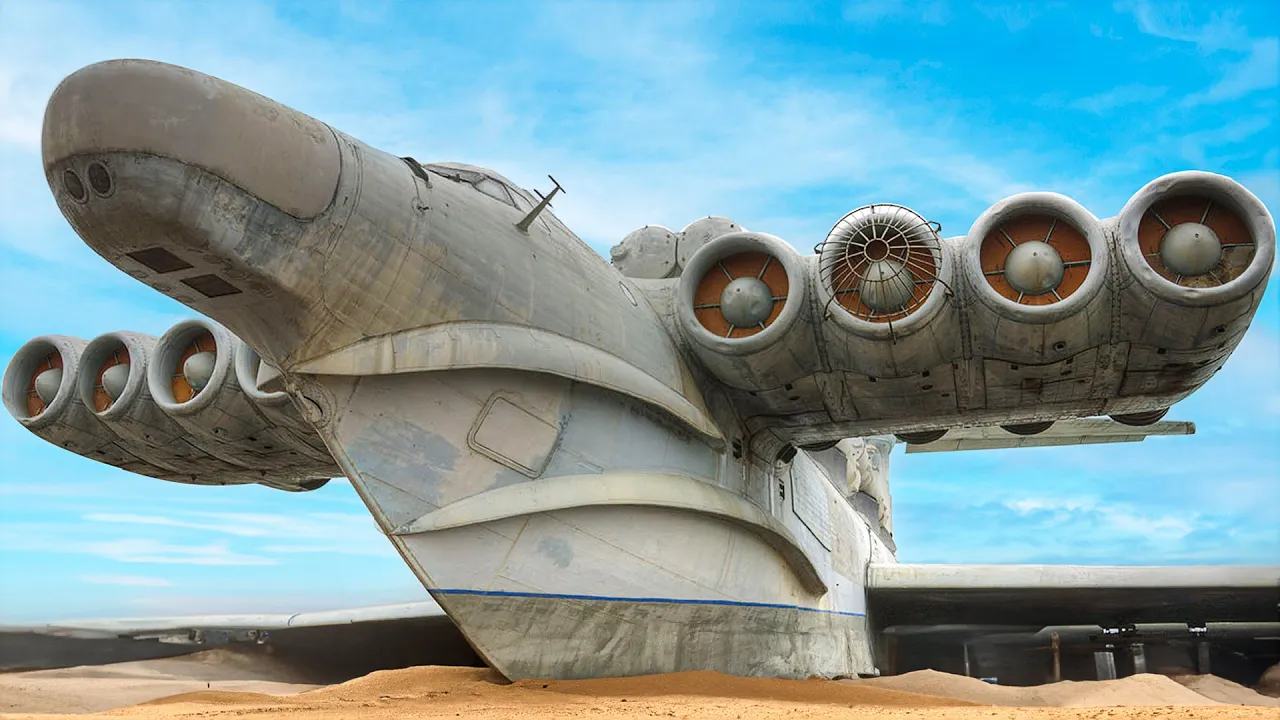
was more unique looking than this MD 160 Lun class acran plan which was discovered beached by the shores of the Caspian Sea just over 3 years ago this boat aircraft hybrid was developed during the Cold War and it really was a F feet of Soviet engineering which terrified the West the arrena plan weighed in at an impressive 286,000 kg had a wingspan of 123 ft and a length of 310 ft so it was nearly close to the size of three blue whales the largest animal ever known to have lived in addition this Beast could reach
a top speed of 340 mph but what is an arran plan and what makes them so unique that even decades on people are still talking about them acrop plans are a boat plane hybrid that fly just above the surface of the water they take advantage of a phenomenon called ground effect which occurs when a vehicle flies at very low altitude creating a cushion of air between its wings and the surface this cushion allows the vehicle to achieve higher speeds with greater efficiency than traditional aircraft ships err plans were primarily developed by the Soviet Union during
the Cold War for military purposes and they are capable of moving at high speeds over water while staying low enough to evade radar detection making them useful for stealth missions this Lun class arran plan in particular was based on the experimental km acran plan which was thought to be the largest aircraft in the world when it was built in 1966 stories of this bowl creation later dubbed the Caspian Sea Monster spread through Western intelligence circles with many dismissing it as mere propaganda or an overblown rumor it first served with the Soviet navy and later after
the Soviet Union's collapse in 1991 with the Russian Navy however the Lun had some major limitations to take advantage of ground effect it had to stay super close to the water only about 5 to 10 ft or 1 and 1/2 to 3 m above the surface so this meant that it couldn't handle rough Seas it also couldn't fly any higher meaning it was stuck to calm Waters which severely limited where it could be deployed this acran plan the Lun class was the only ACR plan ever fully completed of this massive scale It joined the Soviet
Navy's Caspian flotilla in 1987 and then it was retired in the late 1990s it then was stored in a naval base deep inside Russia until July 31st 2020 this is when it was towed out to sea destined for public display in Durban dagistan the tearing operation involved rubber pontoons three tugboats and two escort vessels covering roughly 100 km or 62 Mi however the acrop plan got stuck just offshore on a Sandy Beach falling short of its intended destination and that is where it remains beached until this day and it is still known by the name
the castle I sea monster and only extreme tourists dare to visit its Shores and although this acrop plan might be retired it appears the concept is having a bit of a Revival developers in Russia China and the United States are working on new modern iterations of ground effect vehicles for passengers and cargo Transportation one example being the airfish 8 a modern arran plan designed by Singapore based company widget works for efficient short range water-based travel utilizing ground effect technology the airfish 8 can carry up to eight passengers and travel at speeds much higher than traditional
boats also the US are developing their own type of aop plan such as the Regent sea glider this combines ground effect flight with hydrofoil technology creating a high-speed vehicle designed to operate along Coastal routes intended to link major coastal cities so even though the Lun class acran plan Now lies retired by the Caspian Sea its Legacy is far from over this colossal creation remains a true Masterpiece of Soviet engineering with its influence still inspiring Vehicles well into the 21st century now another Soviet creation which looked like something out of a sci-fi movie is of course
the project EIP an aircraft that looked exactly like a UFO the EIP which means e techology and progress was created by engineer Lev nikovic shulin in 1979 just like the ARR plan this was an allterrain aircraft which could take off from land and water the environmentally friendly and very much Forward Thinking aspect of the EIP was the fact that it had the capabilities to not only run on jet fuel but also hydrogen and natural gas the development of this unique looking aircraft was totally shrouded in mystery during the 1980s and it suffered a series of
technical failings as it almost famously crashed into the snow while flying the Craft's breakthrough only really happened after the collapse of the Soviet Union by 1993 up to 600 people worked on this project and it was even shown at air shows in Moscow and Paris but the success of the project was short-lived despite there being multiple foreign investors interested only one materialized US senator Kurt welen who helped secure an agreement with the US Naval Air systems command nav a to produce a 230 kg AIP prototype with testing plann for 2007 however by 2005 nav pulled
out for unknown reasons and the project finally crumbled and this futuristic creature was left to rust leaving behind the Legacy that UFOs do exist and they were created in the Soviet Union another unique looking Soviet era vehicle which was cloaked in secrecy is the zil 2906 a screw propelled amphibious vehicle built from 1975 to 1979 it's claimed to fame the ability to navigate the harshest terrains from snow to swamps and the aim of this unique looking vehicle to retrieve Russian cosmonauts from harsh terrains like Siberia weighing in at 2000 kg which is about the same
as a white rhinoceros the zil 2906 could hit speed of 45 km an hour on snow and 20 km an hour in swamps only a handful of people knew of this vehicle's existence and today fewer than five examples remain but there have been modern iterations such as the residue Solutions mud Master which is making mine tailings Dam safer in Australia so although the Iron Curtain has fallen the legacy of screw propelled Vehicles still lives on today another vehicle that was built to withstand the tough terrains of Siberia was the SE 2 Aeros sled a yak
12 airplane engine was mounted onto a Gaz M20 sedan and then Teflon coed skis were added to create this unique looking car and snowmobile hybrid the task of this vehicle was solely to deliver the post to snowy isolated regions of Siberia and it made light of frozen rivers Gliding Over them but with limited space for delivering Parcels it was quickly replaced with the reliable and spacious ka30 which remained in service until the 1990s now even 70 years on the SE 2 remains a fascinating example of a creative solution designed to navigate siberia's harsh snow covered
landscape now bullet trains today are nothing new the shinkansen trains in Japan can reach speeds of up to 320 kmph on some lines and China's Shanghai maglev can reach speeds of 43 31 [Applause] kmph but at the peak of the Cold War speeds like this were really inconceivable in the 1960s during the height of the Cold War the Soviet Union was exploring its own High-Speed Rail Innovation with the development of the Speedy wagon laboratory a concept aimed at competing with similar projects in the west at the same time across the Atlantic the United States was
conducting its own highspeed rail tests such as the m497 black beetle project by New York Central Railway which reached speeds of 296 kmph in 1966 with Russia's Speedy wagon laboratory multiple AI 25 jet engines originally designed for the advanced Yak 40 aircraft were mounted on the roof of the train car the super fast train unveiled in October 1970 reached speeds of 200 kmph but despite its remarkable performance the Speedy wagon laboratory never entered mass production and was ultimately abandoned because it was riddled with issues such as stability concerns which isn't too surprising this Beast was
left rusting in some Petersburg until 2008 when T Works a railroad company decided to pop the Speedy Wagon on a plint at their headquarters that is where it remains even today an iconic relic of the past another former Soviet Masterpiece is the bartini berer vva 14 vva 14 is an acronym for vertical takeoff amphibious aircraft and 14 was the number of engines that were on this Beast designed 50 years ago by Visionary engineer Robert bartini this aircraft was aimed to be the most versatile fly machine ever built capable of vertical takeoff hovering and efficient cruising
using ground effect similar to the Acra plans which were being developed during that time the first bartini barrier vva 14 prototype was completed in 1972 in response to the perceived need by the Russians to neutralize United States Navy Polaris missile submarines the vva 14 itself was massive it had a length of 25.97 M M and its wingspan alone was 30 m that's the same as a 10-story building it was also super fast and allegedly could reach a maximum speed of 760 kmph and a cruise speed of 640 kmph with a range of 2,450 km this
means that this craft could in theory reach the US from Russia in around 5 to 6 and 1/2 hours something which terrifed ified the Americans the first prototype flew in 1972 primarily for testing horizontal flight completing 107 flights by 1975 however rather like the acro plans and the other Soviet Vehicles which were being developed at the time the vva 14 was full of problems the lengthy development process meant that by the time the first prototype flew technological advancements in other military aircraft had already progressed and the vva behind after bartini's death attempts to revive the
vva 14 as an Acra plan also failed and the Prototype was moved to a museum where it remains today damaged and incomplete missing critical components with alleged restoration costs of $1.2 million the Caspian Sea Monster project EIP the zil 2906 the se2 Aeros sled the Speedy wagon Laboratory and the bartini barrier vva 14 once wild visions of Soviet Innovation now stand as relics of the past these machines had the potential to change everything but in the end they never quite made it today they sit Frozen in Time reminders of Soviet Ingenuity and ambition behind weird
and wonderful designs that despite their promise never truly materialized [Music]