Stop walking. I know that sounds extreme, but if you are over 65 and walking is your only form of exercise, you may be accelerating muscle loss instead of preventing it. I say this not as a theory, but from experience.
As a surgeon with over 25 years of working directly with older adults, I have treated thousands of patients and I keep seeing the same pattern again and again. People tell me they walk every single day. They feel active.
They feel like they are doing the right thing, but then the truth comes out. They cannot stand up from a chair without pushing off with their hands. They feel unsteady in the bathroom.
Some have already had a fall. Others quietly stop traveling because they no longer trust their balance. So, what is actually happening here?
Walking is not the problem. The problem is that walking is a low-resistance activity. It is excellent for your heart.
It supports your brain. It keeps you moving, but after the age of 65, your muscles have already adapted to it. They are no longer getting the signal they need and day by day, those muscles begin to wither away.
This is not just weakness. This is your body quietly failing you at the exact moment you need it most. When you lose your balance, when you try to catch yourself, and when you try to stand up and your body does not respond the way it used to, and as that strength disappears, your stability goes with it.
Suddenly, something as simple as getting up in the middle of the night to use the bathroom becomes a dangerous gamble. This is not about doing more. It is about doing what actually works.
Stay with me because the next three movements can rebuild strength faster than you think. And before we go on, comment below with your name and where you are watching from. I read every message and I want to know who is taking this step to get stronger today.
The solution is not to walk more. More miles will not fix this. More steps will not bring your strength back.
What your body needs now is a stronger signal. A targeted signal. The kind of stimulus your muscles actually respond to after the age of 65.
That is why you need three specific surgeon-approved movements. Not random exercises. Not long workouts.
Just three precise movements that directly rebuild strength, stability, and control. And here is the part most people get wrong. This does not take hours.
You do not need a gym. You do not need equipment. This can be done at home in less than 10 minutes a day.
That is all it takes to start reversing what has been quietly declining for years. Let's start with the first movement. Sit-to-stand, also known as the chair squat.
This is not just an exercise. This is the movement that determines whether you stay independent or slowly lose control of your daily life. Find a sturdy chair that will not slide.
Stand directly in front of it with your feet about shoulder width apart and your toes pointing straight ahead. From here, push your hips back slowly like you are about to sit down. Lower your body with full control.
Do not drop. Do not rush. When you feel the chair lightly touch the back of your legs, stop.
Do not sit down. That is where most people lose the benefit. Now, drive through your heels and stand back up.
At the top, squeeze your glutes and fully extend your hips. That final contraction is critical. That is what tells your body to rebuild strength.
Keep your chest upright the entire time. Do not let it collapse forward. Your knees should track forward in line with your toes, not falling inward.
Every repetition should be slow, controlled, and deliberate. Start with five repetitions three times per week. It may feel harder than you expect.
That is a good sign. That means your muscles are finally being challenged again. This single movement directly trains one of the most important actions in daily life.
Standing up from a chair. It strengthens your legs where it matters. It improves the communication between your brain and your muscles.
And research has shown that this kind of functional strength training can reduce the risk of falling by up to 50%. Think about that for a moment. One simple movement done consistently can cut your fall risk in half.
This is not about exercise. This is about protecting your independence. Now, let's move to the second movement, the wall push-up.
This is where most people over 65 are dangerously weak and do not even realize it. They focus on walking, but they completely ignore upper body strength. And that becomes a serious problem the moment they need to push, lift, or catch themselves.
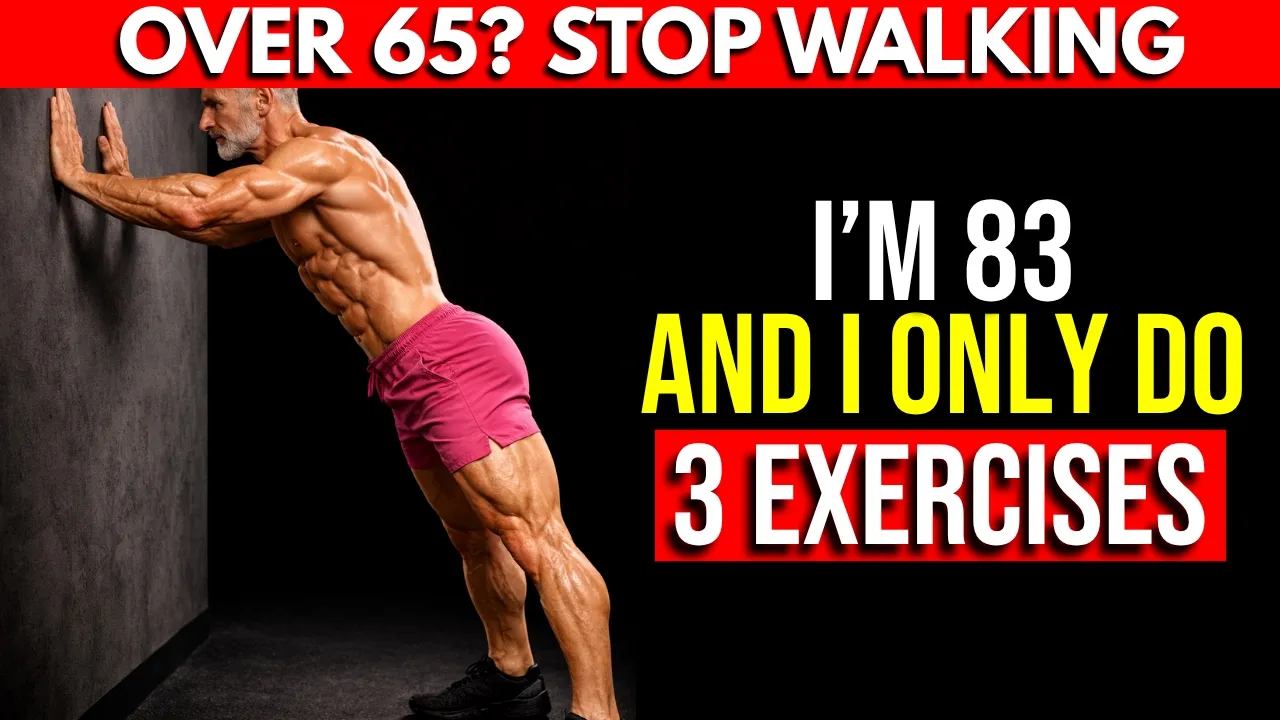
Stand facing a wall about an arm's length away. Place your hands flat against the wall at shoulder height, slightly wider than your shoulders. From here, bend your elbows slowly and bring your chest toward the wall.
Take about 2 seconds on the way down. Control the movement. Do not collapse.
Keep your elbows at about a 45° angle. Do not let them flare out to the sides. Your body should stay in one straight line from head to heel.
No bending at the hips. No sagging. No shortcuts.
Once your chest gets close to the wall, press firmly through your hands and push yourself back to the starting position. That push is where the strength is built. Aim for 8 to 10 repetitions.
If it feels easy, slow it down. Control is what activates the muscle, not speed. This movement strengthens your chest, your shoulders, and the back of your arms.
These are the exact muscles you rely on every single day to push yourself out of bed. To get up from a chair using your hands. To carry groceries.
And most importantly, to catch yourself if you start to fall. This is what most people never think about. When you lose your balance, your legs may fail you.
But your arms are your last line of defense. And if they are not strong enough, a simple loss of balance can turn into a serious injury in a fraction of a second. Your arms may be the only thing stopping a fall from becoming an injury.
Now, the third and final movement. This is where everything comes together. Strength alone is not enough if your body cannot coordinate and react in time.
This movement trains balance, coordination, and core stability all at once. It is called the standing march with arm swing. Stand tall.
If you need support, lightly hold the back of a sturdy chair. From here, lift your right knee up toward hip height while swinging your left arm forward just like a natural walking motion. Move slowly.
Stay in control. Then lower and switch sides. Left knee up, right arm forward.
Do not rush this. Speed is not the goal. Control is what matters.
Keep your posture upright. Do not lean back. Do not wobble.
Focus on the coordination between your arms and your legs. This is where your brain and your body reconnect. Continue this movement for 30 seconds, then rest.
Repeat for two to three rounds. It may look simple, but this is one of the most powerful drills you can do for real-world stability because this is exactly how your body needs to respond in everyday life. When you trip, when you misstep, when something unexpected happens, your body has to react instantly with coordination and control.
This movement activates your core, sharpens your balance, and strengthens the connection between your brain and your muscles. And that connection is what keeps you upright. This is how your body learns to react before a fall happens.
Now, here is how you put all of this together in a way that actually works. You do not need a complicated schedule. You do not need to do this every single day.
In fact, your body responds better when you give it time to recover and adapt. Start with three sessions per week. That is it.
Three days. Each session takes less than 10 minutes. You begin with the sit-to-stand for five controlled repetitions.
Then move to the wall push-up for eight to 10 repetitions. Then finish with the standing march with arm swing for 30 seconds. Rest briefly and repeat if you can.
Consistency matters more than intensity. Doing this three times a week, every week, sends a clear signal to your muscles. That signal is what tells your body to rebuild strength instead of continuing to lose it.
And I want to give you a simple challenge. For the next 14 days, commit to this routine. Just 14 days.
No skipping. No excuses. At the end of those 2 weeks, test yourself.
Stand up from a chair and notice how it feels. Pay attention to your balance when you walk. Notice how stable you feel when you turn or change direction.
Most people are shocked by what changes in such a short time. Because the body is not broken. It has just been under-trained.
You are not trying to become an athlete. You are rebuilding the strength that keeps you independent. And that starts with showing up three times a week for the next 14 days.
And as you take on this 14-day challenge, I want you to make a simple commitment. Go down to the comments right now and write, "I'm in for 14 days. " along with your name and where you are watching from.
This is not just a comment. This is a decision. When you put it in writing, you are far more likely to follow through.
I will be reading those messages and more importantly, you will start seeing other people your age stepping up, taking action, and rebuilding their strength. You are not doing this alone and today is the day you start. Now, step back for a moment and look at what you have just learned.
This is not about walking more. More steps will not fix what your body is losing. What your body needs is a stronger, smarter signal.
The kind of stimulus your muscles actually respond to after the age of 65. And that is exactly what you now have. Three simple movements.
No equipment. No gym. No long workouts.
Just a few minutes a few times a week focused on what actually works. This is how you rebuild strength. This is how you restore stability.
This is how you protect your independence. So, I want you to do something right now. Wherever you are, stand up and do one Sit to stand.
Just one. Feel your legs engage. Feel your body respond.
That feeling is your body waking up again. If this helped you, go down to the comments and write, "I'm starting today. " I read every message and I want to see who is taking this seriously.
Hit the like button so more people your age can find this before it is too late. Subscribe to the channel because next week I am going to show you the number one protein mistake that is quietly destroying muscle after 65. And share this video with someone you care about.
A parent, a friend, a neighbor. Because the truth is, most people think getting weaker is just part of aging. It is not.
Strength is not about your age. It is about what you choose to do today.