There is a question that serious historians do not ask. Not because they have answered it, not because the evidence is too thin to pursue, but because the evidence is exactly thick enough to be dangerous. You have heard the name Tartaria.
You have seen it on the old maps written in careful ink across territories so vast they swallow modern nations whole, stretching from the eastern edges of Europe, across the breadth of Asia, into lands that no living cgrapher has ever walked. A name that appears in hundreds of European records, encyclopedias, diplomatic correspondences, trade documents, and then with a quietness that feels almost deliberate, disappears. But this video is not about the maps.
This video is about what grew there, what was taken, and most importantly, who had both the reach and the reason to take it. If you're new here, welcome to the channel where we dive into history and uncover what has been lost to time. If content like this interests you, hit that subscribe button and turn on notifications.
Now, let's get into the video. If you go back far enough into the oldest surviving illustrations of the Tartarian lands, the ones produced before the great reorganization of historical memory that swept through the 18th and 19th centuries, you will notice something that no one in your education ever pointed you toward. Not the architecture, though the architecture deserves its own conversation.
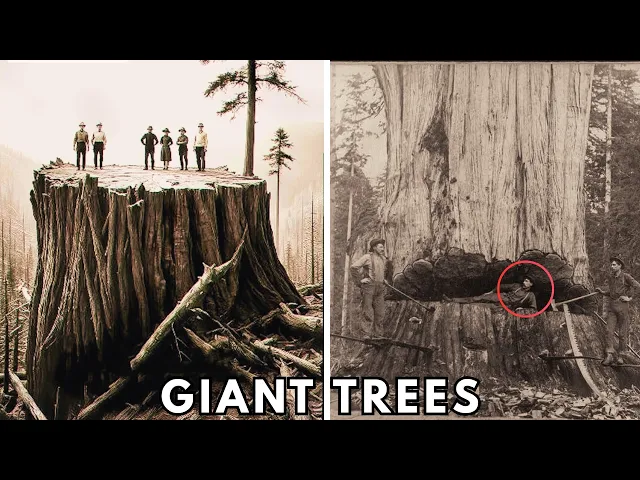
Not the cities, not the roads, not the peoples described in precise Latin annotations along the margins of the page. You will notice the trees. They rise behind every city, every river crossing, every caravan route in these illustrations, not as decorative background flourishes, not as artistic padding in the margins of a composition, but as central features of the landscape drawn with the same careful proportional attention given to everything else in the image.
The horses are horse-sized. The men are man-sized. The buildings are building sized.
And the trees are the size of mountains. Now, before that registers as medieval artistic incompetence or simple exaggeration, hold on, because the same proportions appear across sources that had no connection to one another. Dutch map makers who never met Persian scholars, who never met Chinese chronicers, who never met Russian expedition writers.
across languages, across centuries, across entirely separate ctographic traditions that had no reason to coordinate a shared fiction. The same image repeats with a consistency that deserves serious attention. Forests of living towers, canopies measured not in feet, but in acres, root systems that reshaped the geography around them.
Something was there, and then it was not. And the transition between those two states is where this story truly begins. The geological record gives us a starting point that mainstream science is entirely comfortable with up to a certain point.
The Carboniferous period roughly 300 million years ago produced forests of organisms so large that the word tree barely covers them. Lyopsid trees reaching 30 m. Horsetail species thicker than modern trucks.
A biological world operating at a scale that the earth today simply does not sustain. The standard explanation is that conditions changed. Atmospheric composition shifted.
Oxygen levels dropped. The biological niches that supported megaplora collapsed and the giants passed into the fossil record. That explanation satisfies most people because it places the giants safely in the deep past.
ancient, irrelevant, disconnected from anything that might threaten the coherence of recorded history. But here is the problem. The records we are discussing are not 300 million years old.
The illustrations with their mountainsized trees, the travel accounts describing forests where direct sunlight never reached the ground. The indigenous oral traditions speaking of organisms so integrated with the land that they functioned as a planetary nervous system. These are not fossils.
These are documents produced within the last thousand years, some within the last 500, some within living memory of people whose grandchildren wrote the records we still have. The megaplora of Tartaria, if the evidence is taken seriously, was not a relic of a prehistoric world. It was alive.
It was recent. And that changes everything. The diaries of European travelers who crossed into the Tartarian interior in the 16th and 17th centuries share a quality that you do not find in ordinary travel writing.
They reach for language and find it insufficient. One German expedition writer describes riding for 3 days beneath a continuous canopy and never once seeing the sky, the light arriving instead through the leaves in long, slow columns, thick with moisture, warm with an organic heat, that he compared to the interior of a cathedral, though he noted immediately that no cathedral he had ever entered felt alive the way this did. He did not write that the trees were large.
He wrote that the trees were the world. A French diplomat crossing the same territories a generation later describes trees whose trunks required 20 men standing with arms outstretched to encircle and notes almost as an aside that these were not the largest specimens. These were the younger ones, the ones at the edge of the deep forest, the ones the locals treated as almost incidental.
An English merchant who joined a trade expedition into the interior of what the maps labeled as greater tartery writes about the sound the forests made at night. A low resonance in the ground, felt through the body rather than heard through the ears, [music] as if the earth itself were breathing. These writers were not poets.
They were merchants and diplomats and soldiers, men whose professional survival depended on accurate observation and clear reporting. When they struggle for language, it is not because they are being dramatic. It is because what they encountered genuinely exceeded the categories available to them.
Now, let us talk about what the people who actually lived within these forests understood about them. Because this is where the story becomes something far more remarkable than a record of large trees. The indigenous peoples of the Tartarian territories, [music] the communities whose oral traditions survived at least partially through the great disruptions of the 18th and 19th centuries, do not describe the forests the way the European travelers did.
The Europeans reached for scale. They counted trunk widths and canopy acres and days of travel beneath continuous cover. The indigenous accounts describe something different in kind, not just degree.
They describe the forests as a single living system, not a collection of large trees growing in proximity, but an integrated organism of continental scale. One whose components, the individual trees communicated through the ground itself, responded collectively to damage, maintained the moisture and temperature and soil conditions of entire regions through a biological cooperation so complex and so ancient that it operated more like a mind than like a forest. They say the great trees knew when they were being harmed, not in the metaphorical sense that gets dismissed as animism or naive personification.
in a functional systemic sense. When one of the elders was cut, the surrounding forest responded. The air changed.
Animals moved differently. The ground vibrated at a frequency that could be felt for miles in every direction, as if information about the damage was being transmitted outward through the root network. And here is the thing, modern science has caught up to part of this.
We know now that forests communicate through underground microisal fungal networks. We know that trees release chemical signals when damaged that neighboring trees respond to by increasing their own defenses. We know that old growth forests function as integrated biological systems in ways that young or fragmented forests simply do not.
But the indigenous accounts of the Tartarian forests describe a level of integration that goes beyond anything science has documented in surviving forests. They describe organisms so old and so large that their root systems have had millennia rather than centuries to weave together, creating a network so deep and so extensive that it connected not just tree to tree but forest to water table, water table to river system, river system to regional climate. Remove enough of those connections and you do not clear a forest.
You sever a planetary system. And before we go any further, if you are finding this video valuable, if these questions are opening something up for you that history class never did, please subscribe to the channel. There are thousands of people watching right now who found this place the same way you did because something in the official story never quite sat right.
Subscribe. Leave a comment below telling us what you think happened. And let's keep building this community together.
Because what comes next is the part that the official record has never been able to satisfactorily explain. The environmental collapse that follows the disappearance of the great Tartarian forests in the historical record is not gradual. It does not unfold over the slow centuries that ordinary deforestation would require.
It is sudden and it is severe and it happens in a way that mirrors almost precisely what the indigenous traditions said would happen if the elders were cut. Rivers that appeared in earlier travel accounts as wide, navigable, and reliable become erratic within decades. Springs documented by 17th century expedition writers as permanent features of the landscape simply vanish from 18th century records.
Climates described by traders and diplomats as mild and agriculturally productive become harsh, unpredictable, and hostile to settlement. Soils that sustain dense and organized populations for generations become thin, dry, and unreliable. The land without the giants becomes a different land entirely.
Not deforested in the way that deforested land normally looks. not simply cleared and exposed but fundamentally altered as if the biological infrastructure that maintained its character has been removed at the root level. The indigenous people warned that this would happen.
Their warnings appear in older records translated imperfectly by scribes who did not understand the ecological framework behind what they were hearing. Fragmented by the same archival disruptions that erase so much else from this period. But the core of the warning survives.
Cut the elders and the land forgets what it was. That is not a metaphor. That is a systems description.
And the environmental data from the region in the centuries following the disappearance of the great forests matches that description with a precision that should be far more troubling to mainstream historians than it currently is. So who cut them down? This is where we have to be careful because the honest answer is that we do not have a named organization, a signed mandate, a board of directors for the destruction of the Tartarian megaplora.
What we have is a pattern. And patterns when they are consistent enough across enough independent sources, across enough time and geography, become something that demands explanation. The logging operations described in scattered accounts from the Tartarian territories do not resemble any commercial timber operation on record from the same period.
They share a set of characteristics that appear again and again regardless of which region or which century the account comes from. First, they targeted the oldest trees first. Not the young growth, not the accessible edge timber that any rational commercial operation would begin with, but the deepest, oldest, largest specimens, the ones that would have required the most extraordinary effort to reach and to fell.
Second, they left no commercial trace, no ledgers, no company records, no destination manifests for the timber supposedly harvested. Legitimate commercial ventures in this period generated extensive paper trails because they had investors to answer to, governments to pay duties to, buyers who needed documentation. These operations generated nothing of that kind.
Third, and this is the detail that stays with you, the stumps were destroyed. Not left as remnants, not repurposed as foundations or landmarks, but burned or buried with a thoroughess that goes far beyond any ordinary land clearance practice. A stump of extraordinary size is not an obstacle.
It does not impede farming. It does not block a road. Left standing, it becomes a landmark, a curiosity, a monument that attracts travelers and generates stories and keeps alive in the living landscape a memory of what once stood there.
Burning a stump is not practical. Burning a stump of this scale is extraordinary labor intensive. The only reason to do it is to remove the evidence.
Now we have to ask what kind of authority could organize an operation of this scale? Because the geographical scope of what the records describe is not a regional clearance. It spans thousands of miles.
It operates across territories controlled by different powers, different administrative systems, different languages, and different legal frameworks. It sustains itself over not years but decades, maintaining consistent priorities and consistent methods across distances that would challenge any modern logistics network. Some researchers working at the intersection of alternative history and institutional analysis have pointed toward the major reorganizing powers of the 18th century as the most likely candidates.
The period between roughly 1700 and 1800 was one of the most intensive episodes of imperial expansion, administrative centralization, and deliberate cultural eraser in recorded history. Empires were not simply conquering territory in this period. They were reorganizing it.
Replacing local administrative systems with centralized ones. Replacing local histories with official ones. Replacing local knowledge systems with approved scientific frameworks.
The great encyclopedic projects of the 18th century, the ones that gave us the intellectual architecture of the modern world, were not neutral compilations of existing knowledge. They were editorial projects, decisions about what counted as knowledge, what counted as history, what counted as real. A forest of trees whose scale contradicted the emerging scientific consensus about what plant life was capable of would have been an extremely inconvenient thing to have standing in the landscape.
Not simply because it was evidence of a different world, but because it was evidence that the new frameworks being built to explain the world were inadequate, that the categories being established for what was possible and what was not were wrong in ways that the trees made impossible to ignore. The giants were not just trees. They were a standing reputation of a worldview that was in the process of being installed as the only legitimate one.
There is a detail in certain Central Asian historical surveys from the 19th century that does not receive the attention it deserves. Geological assessments of regions that were described as heavily forested in 17th century records consistently note an anomaly in the soil composition. Layers of organic material at depths that do not correspond to the surface level vegetation.
carbon signatures in the earth that suggest biological activity on a scale far beyond what the landscape at the time of survey would have produced. In plain language, the ground in these regions remembers forests that the surface no longer shows. This is not interpreted in any revolutionary way by the geologists who note it.
It is recorded as a curiosity attributed to climate variation or localized flooding events and passed over but taken in the context of everything else we have discussed. The travel accounts, the indigenous oral traditions, the sudden environmental collapse, the anomalous logging operations with their systematic destruction of stumps and their absence of commercial records. It becomes something more than a curiosity.
It becomes a signature, the physical record of something vast that stood here and was removed. Consider also what happens to the people because the removal of the great forests, if it happened at the scale the evidence suggests, was not only an ecological event, it was a civilizational one. The communities that built their lives within and around these forests, that oriented their calendars, their architectures, their spiritual frameworks, their agricultural systems, their medical knowledge around organisms of this scale, did not simply adapt when the forests were gone.
They collapsed or they dispersed or they were absorbed into the administrative systems of the expanding empires that were reorganizing the region at precisely the same time. The Tartarian peoples whose names appear in the older records as distinct cultural and political entities with their own histories and geographies scatter from the historical record in the same window of time that the forests do. That convergence is not proof of a connection.
But it is the kind of coincidence that a serious historian should find demanding. The land was cleared, the people were cleared, the records were cleared, and what remained was a landscape that the new maps could describe without anomaly, populated by peoples that the new histories could accommodate without contradiction, governed by rules that the new sciences could endorse without discomfort. A world made legible by the removal of everything that made it strange.
The deepest question here is not whether the giants existed. The evidence that something extraordinary grew in these territories is more coherent and more consistent across more independent sources than most events that mainstream history treats as settled. Fact.
The deepest question is what it means that we are only now centuries after their removal beginning to ask seriously whether they were real. What kind of process produces that gap? What kind of institutional gravity keeps a question this significant at the fringes?
Keeps the evidence unassembled, keeps the researchers who pursue it marginalized, keeps the subject out of curricular and textbooks and funded research programs. It is not a conspiracy in the dramatic sense of a single coordinated plan. It is something more mundane and more durable than that.
It is the accumulated weight of a worldview that decided somewhere in the 18th century what kind of world the past was allowed to have been and has been defending that decision ever since. Not with violence mostly, though there are places in this history where violence was not absent, but with something more effective than violence, with the quiet institutional management of what counts as a serious question and what does not, with the placement of curious minds into careers that depend on not pursuing certain lines of evidence too far. with the design of educational systems that produce people who know a great deal but have never been invited to ask whether the frame that organizes what they know is the right one.
The giants of Tartaria were real, not as myth, not as metaphor, not as the artistic exaggeration of preodern cgraphers who did not understand proportion. as organisms, as features of a planetary ecology that operated at a scale our current frameworks cannot accommodate and have not tried particularly hard to explain. They were removed.
By whom in their entirety we cannot say with certainty. But the pattern of their removal, its scale, its systematic thoroughess, [music] its archival dimension, its convergence with the broader reorganization of Tartarian history and Tartarian peoples in the same period points towards something more deliberate than simple land clearance. And we do not know this happened.
Not because the evidence is hidden. The evidence is in the old maps, in the margins of journals that have never been digitized, in the oral traditions of peoples whose histories were deemed too local to preserve. In the anomalous soil compositions of regions that remember forests, the surface is forgotten.
The evidence is not hidden. It is simply not assembled. It is simply not pursued.
It is simply not considered by the institutions that govern what we collectively remember about this world to be worth the asking. But the roots are still there beneath the sediment and the centuries and the carefully managed silence connected across distances that no surface map shows. Holding in the biology of the earth a record that no archive has fully erased.
What grew here was real. What was done to it was deliberate. And the question of who gave the order is one that this world has not yet seriously tried to answer.
That changes now. There is a question that serious historians do not ask. Not because they have answered it, not because the evidence is too thin to pursue, but because the evidence is exactly thick enough to be dangerous.
You have heard the name Tartaria. You have seen it on the old maps written in careful ink across territories so vast they swallow modern nations whole, stretching from the eastern edges of Europe, across the breadth of Asia, into lands that no living cgrapher has ever walked. A name that appears in hundreds of European records, encyclopedias, diplomatic correspondences, trade documents, and then with a quietness that feels almost deliberate, disappears.
But this video is not about the maps. This video is about what grew there, what was taken, and most importantly, who had both the reach and the reason to take it. If you're new here, welcome to the channel where we dive into history and uncover what has been lost to time.
If content like this interests you, hit that subscribe button and turn on notifications. Now, let's get into the video. If you go back far enough into the oldest surviving illustrations of the Tartarian lands, the ones produced before the great reorganization of historical memory that swept through the 18th and 19th centuries, you will notice something that no one in your education ever pointed you toward.
Not the architecture, though the architecture deserves its own conversation. Not the cities, not the roads, not the peoples described in precise Latin annotations along the margins of the page. You will notice the trees.
They rise behind every city, every river crossing, every caravan route in these illustrations, not as decorative background flourishes, not as artistic padding in the margins of a composition, but as central features of the landscape drawn with the same careful proportional attention given to everything else in the image. The horses are horse-sized. The men are man-sized.
The buildings are building sized. And the trees are the size of mountains. Now, before that registers as medieval artistic incompetence or simple exaggeration, hold on, because the same proportions appear across sources that had no connection to one another.
Dutch map makers who never met Persian scholars, who never met Chinese chronicers, who never met Russian expedition writers. across languages, across centuries, across entirely separate ctographic traditions that had no reason to coordinate a shared fiction. The same image repeats with a consistency that deserves serious attention.
Forests of living towers, canopies measured not in feet, but in acres, root systems that reshaped the geography around them. Something was there, and then it was not. And the transition between those two states is where this story truly begins.
The geological record gives us a starting point that mainstream science is entirely comfortable with up to a certain point. The Carboniferous period roughly 300 million years ago produced forests of organisms so large that the word tree barely covers them. Lyopsid trees reaching 30 m.
Horsetail species thicker than modern trucks. A biological world operating at a scale that the earth today simply does not sustain. The standard explanation is that conditions changed.
Atmospheric composition shifted. Oxygen levels dropped. The biological niches that supported megaplora collapsed and the giants passed into the fossil record.
That explanation satisfies most people because it places the giants safely in the deep past. ancient, irrelevant, disconnected from anything that might threaten the coherence of recorded history. But here is the problem.
The records we are discussing are not 300 million years old. The illustrations with their mountainsized trees, the travel accounts describing forests where direct sunlight never reached the ground. The indigenous oral traditions speaking of organisms so integrated with the land that they functioned as a planetary nervous system.
These are not fossils. These are documents produced within the last thousand years, some within the last 500, some within living memory of people whose grandchildren wrote the records we still have. The megaplora of Tartaria, if the evidence is taken seriously, was not a relic of a prehistoric world.
It was alive. It was recent. And that changes everything.
The diaries of European travelers who crossed into the Tartarian interior in the 16th and 17th centuries share a quality that you do not find in ordinary travel writing. They reach for language and find it insufficient. One German expedition writer describes riding for 3 days beneath a continuous canopy and never once seeing the sky, the light arriving instead through the leaves in long, slow columns, thick with moisture, warm with an organic heat, that he compared to the interior of a cathedral, though he noted immediately that no cathedral he had ever entered felt alive the way this did.
He did not write that the trees were large. He wrote that the trees were the world. A French diplomat crossing the same territories a generation later describes trees whose trunks required 20 men standing with arms outstretched to encircle and notes almost as an aside that these were not the largest specimens.
These were the younger ones, the ones at the edge of the deep forest, the ones the locals treated as almost incidental. An English merchant who joined a trade expedition into the interior of what the maps labeled as greater tartery writes about the sound the forests made at night. A low resonance in the ground, felt through the body rather than heard through the ears, [music] as if the earth itself were breathing.
These writers were not poets. They were merchants and diplomats and soldiers, men whose professional survival depended on accurate observation and clear reporting. When they struggle for language, it is not because they are being dramatic.
It is because what they encountered genuinely exceeded the categories available to them. Now, let us talk about what the people who actually lived within these forests understood about them. Because this is where the story becomes something far more remarkable than a record of large trees.
The indigenous peoples of the Tartarian territories, [music] the communities whose oral traditions survived at least partially through the great disruptions of the 18th and 19th centuries, do not describe the forests the way the European travelers did. The Europeans reached for scale. They counted trunk widths and canopy acres and days of travel beneath continuous cover.
The indigenous accounts describe something different in kind, not just degree. They describe the forests as a single living system, not a collection of large trees growing in proximity, but an integrated organism of continental scale. One whose components, the individual trees communicated through the ground itself, responded collectively to damage, maintained the moisture and temperature and soil conditions of entire regions through a biological cooperation so complex and so ancient that it operated more like a mind than like a forest.
They say the great trees knew when they were being harmed, not in the metaphorical sense that gets dismissed as animism or naive personification. in a functional systemic sense. When one of the elders was cut, the surrounding forest responded.
The air changed. Animals moved differently. The ground vibrated at a frequency that could be felt for miles in every direction, as if information about the damage was being transmitted outward through the root network.
And here is the thing, modern science has caught up to part of this. We know now that forests communicate through underground microisal fungal networks. We know that trees release chemical signals when damaged that neighboring trees respond to by increasing their own defenses.
We know that old growth forests function as integrated biological systems in ways that young or fragmented forests simply do not. But the indigenous accounts of the Tartarian forests describe a level of integration that goes beyond anything science has documented in surviving forests. They describe organisms so old and so large that their root systems have had millennia rather than centuries to weave together, creating a network so deep and so extensive that it connected not just tree to tree but forest to water table, water table to river system, river system to regional climate.
Remove enough of those connections and you do not clear a forest. You sever a planetary system. And before we go any further, if you are finding this video valuable, if these questions are opening something up for you that history class never did, please subscribe to the channel.
There are thousands of people watching right now who found this place the same way you did because something in the official story never quite sat right. Subscribe. Leave a comment below telling us what you think happened.
And let's keep building this community together. Because what comes next is the part that the official record has never been able to satisfactorily explain. The environmental collapse that follows the disappearance of the great Tartarian forests in the historical record is not gradual.
It does not unfold over the slow centuries that ordinary deforestation would require. It is sudden and it is severe and it happens in a way that mirrors almost precisely what the indigenous traditions said would happen if the elders were cut. Rivers that appeared in earlier travel accounts as wide, navigable, and reliable become erratic within decades.
Springs documented by 17th century expedition writers as permanent features of the landscape simply vanish from 18th century records. Climates described by traders and diplomats as mild and agriculturally productive become harsh, unpredictable, and hostile to settlement. Soils that sustain dense and organized populations for generations become thin, dry, and unreliable.
The land without the giants becomes a different land entirely. Not deforested in the way that deforested land normally looks. not simply cleared and exposed but fundamentally altered as if the biological infrastructure that maintained its character has been removed at the root level.
The indigenous people warned that this would happen. Their warnings appear in older records translated imperfectly by scribes who did not understand the ecological framework behind what they were hearing. Fragmented by the same archival disruptions that erase so much else from this period.
But the core of the warning survives. Cut the elders and the land forgets what it was. That is not a metaphor.
That is a systems description. And the environmental data from the region in the centuries following the disappearance of the great forests matches that description with a precision that should be far more troubling to mainstream historians than it currently is. So who cut them down?
This is where we have to be careful because the honest answer is that we do not have a named organization, a signed mandate, a board of directors for the destruction of the Tartarian megaplora. What we have is a pattern. And patterns when they are consistent enough across enough independent sources, across enough time and geography, become something that demands explanation.
The logging operations described in scattered accounts from the Tartarian territories do not resemble any commercial timber operation on record from the same period. They share a set of characteristics that appear again and again regardless of which region or which century the account comes from. First, they targeted the oldest trees first.
Not the young growth, not the accessible edge timber that any rational commercial operation would begin with, but the deepest, oldest, largest specimens, the ones that would have required the most extraordinary effort to reach and to fell. Second, they left no commercial trace, no ledgers, no company records, no destination manifests for the timber supposedly harvested. Legitimate commercial ventures in this period generated extensive paper trails because they had investors to answer to, governments to pay duties to, buyers who needed documentation.
These operations generated nothing of that kind. Third, and this is the detail that stays with you, the stumps were destroyed. Not left as remnants, not repurposed as foundations or landmarks, but burned or buried with a thoroughess that goes far beyond any ordinary land clearance practice.
A stump of extraordinary size is not an obstacle. It does not impede farming. It does not block a road.
Left standing, it becomes a landmark, a curiosity, a monument that attracts travelers and generates stories and keeps alive in the living landscape a memory of what once stood there. Burning a stump is not practical. Burning a stump of this scale is extraordinary labor intensive.
The only reason to do it is to remove the evidence. Now we have to ask what kind of authority could organize an operation of this scale? Because the geographical scope of what the records describe is not a regional clearance.
It spans thousands of miles. It operates across territories controlled by different powers, different administrative systems, different languages, and different legal frameworks. It sustains itself over not years but decades, maintaining consistent priorities and consistent methods across distances that would challenge any modern logistics network.
Some researchers working at the intersection of alternative history and institutional analysis have pointed toward the major reorganizing powers of the 18th century as the most likely candidates. The period between roughly 1700 and 1800 was one of the most intensive episodes of imperial expansion, administrative centralization, and deliberate cultural eraser in recorded history. Empires were not simply conquering territory in this period.
They were reorganizing it. Replacing local administrative systems with centralized ones. Replacing local histories with official ones.
Replacing local knowledge systems with approved scientific frameworks. The great encyclopedic projects of the 18th century, the ones that gave us the intellectual architecture of the modern world, were not neutral compilations of existing knowledge. They were editorial projects, decisions about what counted as knowledge, what counted as history, what counted as real.
A forest of trees whose scale contradicted the emerging scientific consensus about what plant life was capable of would have been an extremely inconvenient thing to have standing in the landscape. Not simply because it was evidence of a different world, but because it was evidence that the new frameworks being built to explain the world were inadequate, that the categories being established for what was possible and what was not were wrong in ways that the trees made impossible to ignore. The giants were not just trees.
They were a standing reputation of a worldview that was in the process of being installed as the only legitimate one. There is a detail in certain Central Asian historical surveys from the 19th century that does not receive the attention it deserves. Geological assessments of regions that were described as heavily forested in 17th century records consistently note an anomaly in the soil composition.
Layers of organic material at depths that do not correspond to the surface level vegetation. carbon signatures in the earth that suggest biological activity on a scale far beyond what the landscape at the time of survey would have produced. In plain language, the ground in these regions remembers forests that the surface no longer shows.
This is not interpreted in any revolutionary way by the geologists who note it. It is recorded as a curiosity attributed to climate variation or localized flooding events and passed over but taken in the context of everything else we have discussed. The travel accounts, the indigenous oral traditions, the sudden environmental collapse, the anomalous logging operations with their systematic destruction of stumps and their absence of commercial records.
It becomes something more than a curiosity. It becomes a signature, the physical record of something vast that stood here and was removed. Consider also what happens to the people because the removal of the great forests, if it happened at the scale the evidence suggests, was not only an ecological event, it was a civilizational one.
The communities that built their lives within and around these forests, that oriented their calendars, their architectures, their spiritual frameworks, their agricultural systems, their medical knowledge around organisms of this scale, did not simply adapt when the forests were gone. They collapsed or they dispersed or they were absorbed into the administrative systems of the expanding empires that were reorganizing the region at precisely the same time. The Tartarian peoples whose names appear in the older records as distinct cultural and political entities with their own histories and geographies scatter from the historical record in the same window of time that the forests do.
That convergence is not proof of a connection. But it is the kind of coincidence that a serious historian should find demanding. The land was cleared, the people were cleared, the records were cleared, and what remained was a landscape that the new maps could describe without anomaly, populated by peoples that the new histories could accommodate without contradiction, governed by rules that the new sciences could endorse without discomfort.
A world made legible by the removal of everything that made it strange. The deepest question here is not whether the giants existed. The evidence that something extraordinary grew in these territories is more coherent and more consistent across more independent sources than most events that mainstream history treats as settled.
Fact. The deepest question is what it means that we are only now centuries after their removal beginning to ask seriously whether they were real. What kind of process produces that gap?
What kind of institutional gravity keeps a question this significant at the fringes? Keeps the evidence unassembled, keeps the researchers who pursue it marginalized, keeps the subject out of curricular and textbooks and funded research programs. It is not a conspiracy in the dramatic sense of a single coordinated plan.
It is something more mundane and more durable than that. It is the accumulated weight of a worldview that decided somewhere in the 18th century what kind of world the past was allowed to have been and has been defending that decision ever since. Not with violence mostly, though there are places in this history where violence was not absent, but with something more effective than violence, with the quiet institutional management of what counts as a serious question and what does not, with the placement of curious minds into careers that depend on not pursuing certain lines of evidence too far.
with the design of educational systems that produce people who know a great deal but have never been invited to ask whether the frame that organizes what they know is the right one. The giants of Tartaria were real, not as myth, not as metaphor, not as the artistic exaggeration of preodern cgraphers who did not understand proportion. as organisms, as features of a planetary ecology that operated at a scale our current frameworks cannot accommodate and have not tried particularly hard to explain.
They were removed. By whom in their entirety we cannot say with certainty. But the pattern of their removal, its scale, its systematic thoroughess, [music] its archival dimension, its convergence with the broader reorganization of Tartarian history and Tartarian peoples in the same period points towards something more deliberate than simple land clearance.
And we do not know this happened. Not because the evidence is hidden. The evidence is in the old maps, in the margins of journals that have never been digitized, in the oral traditions of peoples whose histories were deemed too local to preserve.
In the anomalous soil compositions of regions that remember forests, the surface is forgotten. The evidence is not hidden. It is simply not assembled.
It is simply not pursued. It is simply not considered by the institutions that govern what we collectively remember about this world to be worth the asking. But the roots are still there beneath the sediment and the centuries and the carefully managed silence connected across distances that no surface map shows.
Holding in the biology of the earth a record that no archive has fully erased. What grew here was real. What was done to it was deliberate.
And the question of who gave the order is one that this world has not yet seriously tried to answer. That changes now.