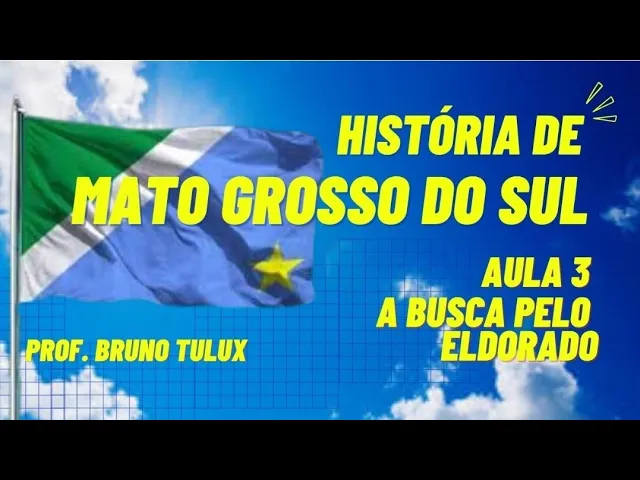
Hello everyone, how are you? I hope you are all well. This is our third lesson in the history of Mato Grosso do Sul course, and the theme of this lesson will be "In Search of the Dorado.
" I am Professor Bruno Tulux, a graduate in history from the Federal University of Mato Grosso do Sul and with a master's degree in history from the Federal University of Grande Dourados. So let's get to our lesson. Pencil and paper in hand, write down your questions, record every important moment of the lesson, and let's go, in search of approval.
After the arrival of Europeans in America, the old social, economic, political, and cultural structure of the continent was shaken. In the first decades after the discovery or arrival of Europeans, expeditions were carried out that explored, recognized, and created new strategies to exploit this territory within the mercantilist objective that was in effect at the time. As early as 1516, the Spanish navigator Juan Diaz Solis arrived at the estuary of the river that we now call the Rio de la Plata and discovered what we now call Marel Plata.
There, Juan Dia Solista encountered the Xrua Indians, who lived in what is now Uruguay, cutting silver objects. However, it was known that these Indians did not master the technique of metallurgy. Evidently, they had obtained these silver ornaments through trade with other peoples, and according to information from the Indians themselves, these were located in the interior of the continent.
This triggered the greed of the Portuguese and Spanish, who were exploring this territory and dreaming of finding mineral riches of gold and silver in this newly discovered continent. It is interesting to note that some place names that emerged during this period refer to these precious metals, such as Mar de Plata (Silver Sea), Rio de la Plata (River of the Plate), and Argentina. All of them refer to silver, but it is known that this metal was not abundant in that region.
But the connection between the native peoples of America could boost the discovery of these minerals, fueling the Europeans ' dream of wealth. This fact, in addition to increasing European greed for the metal, also gave rise to the myth of the silver or golden mountain range that existed in the interior of the continent. However, before returning to Europe with this news, Juan Dia Solis was killed by these same Indians, which caused the rest of the crew who were in Mar de Plata to try to return to Europe to give this news to the Iberian kings.
The 18 survivors of the attack against Juan Dia Solis ended up trying to return to Europe. However, at the beginning of the voyage, near Santa Catarina, these explorers suffered another accident. On this occasion, the survivors were welcomed by the Guarani Carijó Indians.
These Indians coincidentally also carried silver ornaments, which again aroused the interest and greed of these explorers in search of the precious metal. And the news is encouraging, since there is a hypothesis of the existence of a country with abundant silver in the interior of the continent, a reference to the empire below. One of these shipwrecked men, the Portuguese Alexo Garcia, organizes an expedition with the Carijó Indians to Pai Titi, as this country of abundant silver was called by the natives.
Garcia took advantage of the Guarani's belief in the land without evil and managed to gather several thousand Indians. With three other navigators, he led an expedition in search of the so-called Baiti, the longed-for silver mountain that existed in the interior of the continent. Using a land route known to the natives that connected the Atlantic Ocean to the Pacific Ocean, a path called Peabiru, in 1524, Aleixo Garcia was the first European to set foot in the interior of the continent.
He was also the first white man to set foot in the territory of present-day Mato Grosso do Sul, departing from Santa Catarina, entering the territory of present-day Paraná, crossing the Paraná River, traversing the Serra de Maracaju and reaching the Pantanal near the city of Corumbá. Alexo Garcia encountered the Incas even before Francisco Pizarro, and there he sacked some cities and returned to the coast of Santa Catarina with a substantial cargo of silver, fulfilling his desires and his greed. But driven by his greed, Alexio Garcia began to treat the Carijós Indians, who had helped him by guiding him on his expedition through the territory and also fighting the Incas, in a less than friendly manner.
Dissatisfied with the treatment he received from Alexio Garcia, the Indians ended the life of the Portuguese navigator on the banks of the Paraguay River, probably in the territory of Mato Grosso do Sul. Thus, Alexio Garcia was the first white man to set foot and also to die in the territory of present-day Mato Grosso do Sul. All these accounts were given by an African who was a slave of Alexio Garcia and who, upon returning to Santa Catarina, ended up informing the other shipwrecked sailors about the events that had occurred in the interior of the continent.
The death of the Portuguese explorer, however, only increased the desire and curiosity of other European explorers who nurtured the dream of finding a mountain of gold and silver in the interior of South America. This imaginary world, which emerged in the 10th century, populated the minds of these explorers until the beginning of the 17th century, when gold was discovered in another region of central America, also part of the history of Mato Grosso do Sul: the gold mines of Cuiabá. All these events further stirred the region, leading to a growing imagination filled with myths , legends, and fortunes surrounding all the discoveries related to the interior of the continent, especially concerning the territory of present-day Mato Grosso do Sul.
This was lesson number three of our Mato Grosso do Sul history course. I hope you enjoyed this topic, which gradually connects to events related to the presence of Europeans in the territory, linking it to native history, African history, and the local geography, leading us to an understanding of the occupation of this territory. So, if you enjoyed this lesson, I look forward to seeing you in our fourth lesson, which is also very interesting.
And, if you find it worthwhile, share this video, subscribe to the channel, activate the notification bell, and leave a comment. The goal here is always to expand your historical knowledge and help you understand the history of Mato Grosso do Sul and use that knowledge to your advantage when taking a test, a college entrance exam, or even just learning more about the history of our state. Okay?
So I hope to see you in the next lesson. I'll leave it at that for now, and see you next week, everyone. Thanks .