if you're interviewing for a pm role at a top tech company you're most likely going to get questions like what goals would you set for product x in one of my most popular videos i went through a framework teaching you how to tackle these type of questions and lots of you ask for more examples so today i'm going to walk you through a couple more examples using facebook products hey guys i'm diana and i'm a senior product manager at a big tech company in silicon valley california and i teach you the best tips to get
into product management and teach you how to succeed once you've made it to share the framework again we're going to start off with number one what is the product who are the users and what is the value to each of the users in this ecosystem second the northstar metric should represent the value to each of the users in the ecosystem number three we're gonna break down the northstar metric into its components so you can think about the funnel or using growth levers number four the last one is the think about downstream metrics and counter metrics
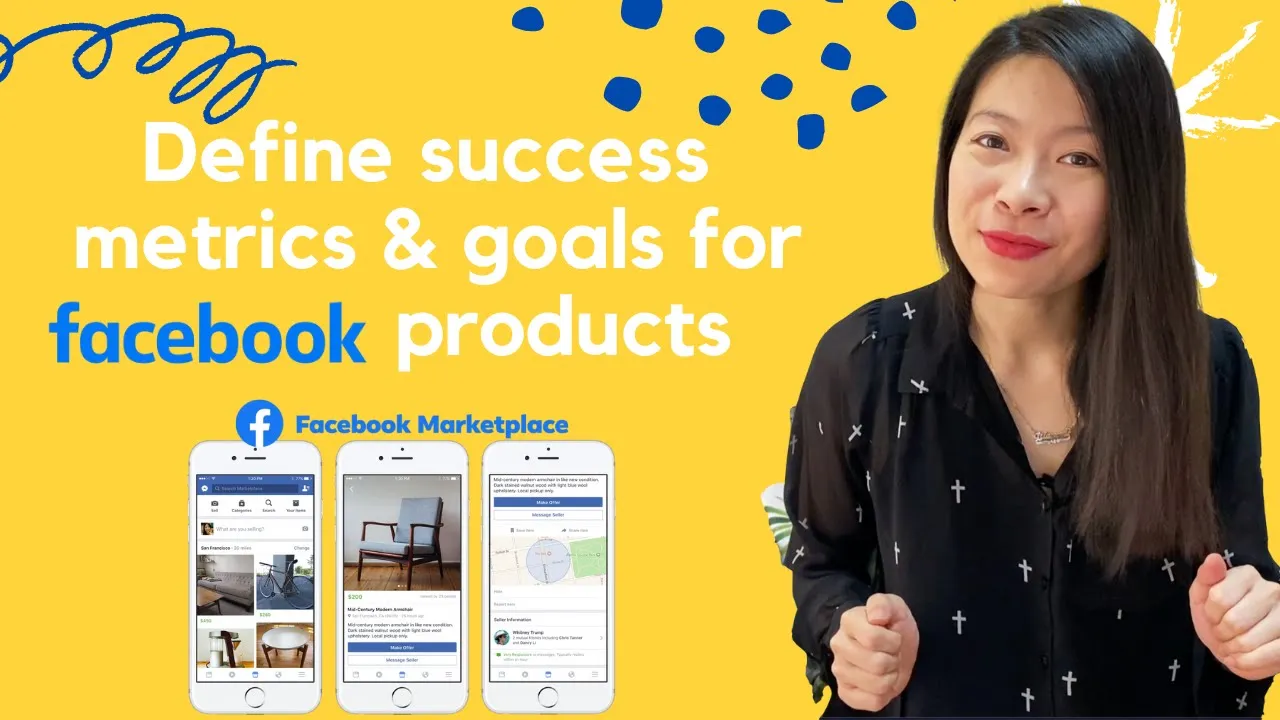
how is this product affecting the rest of the larger product ecosystem if you need a refresher on this framework watch my product interview success metrics and goals video that i'll link above in the end card and now we're gonna tackle one of my favorite facebook products marketplace i spent so much time on marketplace during covid and became a total hoarder so let's talk about the success metrics of marketplace let's run through our framework again the first step the product users and value so in this case marketplace is a product that connects buyers and sellers initially
it started off as a platform connecting you to local sellers which was kind of what craigslist was for and from my own experience it's sort of like an online garage sale and it's just a good way to buy second-hand goods that are cheaper you're helping to save the environment all right all right i won't preach so how does marketplace actually work so a seller will post a listing of the product they're trying to sell posting photos the price and that gets published onto marketplace then buyers see listings that they're interested in either by searching for
a product or just scrolling through the list of products that are new to the platform that might be personalized and recommended to them for example during covet as i was learning to cook i had to buy an instant pot so i searched for an instant pot found a couple of listings then i clicked message the buyer to start that interaction to tell them that i was interested in the listing and potentially wanted to buy it which turned into basically a messenger thread and we had a couple of back and forth and if the price was
good and the location was good i would go pick up my instant pot and hence why during covet i bought many instant pots okay so that's how the product works now what about the users themselves i mentioned on one side we have the sellers who succeed by selling their products that they want to get rid of then we have the buyers like myself who find success when they find great deals on the platform we get to buy a product that they want and then you have facebook who fulfills their mission when these two parties who
might have not known each other connect and interact to make that transaction happen so i'm going to the second step to think of a north star metric i want to think of something that is at the intersection of value between all of these three parties and in this case all three parties are successful when a transaction happens on the platform but as facebook they don't only care that the transaction happens they care that all the interactions are happening too so we want to come up with a metric that captures that at the same time because
a lot of these transactions happen offline it's going to be hard for facebook to measure those transactions which is most transactions on facebook marketplace when they happen offline so given those constraints what could be a good northstar metric to maybe serve as a proxy for transactions happening well let's think before a transaction officially happens the buyer is messaging the seller and there should be some back and forth and those are the interactions that facebook wants to happen on the platform so i might measure the number of meaningful conversations from listings and when i say meaningful
conversations that might be three to four messages back and forth since that's how many messages it might take a seller and buyer to coordinate a sale because think about it a buyer a message expressing interest the seller will confirm that it's still available and share an address and then the buyer has to again confirm that they're still interested and that they're coming so the most efficient conversation will have at least three messages between the seller and the buyer and that's why we chose three but i might work with our data scientists to find that this
is actually represented in the data now we have our northstar metric let's talk about the third step which is breaking down the northstar metric into components that represent the health of the ecosystem so again this is a two-sided ecosystem with sellers on one side which is the supply that you have to build in the beginning here one of the key metrics i'll measure is the number of active listings per day and under that i might further want to measure whoops the electricity just went out all right we're going to keep going hopefully the lighting isn't
too terrible because there's still some natural sunlight what makes up the number of active listings well you're going to have to have a number of active sellers on the platform another metric you'll want to know the average number of listings that each seller has on the platform and again this supply side is so important because we want to keep a healthy supply of products to keep people's interests without listings or products the product just wouldn't be very valuable other metrics might be what's the average click-through rate on the listings because i want to assess that
these listings are actually relevant to our users and i might set a certain threshold that i don't want to go below another metric we might want to measure is the total gmv or gross merchandise value on the platform per day this not only tells us how many listings are happening what is the value of all of these listings combined because selling a tv for 300 is going to be much more meaningful to an individual than selling half a bottle of bleach clorox for two dollars which during the pandemic i successfully sold another metric on the
supply side is a number of listings with at least one view one last metric i measure on the supply side is the number of listings with at least one click this would be another metric to help us represent the relevance of these products to our users now let's go to the other side of the healthy ecosystem which is the number of active buyers would be one of my first metrics having a good number of shoppers on the platform is going to be key to driving value for sellers because it encourages them to list more items
if they successfully have sold on marketplace before at this point i've encouraged so many of my friends to use marketplace and i remember that aha moment for them when they found value in the platform was when they sold their first product on marketplace and that was what kept their trust in marketplace as a platform to sell more things but also to continue buying things on the platform some other things i want to measure from the buyer side is a number of messages started from the buyers and this metric can help us flag any friction that
might be stopping the buyers from reaching out to the sellers about a listing and because the buyers are the first in the ecosystem to express interest we'll want to make sure this is a healthy number per listing now our fourth step is to cover downstream metrics and counter metrics again so what might happen in the ecosystem with marketplace before marketplace existed there were actually a ton of groups that were for buying and selling so i'd imagine with the introduction of marketplace and the growth of marketplace the activity in these groups would see a decrease so
that's something that could happen in the ecosystem another downstream effect marketplace could have is increasing the time spent on facebook especially for users who might not use facebook anymore to post or keep updated on their friends but now they're given another use case to keep them coming back to facebook what are some counter metrics basically negative impacts to the product or the ecosystem i definitely seen some listings on marketplace that were not legit for example people selling cars or what was it twenty dollars that was definitely gimmicky to try to get you to click on
the link so here some counter metrics would be the number of reported listings the number of listings taken down the number of reported sellers another metric would be the number of returned items sold items that were then unmarked sold and something else i might measure is the number of replies to buyers because if we're not seeing sellers replying to buyers it's also not going to be a great experience so that was a mouthful but i hope showing you those examples help you understand how the framework can be used lastly i'm going to share some common
mistakes you want to avoid and some best practices that i see the best candidates use so common mistakes monthly active users daily active users is not always a north star metric two complex metrics are usually not great north star metrics you want something easy and simple to count now what are some of the best candidates do one they create a narrative around the product going from the value to the users to breaking down these metrics so it's a cohesive story and not just a bunch of metrics that i come up with the best candidates will
remember to identify both sides of the ecosystem rather than just representing one side great candidates will give concrete metrics for example per day per month great candidates will also highlight downstream effects to the ecosystem and lastly great candidates will tell you why it's important to measure certain metrics for those who've been watching my videos you know this video is different from the others because it's mostly focused on examples rather than a framework and it was kind of an experiment so let me know in the comments below whether this was helpful or not and whether you
want me to go through more examples and make sure to like the video and i'm going to be producing more videos like this because i think examples are generally very helpful in the coming weeks so make sure to subscribe so you don't miss it and check out these two other videos to help you ace the product manager interview thanks guys