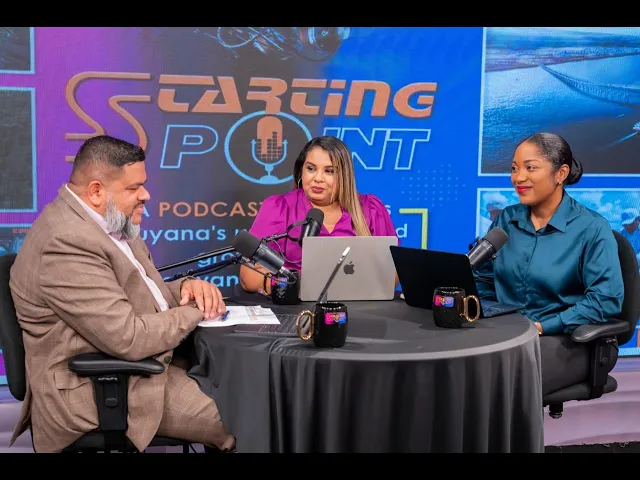
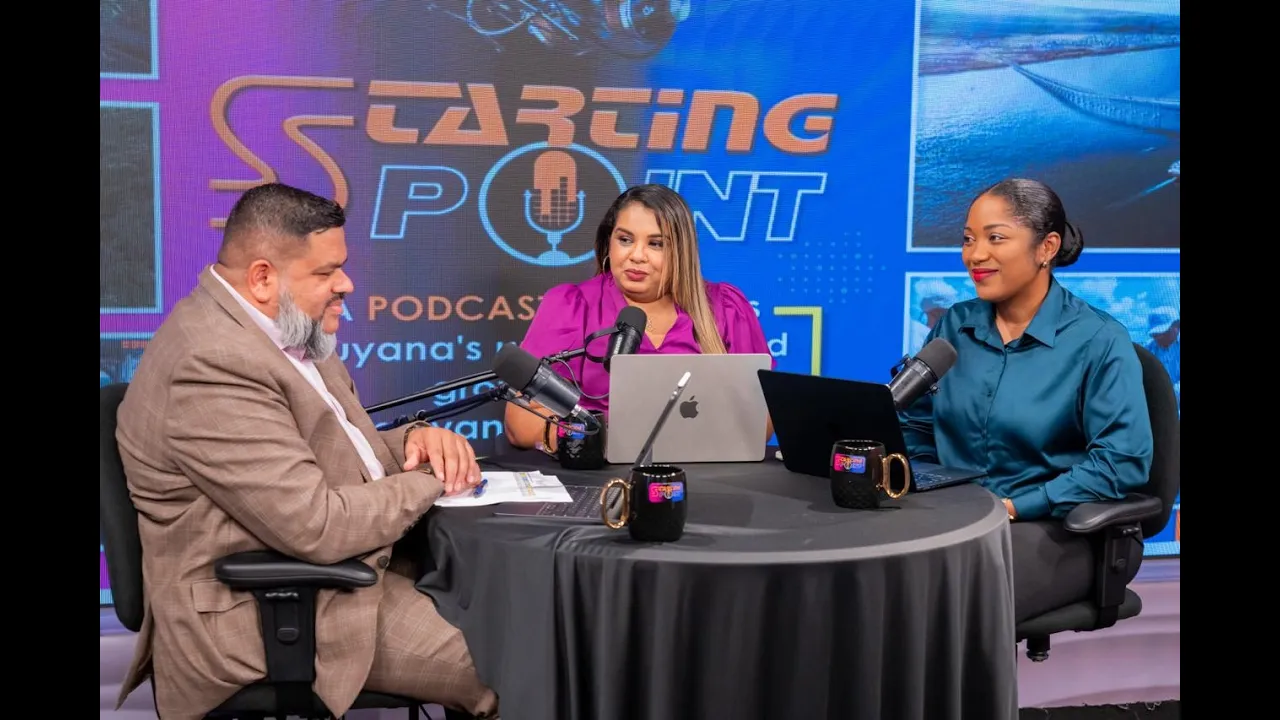
This is Starting Point, a podcast that tracks Guyana's unprecedented growth from all vantage points. Join your hosts, Kiana Wilberg and Fiza Hannif, as they dive deep into the heart of topical issues. Hi there. Welcome to this week's episode of Starting Point. I'm your host, Farza Hannif, and I'm joined by Kiana Wilberg. When gy speak about public health care, the George Public Hospital Corporation often stands at the center of that conversation. Today we are joined by the man leading the institution through one of the most transformative periods in its history. Having served at the GPHC since
2002 and as CEO since 2021, he has played a key role in advancing the hospital's modernization and expanding specialized care for gy. Joining us today is the chief executive officer of the George Public Hospital Cooperation, Mr. Robbie Ramaran. Mr. Ramaran, welcome to Starting Point. Thank you for having me and those very kind words. You know, we have all endured our time at the Georgian public hospital one time or another. And I really want to kickstart our conversation on that note. The GPAC has endured years of criticism for providing services that people did not find to
be up to par with other hospitals. But over the years, we've seen a significant shift in how those services are now being dispensed to the citizens. And I have actually observed some positive comments in social media about the more advanced surgeries and treatments at Georgia hospital. What is the reason for this? Uh I think we have good people working at the hospital and I will for started out at thanking each one of them every day for showing up um amidst various challenges. Healthcare is not easy. We spend many long hours. Um, but the bottom line
that drives the change, the evolution of Georgetown Hospital, and it's not a one-man show, it's not my show. It's building out a team's effort. Um, as you know, I have spent many of years of my life at the Georgetown Hospital. Actually starting working there out of high school at 17 years old. So, I have been there. I have seen the um I've known the hospital from what it was from dilapidated building, outdated equipment. There was a time in in in in um the hospital where we couldn't afford to buy certain equipment and and supplies and
we used to rely heavily on on um donations from abroad and most times use products. Um but now with the with the advent of oil and that new prosperity, we're able to the president with his mandates are able to invest more in healthcare and h having that investment. we need to have people who are there uh to champion every level and be invested. Um so it's understanding the dynamics of healthcare and I think for the number of um 20 plus years that I have been around the hospital um understanding the dynamics of healthcare has really
helped me um to position the hospital shaping um that journey and also working with the technical people the doctors and every the nurses and every category of staff listen to them hear their their mandate what their wish is their ambitions and working towards that collective goal. Yeah, you spoke about having more updated equipment. How much money can you say has been invested into the George Hospital over the past uh five years and where are where has that investment been more visible and impactful? Um over the last 5 years with that was excluding 2026 there have
been $85.2 billion. Um a lot of that money is spending on our staff. Uh we have a high payroll approximately a billion dollar um a month. We have um over 2500 staff and we are still short. Um but we have highly technical skilled staff and with all the salary increase over the last five years has really raised the um the wage. But in terms of where it is impactful you can see where the impact in in a lot of um training post-graduate training we right now we have 21 post-graduate training that is being done at
the hospital. for doctors and nurses. Um in collaboration with the University of Guyana and several universities abroad like U McMaster um University of Calgary um University of Vanderbilt many of them. So we are partnering training um our staff heavily um so that they can meet the needs of our people in specialized care and also investing in a lot of state-of-the-art equipment. Mhm. There are equipment that we have at Georgetown Hospital that are not even in the Caribbean. Um, so a lot of those have been on infrastructural improvement. I always said once we give the people
the tools, they shouldn't complain. Now what we have to do is work on the human resource aspect to deliver that service to the people that they need. A major impact um I'll attribute um is on maternal debt. You can see that there have been a significant increase over the last year. Mhm. As we love to say, knock wood. So far for this year, we only had two debts and both are indirect debts. Last year we had 11 of which most of it were in in um indirect debts. Indirect debts are not are not really maternal
complications debt but um other um co-mobilities that that that has been developed. So I I also want to make mention of a massive investment that is ongoing at the hospital currently. If you go to the hospital, you'll see a new building that is going up there. That's our medical imaging center. Um, but let me recap a little bit. In 2021, when I went back to the hospital, the hospital in 2021 did not have a functional extra machines. This is our national hospital that didn't have a functional extra machine in 2021. We replace those machines. Now,
we are constructing this medical imaging center. What will be in that center? a MRI that will be the force in the public sector. We have a CT scan. Um, it's aged. We have quite a uh some reservations about it. We bought another CT scan. So, we'll have two CTC scans. We bought we have a cat lab. We bought another cat lab. Uh, we bought two new brand new mimography machine and a ESW which are extra corporal shockwave little trips. This is a machine that is being used for treatment of kidney stones and I was told
by the doctors you don't even put the patient to sleep and you go home as soon as you finish the surgery and this is machine they also told me no way in the Caribbean have it so and it's a massive huge investment um over a billion dollar in in for the equipment and the building um so these are some of the exciting things that are happen in the hospital that transform our diagnostic capabilities which will help us to diagnose the patient and treat them better. Indeed. But GBHC over the years it has without question shouldered
the weight of the national health care delivery in this country and it's now being challenged to not just modernize its services but to meet this goal settled by the president to help Guyana deliver worldclass services. How has that new mandate influenced your leadership style at GPHC? Like I said, I have been around the hospital for a very long time. Yes, there was a time when we needed something in healthcare. We had to advocate for it. We had to champion for it. There were many levels that we had to go through. sometimes from the management level
um at the board level, ministerial level, ministry of health, ministry of finance, um cabinet approval gets it into the budget. Um so it it's it's sometimes it's back years ago it really was a challenge. Um not that our leaders didn't understand the need, but like I said, we didn't have this this sort of fundings that we have now. But with a mandate for president for a world-class healthcare system has really made my job very easy. Some of the things that we would have advocated for as end user is coming from the president recently robotics. Yeah,
I have a proposal on my desk from the doctors to do robotics. And the same week the doctors gave me the proposal, I was called to a meeting by with the president and and other member the ministers and to to discuss robotics five weeks ago and I haven't read that proposal because there because you're already we already get the go-ahad, right? And all we need to put the puzzle to pieces together and make it work. we deliver over over the weekend. Um, electronic health records when I went back to the hospital in 2021, we started
working with PAHO to have very fragmented pieces of electronic health records because it's certainly improved operation efficiencies and patient care. And I was working and then the president one day saw a news item with Paho that that was in the news and he called me and he said, "What's this about?" to the next plane and he said what about a full-fledged electronic health record system I said that's the dream boss and it's happening so when you have and president Ali serve as a member of the board of Georgetown hospital many years ago when he was
a minister of finance so he do understand how the gears grinds in healthcare he was part of there and and find his cabinet role as a minister as well of housing he's have enough experience to understand the importance of healthcare to the nation so that has really really made my job easier and with that drive building out the right team of people at the Georgetown Hospital get the right leadership um persons in in the various area that they can champion and they don't sleep like me so we we get things going. So it truly made
our jobs easier and and and we are very inspired. We love to say the best is yet to come. If if Ken if you would let me I I want to go back to the digital transformation taking place. you you mentioned it and I I recall that we're doing the e digital um ID cards now and your health records will be linked to that card eventually. Uh will GPAC be ready for that and what else needs to be done from your end to get up to scratch? Um the discussions being have about the the ecard
eid card be linked to that but we are not going to look at integrating that as yet. Our a main aim is to build out the infrastructure and implement this in the hospital and get it going and then we could always use back the your e-card as a a unique patient identification. So there are plans in place but the focus is now at this point is not to integrate the two um but to get the system up and running um get over all the teaching issue that may be and then we'll we'll how soon before
GPAC is fully digital? Um it's not an easy task. It's it's George Hospital is very complex as you know um there are lots of department there are actually 74 different departments in the hospital being inpatient outpatients um so it's a lot of um discussions that are ongoing first we have to do we do a process mapping document what we are doing review that and make and and decide the future state and how we want the system to be we don't want to dis designed an electronic health record system with the same manual system that we
have. There are many areas that we can improve. There are many redundancy that happen because of a paper trail and and and documentation purposes. Um but make the system more lean, more logical, more coordinated and decide the future state takes a lot of time. And then the software is a generic software. we have to have several discussions with the developers on how to customize this to fit the need of Georgetown Hospital. So it's it's a quite of a task. Um we had embarked to do it in 18 months and we realized that we were a
little bit too ambitious to be honest. Um and we have revised that that so we're looking at about um two years two and a half years. So let let's assume by mid next year we should be able to complete. What stage are you at right now in building out the infrastructure? Well, the IT infrastructure is completed. We finished u festival city and we are now um developing the urgent care. We were actually supposed to go live today for urgent care. This is a department that was formerly calling medical outpatient department. So now we rename it
to to in keeping with modern um concepts and and the EHR. Um so today we were actually but because of wanting to get it right we pushed back. Um so the the IT infrastructure is there is and there there's a whole framework of implementation a governance committee a steering committee every different segment of the operation there is an advisory committee. So all that is in place. Um but what takes the time is actually designing that software that meets our need and it's lean it's efficient be staff friendly and patient friendly as well. Okay. So Mr.
Dr. Ramberan, with what you've explained to us thus far, is it safe to say that GPHC is now one of the best public health care institutions in the country or it is the best? It is the best. Okay. And not just public healthare, it is the best health institution in this country and I will even give myself the liberty. It's in the top five in the Caribbean. Fantastic. might be higher but I'll be very cautioned with with um not because I work at Georgetown hospital some of the fantastic things that are being done there on
a daily basis it's amazing the story don't be told the people run with the negative even if we do testimonies and put them out there they don't make the tractions as the negative and sometimes the negative thing is all about a perception and not the reality of what occur um but we are in the healthcare industry and we see the and we know of the complaints that we get from other institutions and the corrections that we have to do as well. Um but not because I am working there and in charge of the hospital but
from a personal perspective we are delivering the best care in this country and I'm inclined to believe you at that because just recently I have a friend and his mom fell and broke her hip and she was admitted at a private hospital and she had to be transferred to GPSC because they couldn't do that surgery at a private hospital but the George public hospital could have done that for her. So, I am really inclined to believe you that we are among the best in the Caribbean. We are. We are. And and hip surgeries, well, if
it was a hip replacement, it's free. Mhm. Six years ago, you had to pay to get it done at Georgetown Hospital. Wow. Now, it's free. Knee replacement is free. And and and these and and we are doing lots of these surgery. They are if you were to do them private is millions of dollars. Yeah. And we we're getting good reviews. That's fantastic. I'm really happy to hear that especially knowing what GPC has been through over the years in terms like you said the negative um traction and criticisms. Now I know we have and if I
if I may say and if you think about those criticisms right those criticisms were so many in the days of newspaper. Yeah. Today we have so many medium of communication social media from Facebook, WhatsApp, Tik Tok. Tik Tok, Instagram, LinkedIn. You still have the newspaper. You have so many um little news outlets on on on to call them on the and the social media influenc the social media and you are not seeing that as compared to what you were seeing in the print news. Now the reach is much more than before. Mhm. Right. And so
if we used to see so many in the print paper, imagine that there were so many that weren't even captured then. Yeah. Now everybody can go live. So we we are doing something good definitely doing a lot of things good definitely a shift um Mr. Mr. Rambran, we have six more hospitals and numerous healthcare facilities across the country. Um, do you think that this has helped to ease the pressure from the George Hospital? It does. We we have been seeing an a decrease in um the outpatient patient who comes to our outpatient service. We have
been seeing a a decrease in that in terms of inpatient and um surgery and emergency uh visits. It's still up there. But those hospital will certainly take the burden off of Georgetown Hospital. It's just that we came from a culture where people bypass all the hospitals, all the health center and they come to Georgia hospital. Those hospital are relatively new. As time progresses, they will improve just like how the Georgetown hospital has improved over the year. There is no if or but about that. That will be the reality. We are training a lot of more
specialists. The specialists will be in those hospital. A lot of the service at Georgetown hospital will be decentralized to those hospital. So eventually the public confidence in those hospital will be built as how it has been done at Georgetown hospital and it will certainly take the load off of Georgetown hospital. We will have to reposition ourselves because if we these all these hospitals that are being built will start deliver these service have highly technical skilled people there then we should see less people. What do what do we do with Georgetown hospital? How do we go
forward? super specialty, sub specialty and our teaching hospital continue to train people in every level to go out to all these health institutions where the hospital health centers to deliver better care to the people of Guyana. They deserve it. Mr. Rembrandt, with the pace with which GPHC is moving with its transformation, one of the challenges that will be present will be the question of labor. How are you meeting that challenge? Um in terms for the doctors there is there isn't much of a challenge. There's a huge challenge um in nursing staff. Um we have engaged
um human resource agencies, talent agency in recruiting staff which we're in the process of having discussions. Um but other than that we have been training a lot of of of um people in Guyana for patient care assistant which complement um nursing there is um nursing assistant that a lot of them were graduated at the end of this year about 600 um registered nurse will be will be um graduated. So while we are training, we are looking to to bring in some specialized staff who will help boost that that that workforce in the nursing service. There
is a little bit of gap in in in in pharmacy and and medical tech. But now that with with the new hospitals that are opened um people are going there to work because they live closer and that is understandable. The service has to be run there, they live closer, it's less um a cost for them to come to Georgetown. So yeah being that now we we have repositioned um in in those departments and looking for for staff but our major challenge is in the nursing service and we are working with both training and recruitment. How
many nurses do you have and how many more do you need? I have about 700 nurses in direct care and I am that's represent about 65% only. Yeah. So I'm just about 35. So where are you looking to import these specialized nurses from? There have been conversation with with with um various um talent agencies um in India, in the Philippines. Um there were discussion in Cuba but we all know the reality there. Um so those are some areas we were been exploring. Okay. Um you spoke about maternal deaths earlier and you said that this year
we've only had two so far. That's right. And is a significant reduction. Yeah. Knockwood. a significant reduction from what we've seen over the the years. But what what has the hospital been able to do to reduce um maternal deaths? Uh the first thing we have done woman and child health is pride. Mhm. Of me of mine. And when I went back in the hospital, having looked at so many things and there were so many priorities, competing priorities, I had to decide where we will make the biggest impact. And I remember when when I was just
uh probably a stores coordinator at the time, I used to tell the former CEO Mike and I said there are three areas in this hospital that we have to focus on. the emergency room, the the maternity department, and our supplies and logistics because those three areas are often times where a lot of people place emphasis on. Yes. So, having been telling him that story for so many years, it dawned upon me, this is where I really need to start from. Yeah. So, we ch actually changed the head of department for the maternity. Mhm. complete restructuring
of the staff and how they work and how they how they report to work. um the whole the shift systems the on call system having staff these are these are physicians placed in the unit they are assigned to the unit so they have more monitoring direct monitoring of of of the department rather than before people are on call in a team they are still in a team on call but they used to be they didn't have direct responsibility for a unit let's say labor ward prenatal postnatal um they would wait on a call but Now
they are assigned to these area. So they have to know everything that is going on in there. And that has been the fundamental um breakthrough for us in getting the folks there holding them accountable and and and that has that has really been the torn upon again with with some infrastructural changes. We did some expansion to the maternal ward make it more comfortable air condition the all the wards in the maternity department. People now don't want to go home. They say our food in the place is cold. It's like a hotel. So we have those
challenges. Um and equipment we have invested heavily in in specialized equipment that do a lot of tracing and monitoring of patients and those with the equipment and having the staff realigned with all the training that they're getting as well. We have uh Mount Sinai, we have Northwell, all of those are working with us in training our staff to to improve on their um clinical outcomes. Do you still have that issue where if a private hospital has a a a pregnant mother and they run into complications during labor, they transfer that patient to GPHC? They do.
You still have that and then if unfortunately that mom or the child dies, it's recorded as death at GPS. I always quarrel about that. Um sometimes there are patients who are who comes to the hospital and there's absolutely nothing we can do for them. Yeah. because they have been in such a bad state. Um unfortunately and but we are a referral hospital. We can't refuse. Mhm. Um we we have to accept um the patient and try our best to do what majority of our deaths last year were patient that came to the hospital actually deliver
outside of Georgetown hospital and came to us with last year and the year before came to us with complications from private institutions private and they are public but last year there were more private last year there were more private um patients maternal patients that were referred to us that subsequently died than than previous years. Okay. Just wanted to talk a bit about mental health. Now, now this is also a crucial part of our healthc care needs and GPHC of course it's had its fair share of dealing with a few tragic cases. What have been some
of the improvements since dealing with these cases and what you believe to be the immediate needs that need to be addressed along the way? Mental health is a serious business and what happened to those patients were unfortunate. Um we wish we can save every patient not just mental patient and especially the patient to die from those circumstances is sometimes not easy for us to deal with. I know I sometimes um I would break down listening to some of the stories. My doctor was um Stacy was just reminding me on my way over that please don't
cry on an interview. She said the last time I had an interview with um Kiana that I cried I can't remember. Um but sometimes we pass we not sometimes we are always passionate about what we do and we are human and sometimes some of the things that are said to us really breaks us. Um so it was really unfortunate. Um you know there were one patient who had a self-inflict um on his neck went into the doctors took the patient to the theater after hours of surgery saved his life. We put him in a secure
room that was locked up with their condition with a nurse. The nurse just left to go to get a BPA apparatus to test his pressure. And when she's walking back the window was open. He opened it and went through. Um so it it is unfortunate for in in terms of infrastructural we have now bar those windows up. Um it was something we really didn't want to do because it's a safety concern if any if there's a fire if there's a fire any adverse event that we need to evacuate. Um those things are impediments. Um but
sometimes dam if you do dam if you don't we had to put them there because we can't take continue. There were three deaths I believe um in a very short period of time and we don't want this to be the reason. We had to find ways on improvising how we put the grills on so in the event of these emergency that they can easily be be removed but not so easily removed that somebody could remove it. No, not so easily removed by someone who isn't there as a patient isn't there. Yeah. Um other than um
so we bar the windows, some corridors, um enhanced patient monitoring, put patients in in in isolated wards and assigned a staff, a a PCA or a nurse that worked with them or um that is in the room with them at all time. We even had to say if you're going to leave the room, please call for someone to come in the room because of that recent um tragedy. Um we have also worked on improving um our policies and and and clinic clinical um improvement. Um we work them on on on how you how we'll manage
the the um these cases. Um also training the staff on a more advanced way. Um it's quite an overwhelming number of patients that we have on a daily basis that are on suicide watch. Yeah. It's quite a number. Um how and it's in the double digit. Yes, you have double digits. You have double double digit patient on a daily basis that are admitted on and are placed on suicide watch. Okay. And do you have have you seen that number increase dramatically over the last 5 years or is it has it always been high? It has
always been high but we had seen an increase in patient attempting suicide after those incidents. There were an increase patient being admitted for so after they saw and heard what happened they were more yeah people um decide that that they'll do it too. Yeah. Um and it's unfortunate but so it it's a difficult one to manage. But what's your recovery like in in in mental health cases? I mean and is is the counseling like working? Yeah, certainly it working because a lot of those patients after counseling speaking to the doctor um get importantly and this
is sometimes something that is really really absent um prior to these um patients or before they become patients um attempted suicide is that there are not enough support especially family supports. Mhm. Almost every one of our patient have complained about family support. So once they're in our care and we start talking to them and get the doctors to work, the social worker, get the family involved and have some conversations and have them assigned to doctors or or or social workers um directly where they where they can have counseling. It's been working. It's been working. Yeah.
Now I want to um switch the conversation to robotics. We I know you mentioned it briefly but I want to get a little bit more into it. Um Ghana recently made history with having the longest distance robotic heart surgery and now that we have achieved such a feat what is GPSC doing to ensure that robotic surgery remains a permanent part of the healthcare delivery. So there are two components to robotic surgery. There is teley robotic surgery and there is robotic surgery that is done locally. Mh. So on that was Tuesday. I get distracted by these
the holiday holidays and this weekend. On Tuesday we did three robotic surgery. One was a teley surgery. The surgeon was at Georgetown hospital and the patient was in India. Mhm. That is the future. That's where we will get and not necessarily the surgeon operating on patients abroad. Yeah, that will that will eventually happen. But we can have highly complex case where surgeons abroad operates here. Or we can even do teaching. We can we have proctors and um and and specialists abroad who do the surgery and teach our local at the same time. But robotics done
locally. We did one of those surgery Dr. um Hem Chan Ram Ram Hemorrh Ramcharan he did one of those surgery um on Tuesdays as well an ingual hernia repair was very successful um patient was discharged yesterday and is at home resting um so there were seven there were seven doctors that went to India that were being trained for robotic surgery um in in in the department of surgery obstetric and gynecology ology and neurology. Now the plan is whatever training they have is to start have doing those surgery here. We have um proctors which are specialists
doctors in in robotics will come to Guyana. There's Dr. Pedro from Ecuador is going to come here to work along with our our our doctors as we build out this um local robotics surgery. Um so yeah I spoke to the guys yesterday and and they are already planning cases in the coming week um to get it done. So this is the future. Listen in 2021 the Georgetown hospital had two laparoscopic tower. This is where we do laparoscopic surgery. Before that we every surgery was open. Now we have seven laparoscopic towers. Each one of our operating
theater have a tower. Now we have leap from laparoscopic for the audience and some members who may not be familiar with that term. Could you just break it down a bit for them? So there open surgery and then there's laposcopic surgery. So there's where they made very small incisions and they put camera in. Say if you're doing an appendix the small incision they put camera and then there are other um incisions where they put the for um they they throw cards in and and the staples and so forth. So there's no big incisions. So that
reduces the trauma on the body trauma infection faster recovery back to normal life less hospital stay um lots of benefit all all for the benefits. Truly these techniques are much more expensive than a open open surgery. Mhm. Um the the robotic techniques is much more expensive than the laparoscopic technique. The laposcopic is much more expensive than the open. But the ultimate benefit is the patient. Imagine we had a patient at ingual corneary repairs back. You had to spend four to five to seven days in a hospital. We did a robotics you went home the next
day. Laparoscopic basically used to go in two days. So there are so many benefits and robotics is the future and the good thing about robotics my hand can turn to a certain degree. Robotics goes way farther. So the the the surgeons are enjoying it. I was in the operating room when they were operating on the heart and and and then when Dr. Raman was and I put the glasses on and I was looking as 3D glasses and looking at what they were doing. It felt like I was standing in this patient's stomach seeing everything. So
the robotics is the future. Um this is a mandate from his excellency and my colleagues at the hospital, the surgeons are excited and I know they'll make the best out of this. The doctors are behaving like kids with a new toy. You know that feeling? You all had that feeling, right? Definitely. Definitely. We had that feeling. That's the That's them. there are so excited about what is happening at the hospital. How soon can we see the establishment of that um international training hub for robotic surgery? um which uh the one that the president the president
mentioned with SSI Mantra ecosystem what role will GP that's a council they putting together in advancing robotic surgery I don't think well not robotic I don't think it's just they will look at robotic surgery but they will look at robotics in healthcare in general okay and robotics and AI um I can um comment on on the time timeline that's the that's the president he's he's dealing completely with that he will constitute an an appoint that committee. Okay. Yeah. Thank you. Okay. But beyond robotics, what other aspects of GPHC would you say are undergoing digital reform?
I know you spoke about the health records, but apart from those two things, is there anything else going on be behind the scenes that you can tell us about? Yeah. Well, I mean, we I mean, we had this before. I can remember in 2013 I went to to Trinidad for carnival and every time I traveled abroad I tried to find someone who can take me into a hospital just to do a walk through even I'm on holiday anything I really love going into hospital and walk just walk and and observe and it stimulates um thoughts
and and and I remember they had digital x-ray and I came back and tell then CEO because at then we had uh issues about disposing of chemical that we use to develop the flims from the x-rays. So I told him this is this is the technology and eventually in so he said let's put it in the budget in 20 2014 we got the money in 2014 to to do um digital x-ray and have a pack system. So from 2014 when I went back in 2021 it's unfortunately that we only had five station viewing station around
the hospital in the theater the emergency room and the ICU and the and the radiology department. Now we have almost 90 computer system around the hospital in every ward in every clinic. So if you're in a clinic you don't have to leave and go to the emergency room to view someone X-ray or imaging. So that that that we have really built out the um the radiology we have a um lab um information system and all of these we were doing before we were preparing before. So when we have an EHR we integrate integrate we have
a blood banking software. Um so all of that was um ongoing to integrate into this new electronic health record system. Um so but other than other than the in terms of the health aspect there are also a lot of digital transformation that is happening at the hospital. Um we no longer cut prince and cut pay slip. Wow. It is emailed to everyone there. They there um almost 90% of our staff signs clocking their time using biometrics. January uh June 1st, everyone will sign in. There will be no more paper base. You apply for your leave
using an app, no more paper. Um we are we have a new accounting system, ARP pack system. From 2020 to 2025, there was no auditing of the hospital. So when I went back, we had to work diligently to bring all those um pull all those financial records and create um financial statement and get them audited. So we recently completed 2023 audit 24 is going to start um in the new month. So in the next couple of months we'll be up to date with all our record and we implemented a uh accounting software named the old
name was act it's referred to as sage 300 now and that has been helping us to monitor um finance and also inventory. So there are a lot of uh human resource we have a human resource um information system that is currently being implemented. So it's not we are not just looking at the healthcare aspect we're looking at all the support services that will be integrated in that. We have a new facilities management computerized facilities management software that that very soon anyone could to could send an email. They can access it on their phone to download
an app of staff with your credentials. And if you saw, so I want to promote this thing in the hospital. See something, say something. You see a light bulb blow, drop a message, drop in in in the we call it the fault reporting system. Send it so that we can be on top of of things to fix it. So other than the healthcare aspect of the digital transformation, there are a lot of the support office that has been digitalized as well. Before we close, I wanted to touch quickly on public trust and how you go
about ensuring that there is accountability where your doctors and your medical staff they're concerned and ensuring that they're held to certain standards of care that they are expected to deliver. How do you go about ensuring accountability in that regard? So there was a time at the hospital that people were not held accountable. My bosses hold me accountable. I get called all hours all day. So I have to hold the people who works with me, my team accountable. And in doing so, we had to put a lot of systems in place. For example, time and attendance
system is one of them. Ensuring people are coming to work. They're coming to work on time. They're delivering they are delivering service to the people and not disappearing. I mean you could still disappear with the time clock but at least there is some form of monitoring and we had to relooked on how we were doing things. How can we hold people more accountable? We created a strategic management department. The Georgetown hospital never had a strategic management department and under the department they have units like monitoring and evaluation. They have departmental policy and governance. So because
you can ask a clinical person especially a doctor about how we should do something. How do you think we should develop a protocol and he will give you he or she will give you the best possible process. Ask them to put it on paper. You wait forever. Mhm. To address that, we create this policy and governance unit that works with these technical skills and create these policies, statement of work, standard operating procedures. That's what we were doing. The eony department, they are key performance indicators that we look for. Please you go and look at these
indicators, measure them. They are the internal audit department. While they are not technical in in in some cases um well in most cases but we ask them to do chart review. We have committees that are doing chart review. We have independent committees outside of Georgetown Hospital outside of Guyana that we will ask to do review of patients maybe at death or some adverse event or just pull a random chart. How often do you do those you monthly checks? Monthly. Wow. monthly because we have to hold people accountable and Guyana healthc care has been lagging for
quite a long time and there have been lots of investment in infrastructure and equipment and in human resource in terms of training and and and so forth because we send a lot of people abroad for do fellowship but most importantly the human resource is important and we have to help them accountable to what they're doing Um there are tear huddle system that every morning every morning at 9:00 I will meet with 53 of my heads all directors all heads of department managers for key services like lab x-ray pharmacy um the head of sanitation the head
of plumbing the head of the kitchen everyone 53 of us reach every morning to discuss what are the challenges we are having in our unit because every your challenge is it's a domino effect. It's a puzzle. So someone will come to the let's say a doctor from the the theater will come from the anesthesia department and say anesthesia machine in room one isn't working. When we reach to the biomed person who has to report biomed has to report if he's aware that that um anesthesia machine is down. If he's not aware, he will he will
he will make a commitment there to go and check it and what if he's aware what interventions were done and what what what needs to get done to fix it. So all these huddles um the tear huddle at at from from the the the bottom from the ward to the to the supervisor to the managers to the directors and then come to my huddle at 9:00 in the morning has really helped um to hold people accountable and fix um any challenges that is in the system so that people can be safe. If the huddle is
basically safe, patient, safe staff, safe environment and that has worked that has held people accountable and honestly I used to get tons of calls through the entire night. Now I hardly get those calls because people are involved. We have a WhatsApp group and the dissemination of information is there. Everybody's there seeing what is happening and and where it responsible get it fixed. Um, so I can tell you people have now realized that they need to do things differently and they are doing things differently and they realize that it's not just a talk. It's not just
a gaff about providing proper healthcare to the people. It's it we we really mean business and people are getting involved. Doctors are coming to me and ask me how I can feel be more inclusive. Nurses are coming to me how can I be more inclusive? How can I play a part in in in this transformation? So there are still those one and two here and there that we have to work on. A lot of customer training has been done but I think largely the culture and the norms of the past of yesterday years is changing.
There's one thing that that I've always been curious about. Most of the doctors that we see working at GPSC also work in almost all of the private healthcare institutions. How how does that how does that work? Does it take away from providing the best health care to to patients at the GPSC? Honestly, yes, it does. It's something that we're working to address. I mean, they have to be they because of of so many patients if you remove let's say for example if you close all the private schools the pro the public school will can't take
off those right students. Similarly, they are the private hospital and because of the absence of specialists in those hospitals or the specialist at Georgetown hospital will go there and and and work. Um but we are but if they don't then what happens those patient comes to us. Yeah. And we we can we'll have a a a big backlog where we can become overwhelmed. But we are working with the doctors to ensure and that's things like time and attendance and the different um accounting process we to ensure while they are doing their private practices that it
is not at an expense and the consequence to our patient. So you have an understanding it there was always an understanding but time and time has changed. People have doing things their own way and some things we are pressing the reset button on. Okay. But you can't also afford to lose them a GPA. No, for sure not. Uh we we can't we can't. The the all the staff are valuable. Um we just have to to work out uh a way in in our best interest. Yeah. So one of the things that we do to for
season 3 is our previous guest, they leave a question for the next person without knowing who that might be. And our last guest was region 4 regional executive officer Mr. Juan Edgel Jr. So here's his question for you. What is one thing about Guyana that makes you proud to be Gy? So much. Yeah, there there there are so many things. Um my brother migrated. I have lots of family abroad. Coming out of high school, everyone is encouraging me to migrate. I lost my dad in 2002. I was just 17. Just started working at the hospital.
And I think to myself, you know, should I really take up this offer? But there was something about my dad's death that keeps me around, has made me more passionate about what I'm doing. The passionate and love for what I'm doing because he was a victim of poor healthcare. And that's the reason why I go over and beyond to fix a system that is broken because there's a lot of work still needs to be done. We have came a long way but there's a far way more to go and I see healthcare as my pride
and joy and with the blessings of oil and the additional resources that we can invest and really and truly deliver the care that our people deserve. There is nothing pleases me more. There is nothing inspired me more. I go to work every single day of the week. Seven days a week. Seven days a week. Is that good for your health? On Sundays, I don't really go work, but I go walk around because I might miss the place if I don't go. I will miss the place. I think you're a bit of a workaholic, aren't you?
Yeah. Yeah. Because I have a love and a passion. And being in the hospital there's this fire in my belly that burns that people the ordinary people and like I often tells the staff people comes to us at the most vulnerable of time. They don't come to us because they want to. They don't have a choice. Some of them don't have a choice. So they come here and we have to be show them empathy. It's not what we say but it's how we say it. Okay. Um but with what's happening in healthcare with the sort
of investment in healthcare and with the way I would love to see healthcare it's completely aligned and the passion is burning. I want to be there. I'm not going to leave Guyana for for nothing. Yeah. I'm already older too reasonably. It doesn't it doesn't show. I think it's safe to say that you found your calling. Yeah, I do. I do. uh you know um I usually tell people that I was inspired to be there and I used to make jokes when I I was 18 years old and some of my friend will remind was I
used to tell them Barnam and Jan die and they leave this hospital in the will for me so I have to make sure everything is all right here and sometimes they they tell the staff would say to me that I behave like I own the hospital and I would tell them yes I owned it I am the chief executive officer I am respons responsible for it and I will treat it as if it was my own business. Mhm. So it's a calling. Healthcare is a calling. Health care is not a job. It's an obligation. Health
care is a public goods. It's it's for the people and there's nothing inspired me more. I tell people look how many people are contractors these days and get rich and driving fancy. I could have turned a contractor too. Right. Right. N man I good. I love the hospital. That's my that's my forest home indeed. Mr. Ramaran want we want to thank you for sharing so much insight regarding what's taking place. The transformation is indeed real a GPHC and we're excited to see what's next in the 2026 to 2030 chapter. We're definitely looking forward to that.
So thanks again for your time. Welcome to our audience. Thank you as well for joining us. We know that you've learned quite a lot about what's happening at GPHC and the transformation taking place in Guyana's healthcare sector. We look forward to bringing you more insights from leaders across Guyana. So continue to follow us. Same time, same place. See you next week. Thanks for watching Starting Point. Follow us on Spotify, YouTube, Facebook, Instagram, and LinkedIn for critical updates and exclusive content.