hello everyone and Welcome to our module on trii triom disorders are disorders that occur when a baby is born with three copies of one of the chromosomes instead of two the most common triom disorder is Down syndrome which is triom 21 which I talk about in a separate module in this module we'll talk about two less common triom disorders Edward syndrome which is triom 18 and patau syndrome which is triom 13 all of the triome orders on the last slide down syndrome Edward syndrome and patau syndrome share some common features which can help you to
remember them as a medical student first of all they are all associated with Advanced maternal age and they are also all most commonly due to myotic non-disjunction which I discuss in more detail in the Down Syndrome video and the video on meiosis in addition all three of these triom disorders share common features including intellectual disability physical deformities and congenital heart defects and an easy way to remember Edward Sy and patau syndrome that I've always found helpful is to just think of them as more severe versions of down syndrome children with Down Syndrome can be functional
and sometimes can live long lives children with Edward syndrome and patau syndrome are more severely disabled and often Die In Utero or early in life we'll start by talking about Edward syndrome which is triom 18 this is the second most common triom in live burst down syndrome or chromosome 21 trii is the most common children born with Edward Syndrome have severe intellectual disability and this often occurs in female babies there's a 3 to1 female to male ratio babies with Edwards syndrome have poor intrauterine growth they are often born with a low birth weight one of
the characteristic features is a very abnormally shaped head it's often very small and the back of the head protrudes out this is described as having a prominent oxa put you can Google this and see pictures of baby with Edward's syndrome their head is very misshapen the ears are low set just like in children with Down syndrome and they often have a small jaw and mouth and then two characteristic features that are often helpful especially in board questions are that children with Edward syndrome often have clenched fists with overlapping fingers like as is shown in this
picture on the screen in addition they often have curved feet that are described as rocker bottom feet just like down syndrome Edward syndrome is associated with congenital heart disease and gastrointestinal defects congenital heart disease occurs in about 50% of babies it's often ventricular sepal defects or pdas gastrointestinal defects are more common in Edwards syndrome than a down Sy syndrome in Down syndrome they only occur in a few percent of cases in Edwards syndrome 75% of babies have a gastrointestinal defect it's often a mecal diverticulum but can also be Mal rotation or analisia and I talk
about all of these congenital GI defects in the gastro Urology section as I said before an easy way to remember Edward syndrome is to think of it as a more severe form of down syndrome children with Down Syndrome often grow into adulthood however most babies with Edwards syndrome Die In Utero and 50% of affected infants die in the first two weeks of life and only a few per survive the first year of Life many cases of Edward syndrome are often diagnosed by fetal ultrasound these babies have so many physical and congenital abnormalities that you can
often identify them in the womb you may see limb deformities you may see congenital heart defects you may see that the skull is misshapen if the case is not diagnosed by fetal ultrasound there is maternal blood testing that can be used to suggest a diagnosis similar to the way it is used in Down syndrome I talk about this in more detail in the video on down syndrome but there are first trimester blood tests that can be done in the mother to determine the likelihood that the baby has Edward syndrome so the two blood tests used
in the first trimester for down and Edward syndrome are Papa and beta HCG in the Down Syndrome video I talked about how levels of Pape are lower than normal in pregnancies associated with Down syndrome and beta HCG levels are higher than normal in pregnancies associated with Down syndrome in pregnancies associated with Edwards syndrome both levels are low and in fact it's very easy to remember the screening results you would expect in Edwards syndrome because they are all lower than normal in the second trimester there is a screening test for Down syndrome called the quad screen
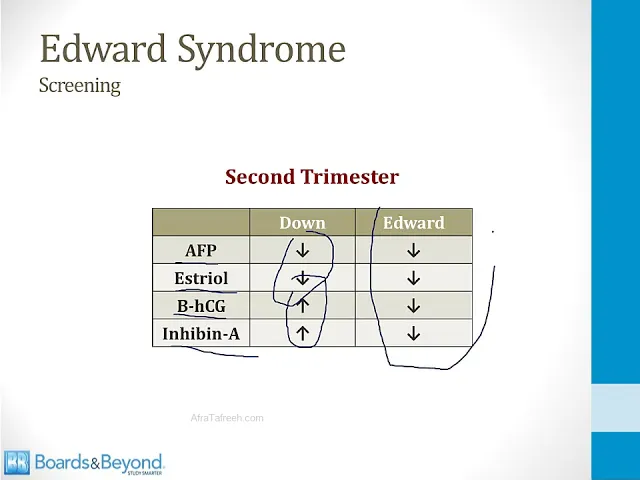
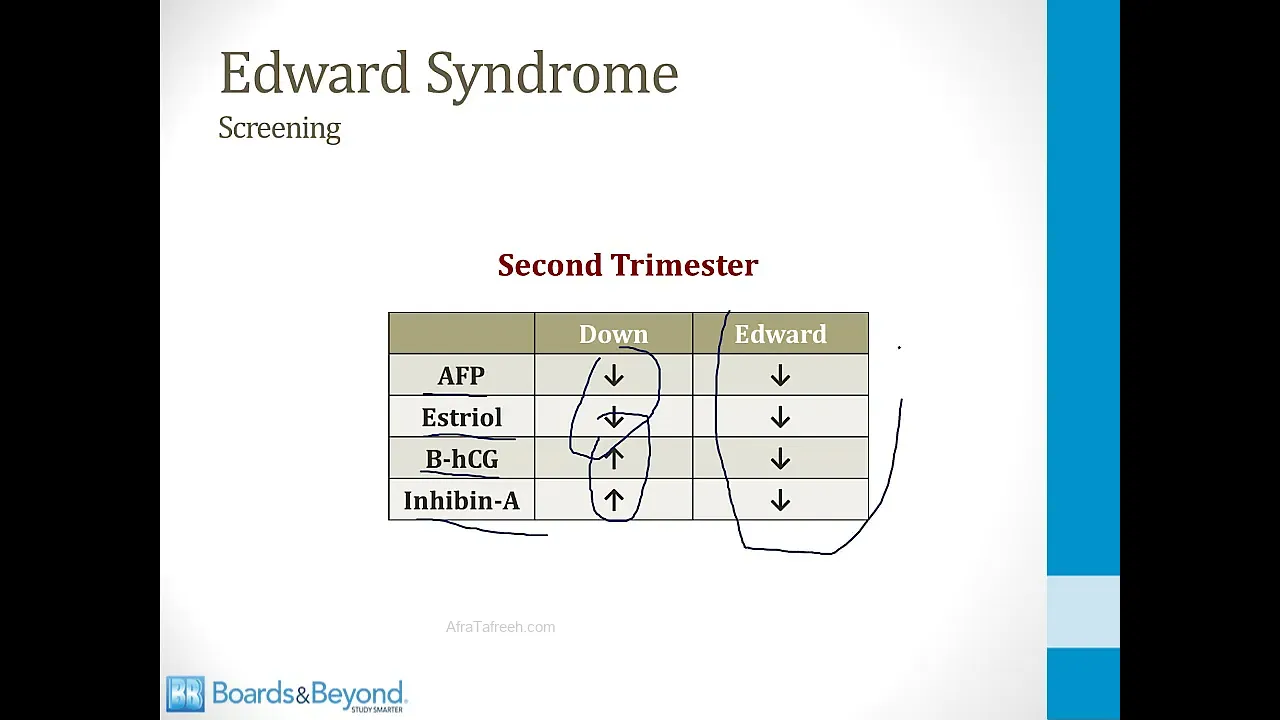
this test involves measurement of the serum levels of four markers of down syndrome in the mother's blood those four markers are AFP estriol beta HCG and inhib and a these four markers and the quad screen can also be suggestive of Edward syndrome in Down syndrome the first two AFP and at strial are typically lower than normal but the last two beta HCG and inhibit a usually have levels in the mother serum that are higher than normal in Edward syndrome the levels of all four markers are usually lower than normal moving on let's talk about patau
syndrome which is triom 13 this is much more rare than Down syndrome or Edward syndrome you can think of it as a much more severe syndrome than either Down syndrome or Edwards syndrome babies with triom 13 have severe intellectual disability they have severe structural malformations and it's usually detected by fetal ultrasound in more than 90% of cases because the babies are so abnormal when ultrasound pictures are obtained some of the key features I've listed on this Slide the eyes are often abnormal these babies can have micropthalmia which is abnormally small eyes they can also sometimes
have an opthalmia which is absence of one or both eyes they often have a cleft lip or pallet and another characteristic finding is called post axial polya ility so polya ility is an extra finger or toe and post axial means the extra digit is away from the midline so in other words in the hand it's on the owner side shown on the screen is pre-axial polyc ility on the top that's where the extra finger is on the thumb side the bottom of the screen is post axial that's where the extra digit is on the owner
side of the hand you can also see extra digits in the feet these babies often have Holo pros and sephy I discussed this in the embryology video in the neurology section this is a central nervous system malformation where there is failure of cleavage of the pros and sephylon this leads to left and right hemispheres of the brain that fail to separate it can result in an alobar brain where there are no apparent lobes of the brain present congenital heart disease is very common in triom 13 seen in 80% of cases it can include ventricular sepal
defects pdas and atrial sepal defects among many other abnormalities as I said before this is a very severe chromosomal anomaly most cases Die In Utero the median survival after birth is 7 days and 91% of babies with triom 13 die within the first year of life and I mentioned this before but usually triom 13 is diagnosed by fetal ultrasound if first trimester maternal serum screening is done the results will be abnormal in a similar manner to the way they are abnormal in Edwards syndrome both Edwards syndrome and patau syndrome give levels in the materal serum
of Pap a and beta HCG in the first trimester that are lower than normal this is in contrast to Down syndrome where the pap a level can be lower than normal but the beta HTG level is higher than normal and that concludes our video on Tri zomies