Research, the word sounds very impressive. People often associate it with great discoveries such as vaccines in medicine, inventions and Nobel prizes. Research generally does not start out with great successes and final answers or working inventions in mind.
It starts out with something small but very powerful, spurred on by the curiosity of the mind. It starts with a question. Why is that?
This question that can be asked in any field of science and knowledge, is what sparks our curiosity and our search for an answer. This search for an answer fuels the world of research. as society itself is becoming increasingly more complex, more interconnected and more technologically advanced than ever before.
Due to these advances, more data is available than ever before. However, collecting, analyzing and interpreting said data is no longer a one-person job or the prerogative of just one research discipline. It requires multiple people from a variety of backgrounds and fields of science to work together to carry out the research to answer today's questions.
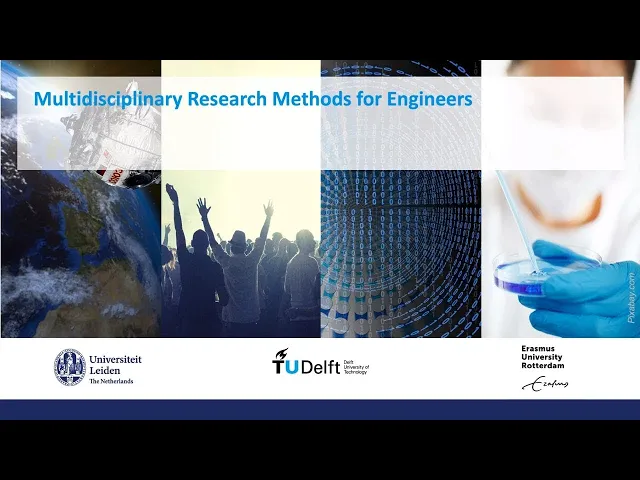
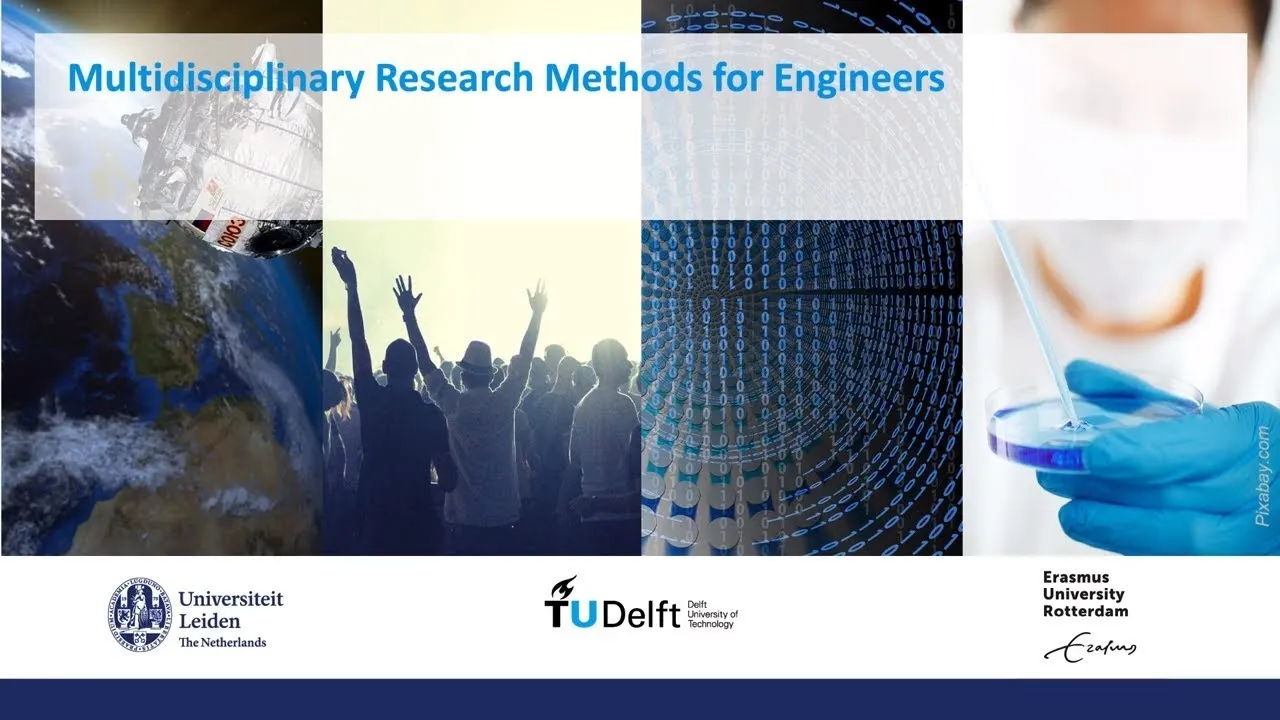
Hi, and welcome to multidisciplinary research methods for engineers. My name is Gillian Saunders-Smits and I'm an associate professor at the Faculty of Aerospace Engineering at Delft University of Technology in the Netherlands, where I've been teaching research methodology to Aerospace Engineering students for the past 10 years. Together with professor Marcus Specht, director of the Leiden, Delft, Erasmus Center for Education and Learning, Martine Schophuizen and Jacqueline Wong we will take you through the methods in the madness that research can be.
We will introduce you to the language of multidisciplinary research, explain the different phases of research, and introduce you to a variety of qualitative and quantitative research methods as well as mix method approaches. You will learn how to turn your question into a research objective and a set of research questions and how to design your research study or experiment. We will show you how to collect, analyze and interpret data illustrated by practical examples of ongoing research at the three universities within the LDE University collaboration: Leiden University, Delft University of Technology and Erasmus University Rotterdam.
The course is aimed at starting engineering researchers in industry, local and national government, research institutes, international organizations and universities. But it is open to anyone who wants to know more about how multidisciplinary scientific research is conducted, or to anyone who would like to set up a scientific study. Inspiring video lectures are interlaced with interactive exercises and self-assessment quizzes.
For those of you who are up for a real challenge in the last module of the course, you can opt to write a research plan for a multidisciplinary research study. We hope you will join us in this course and we were looking forward to meeting you online soon!